Endangered
Thorectes sardous
Thorectes sardous
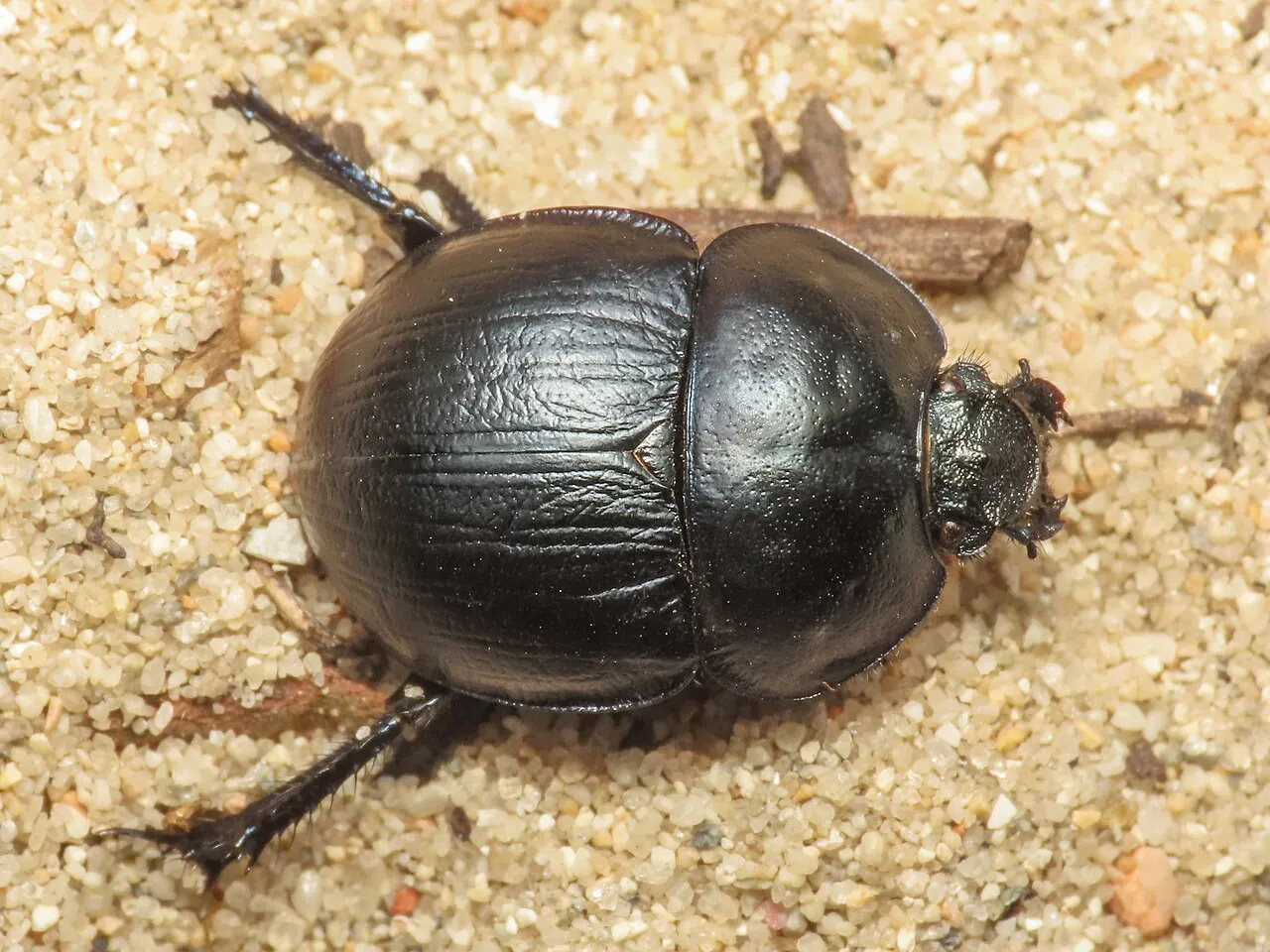
Thorectes sardous (also filed as Jekelius sardous) is an earth-boring dung beetle found only on the islands of Sardinia and Corsica, mostly on coastal sand. The IUCN Red List classed it as Endangered in 2015. Tourism and recreation areas are the main threat to the dunes it depends on.
How to recognise it
This is a beetle of the family Geotrupidae, the earth-boring dung beetles. A French entomologist who reported it on Corsica in 1996 found it flatter and less domed than the other Corsican and French Thorectes. It has a distinct bump on the front of the head, and the lines along the wing cases are dotted rather than continuous.
Its close look-alike is Thorectes marginatus. In T. sardous the shoulders of the wing cases are rounded and the back corners of the thorax are broadly rounded. Some catalogues, including GBIF, file the species as Jekelius sardous, treating Jekelius as a genus, while others keep it in Thorectes (subgenus Jekelius). It is the same animal under either name.
Where it lives
The beetle was long thought to be found only on Sardinia. Three fresh males collected on Chiavari beach, Gulf of Porticcio, on 20 June 1991 gave the first Corsican record. Another population was found in the Ostriconi dunes on Corsica's north-west coast, where 10 specimens were collected over 10 to 13 October 2020. Only a few Corsican sites are known, and French entomologists report it there only on the coast.
On Sardinia, a 2011 survey of southern lamellicorn beetles listed records from many coastal sites, such as the Piscinas river mouth, Marina di Arbus, Cala Domestica and Isola di San Pietro, plus several inland records, the highest at 954 m. The Red List gives an area of occupancy of about 180 square kilometres within a wider range of roughly 35,000 square kilometres, and names coastal sand dunes as its habitat.
Pins are Wikidata “endemic to” fields. Orange dots, when present, are GBIF occurrence tiles — survey bias included.
How it lives
At the Ostriconi dunes in Corsica, a site of the French coastal conservation agency (Conservatoire du littoral), the beetle feeds partly on rabbit droppings. Older literature gives its active season as spring to summer, but entomologists working there in 2020 found none in June and many in October, so it may be more active in autumn than thought. The Sardinian survey lists adult records in April, May and July through December.
Why it is in trouble
Dunes are popular for beach tourism, and the Red List names tourism and recreation areas as the main threat, affecting the majority of its range and causing rapid declines. Housing and other development, other changes to the ecosystem and collection of specimens are also listed, with unknown scope. The IUCN records its populations as severely fragmented and the area it occupies as still shrinking. The trend is decreasing. No population count has been published.
What is being done
The IUCN lists habitat protection, site and area protection, site management and awareness as conservation actions, and names research on life history, habitat trends and an area-based management plan as needs. Corsican entomologists describe the Ostriconi dunes as still holding a fine population. Their 2020 survey produced the first DNA barcodes for the species. The assessment records the species' presence in a protected area as unknown.
Sources
Written for this catalog in our own words from the sources below, checked against them on 12 November 2026. Population figures are estimates and carry the year they were made. Status and assessment year: IUCN. 2026. The IUCN Red List of Threatened Species. Version 2026-1. iucnredlist.org.
- IUCN Red List assessment, Thorectes sardous (2015)
- Touroult et al., Coleopteres de Corse, Bulletin de la Societe entomologique de France 128(4)
- Moretto 1996, Un Thorectes nouveau pour la Corse (Linneenne de Lyon)
- Carpaneto et al. 2011, The Lamellicorn Beetles of Southern Sardinia
- GBIF backbone record
- Wikipedia, Geotrupidae




