Critically Endangered
Thickshell pondsnail
Stagnicola utahensis
The thickshell pondsnail (Stagnicola utahensis, now often placed in Ladislavella) is a freshwater snail known only from Utah Lake in Utah, United States. The IUCN Red List assessed it as Critically Endangered, flagged as possibly extinct, in 2012. No living snails have been reported since the early 1930s.
How to recognise it
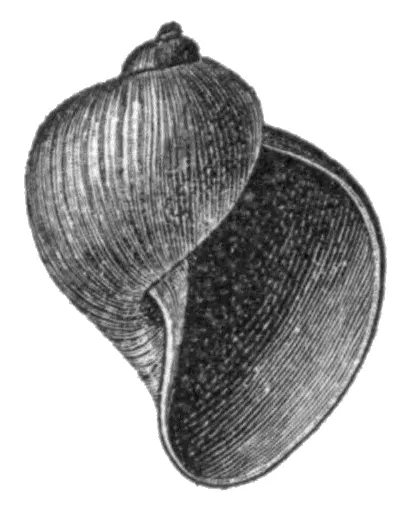
It's a small air-breathing pond snail in the family Lymnaeidae. The shell is rounded and slightly umbilicated, meaning a small pit sits near the base, with irregular ribs. It is pale horn-coloured and nearly see-through, and the inside of the opening is pearly white.
The spire is small and conical, with about 4 to 4.5 shouldered whorls. Shells average about 13.4 mm tall and 7.1 mm wide, with the largest recorded near 16.8 mm by 8.9 mm. Details of its radula, the toothed feeding ribbon, have never been published.
Where it lived
Richard Ellsworth Call described the snail in 1884 as a variety of another pond snail, Radix ampla, from Utah Lake near Lehi. It has never been found anywhere else. Utah Lake covers about 380 square kilometres but is very shallow, averaging around 3 metres deep. The Red List counts a single location and records the habitat as a permanent freshwater lake.
In the lake it lived alongside two other snails, Valvata utahensis and Fluminicola fusca, and a small clam, Sphaerium dentatum, all of which were abundant. The thickshell pondsnail itself was already regarded as rare in the 1880s.
Pins are Wikidata “endemic to” fields. Orange dots, when present, are GBIF occurrence tiles — survey bias included.
Why it disappeared
The last living examples were found in the early 1930s, with 1933 given for the most recent. The Red List names drought and temperature extremes as threats and notes ecosystem degradation. The assessment gives no population size or trend, and it flags the species as possibly extinct.
The 1930s were a time of severe drought, when Utah Lake's level fell and much of the shallow lake froze. The Utah Lake sculpin, a fish last collected in 1928, was lost around the same time. Common carp, introduced in 1883, now make up about 90 percent of the lake's biomass. No cause of the snail's disappearance has been established.
What is being done
The Red List lists no conservation actions in place and flags the species as possibly extinct. NatureServe treats it as presumed extinct, and a conservation database lists it as missing.
Sources
Written for this catalog in our own words from the sources below, checked against them on 12 November 2026. Population figures are estimates and carry the year they were made. Status and assessment year: IUCN. 2026. The IUCN Red List of Threatened Species. Version 2026-1. iucnredlist.org.




