Endangered
Theba arinagae
Theba arinagae
Theba arinagae is a small land snail in the family Helicidae, found only on the east coast of Gran Canaria in the Canary Islands. It was described in 1987 from fossil shells, and the IUCN now treats it as a living species. The Red List rated it Endangered in 2026, an improvement on its 2011 Critically Endangered listing.
How to recognise it
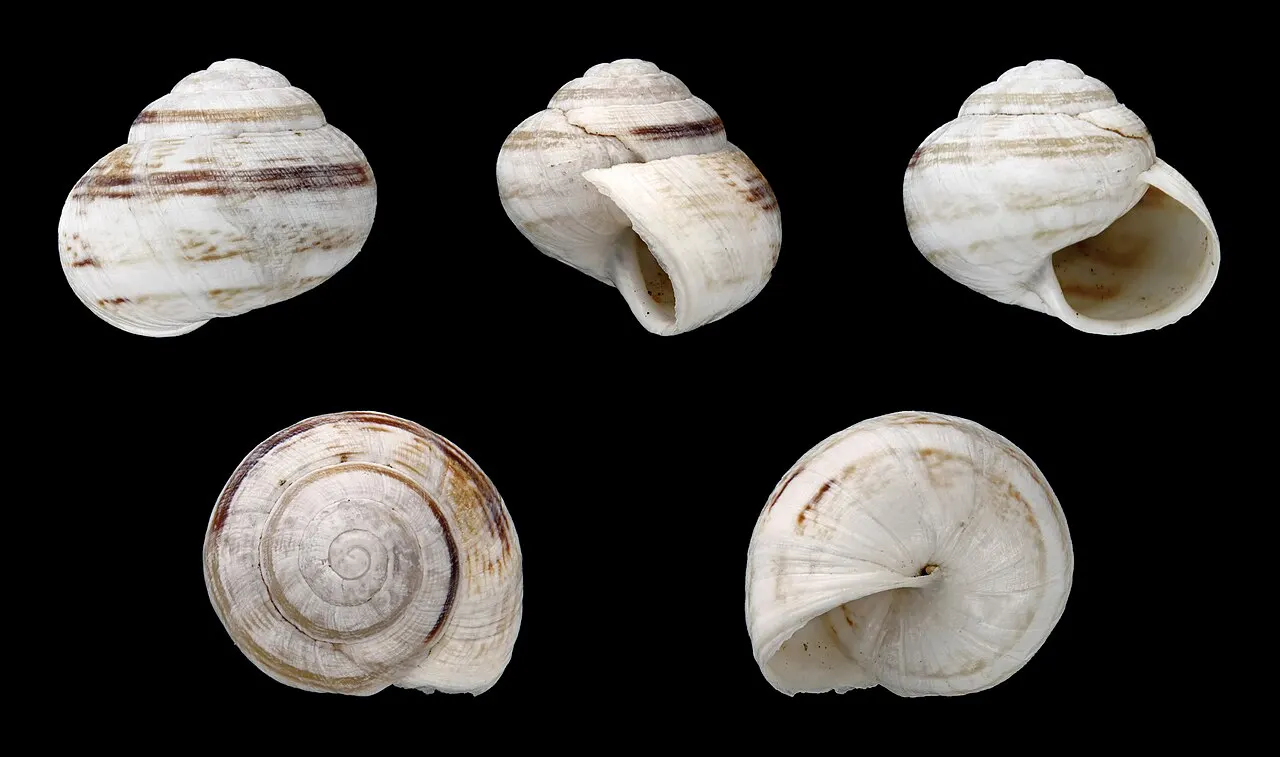
The shell is globular, with roughly four and a quarter to five and a quarter very convex whorls and a round opening. The navel is almost completely hidden by the folded edge of the lip. Adult shells measured 9.7 to 14.3 mm wide in the original description.
Where a colour pattern survives, there are two broad bands above the midline of the shell and two below it, often broken up and split into narrower irregular bands. Unlike most Theba snails, the young are not sharply keeled. The three other Theba species native to the Canary Islands have larger, flatter shells with a keel or angle along the edge.
Fossil shells and living snails
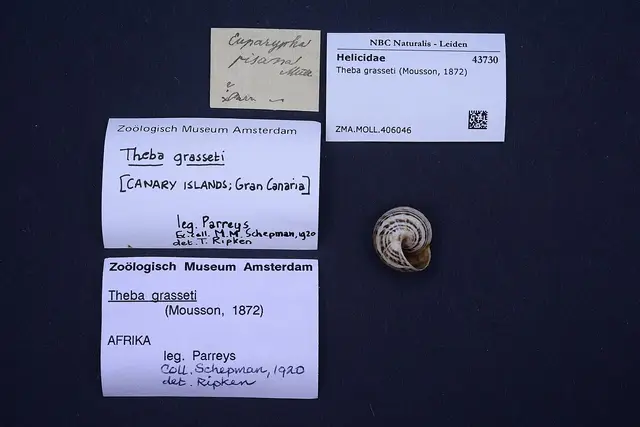
The snail was named by Gittenberger and Ripken in 1987, in a revision of the genus Theba published in Zoologische Verhandelingen. The type material came from sandy deposits of unknown age at two sites on the Gran Canaria coast: near the Arinaga lighthouse and at Playa Ojo de Garza, north of Gando airport. The paper called it a fossil species and named it after Arinaga.
The IUCN assessment, however, lists the species as present today and records it as a living population on the Montaña de Arinaga volcano. It says snails were recorded there again, and at a new site at Tufia, in 2024. Only the IUCN account was found for living animals, and it gives no population estimate. The same assessment says the species also turns up as fossil or subfossil shells on Fuerteventura.
Where it lives
In the past the snail ranged along the east coast of Gran Canaria, roughly from Jinámar in the north to the Montaña de Arinaga in the south. Today it is known from two locations, with most animals at the Montaña de Arinaga. The assessment gives an area of occupancy of 8 square kilometres and an elevation range of 20 to 180 m. Older accounts put the range at about 4 square kilometres on one volcano summit.
At the Montaña de Arinaga the snail was found in a narrow strip of rocky ground above sandy slopes, about 300 m by 50 m, in 1992. The Tufia animals live in a coastal dune system with native dune plants. The assessment lists rocky areas and coastal sand dunes as its habitats.
Pins are Wikidata “endemic to” fields. Orange dots, when present, are GBIF occurrence tiles — survey bias included.
Why it is in trouble
The IUCN record shows Vulnerable in 1996, Critically Endangered in 2011 and Endangered in 2026. The 2026 listing uses criterion B2ab(iii), which covers a small area of occupancy, few locations and a continuing decline in habitat quality. The population trend is unknown and the population is suspected to be low.
At the Montaña de Arinaga, gravel was once extracted from the site. Sand blown from a nearby quarry in strong winds is now the main concern, and a military transmission mast and its access roads bring extra traffic. Long droughts linked to climate change may become a serious threat. At Tufia, outdoor activities and litter are potential problems.
What is being done
Both sites lie inside protected areas: the Montaña de Arinaga Natural Monument and the Tufia Site of Scientific Interest, each also a European Special Area of Conservation. The IUCN estimates 91 to 100 percent of the population is protected.
There is no recovery plan and no systematic monitoring scheme. The assessment lists habitat restoration as a needed action and recommends monitoring of the snail and its habitat.
Sources
Written for this catalog in our own words from the sources below, checked against them on 12 November 2026. Population figures are estimates and carry the year they were made. Status and assessment year: IUCN. 2026. The IUCN Red List of Threatened Species. Version 2026-1. iucnredlist.org.