Endangered
Tenerife speckled lizard
Gallotia intermedia
The Tenerife speckled lizard (Gallotia intermedia) is a large lacertid found only on the Canary island of Tenerife, in two small coastal areas. It was unknown to science until 1996. The IUCN Red List rated it Endangered in 2024, after Critically Endangered ratings in 2006 and 2009, and records the trend as decreasing.
How to recognise it
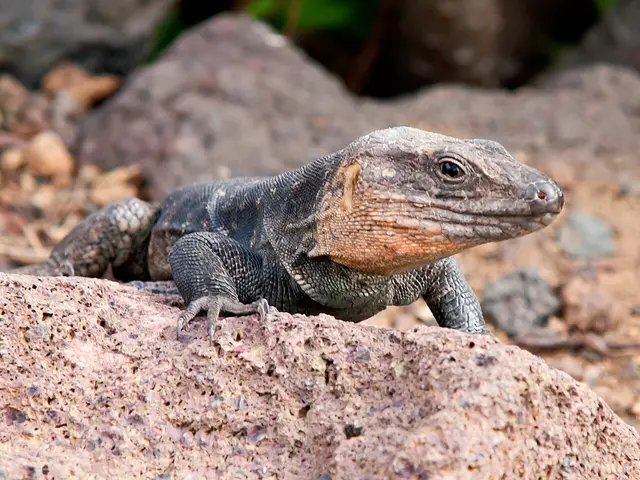
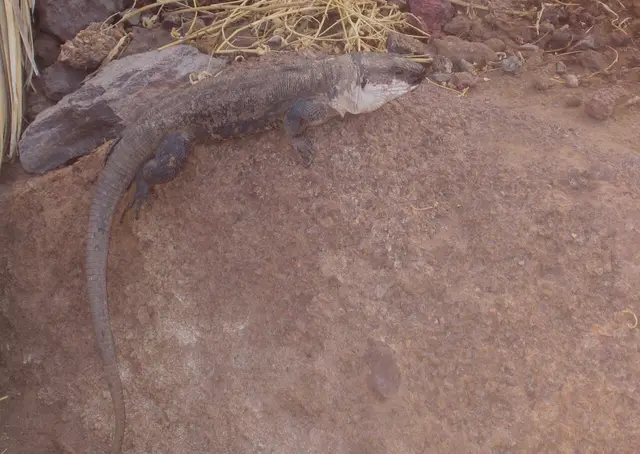
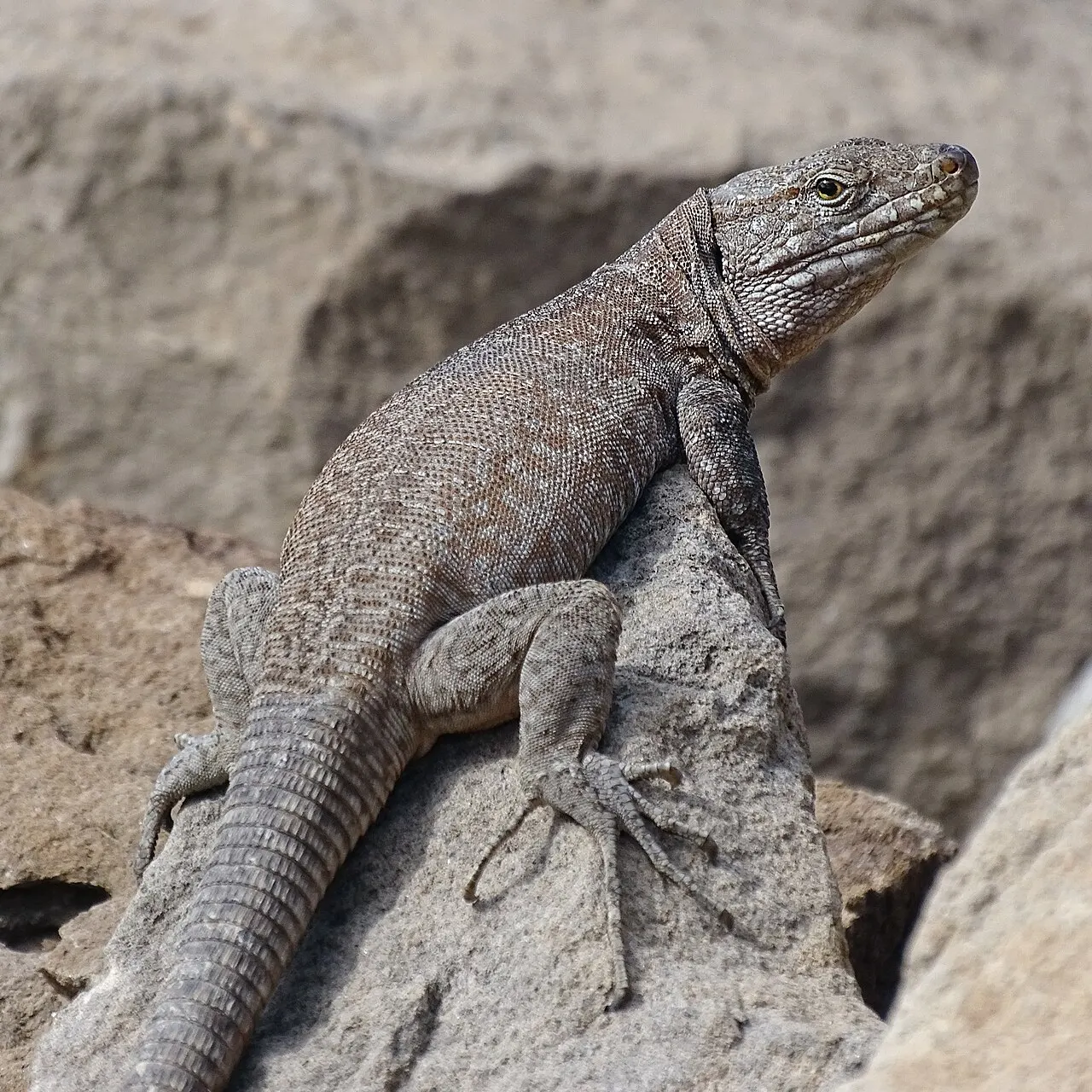
It's the smallest member of the group of giant lizards found on the western Canary Islands, though still a big animal, reportedly 45 to 75 cm long. Its scientific name refers to a body size, scale pattern and colouring that sit between those of two relatives, Gallotia galloti and G. simonyi.
Where it lives
The biologist Efraín Hernández found it in 1996 in the Macizo de Teno, in the far northwest of Tenerife. The name first appeared in a 1999 field guide, and a formal description by Hernández, Nogales and Martín followed in 2000 in the journal Herpetologica. Whether the 1999 naming counts is still a point of nomenclature.
The lizard is thought to have been widespread on the island once. It now survives in two places only: a short stretch of coast in the northwest, around Los Gigantes, and the Guaza cliffs in the south. It uses rugged ground with rocks and boulders, often small ledges with sparse plants, and is now confined mainly to cliffs and their surroundings, a small part of its former range.
The 2024 Red List assessment names rocky areas and dry shrubland as its habitats, an area of occupancy of roughly 16 to 44 square kilometres, and an extent of occurrence of about 227 square kilometres.
Pins are Wikidata “endemic to” fields. Orange dots, when present, are GBIF occurrence tiles — survey bias included.
How it lives
The diet is described as largely herbivorous, and the species lays eggs. Little else about its biology is well documented.
Why it is in trouble
Introduced predators are the main threat. The Red List names feral cats and rats, and lists tourism and recreation areas as a further ongoing pressure. Cats are presumed to have caused the historical decline. Several of the smallest groups, with only a few animals each, may also suffer from inbreeding.
Counts have been low. A 2009 European assessment gave about 500 animals in around 40 isolated populations along 9 km of the northwest coast, and about 100 at Guaza, with numbers rising thanks to cat and rat control. A 2017 news report on the recovery plan put the total at about 1,400, roughly 900 at Guaza and 200 to 400 at Los Gigantes. These counts come from different surveys.
The 2024 assessment moved the lizard from Critically Endangered to Endangered. It records a population reduction under criterion A4a, a severely fragmented population, and a decreasing trend.
What is being done
Fencing has been used to keep cats away from some groups. A recovery plan was approved by Tenerife's government in November 2017, and a new decree approving a recovery plan followed in March 2026 (Decree 42/2026). The newer plan aims to raise numbers, control threats, secure captive (ex situ) populations, raise awareness, and expand existing populations and found new ones. It also regulates land use in designated critical areas. The lizard is listed as endangered in both the Canarian and Spanish catalogues of threatened species.
The 2024 assessment records a recovery plan, systematic monitoring and awareness programmes as in place, and says the lizard occurs in at least one protected area. Captive breeding is among its listed conservation actions.
Sources
Written for this catalog in our own words from the sources below, checked against them on 12 November 2026. Population figures are estimates and carry the year they were made. Status and assessment year: IUCN. 2026. The IUCN Red List of Threatened Species. Version 2026-1. iucnredlist.org.
- IUCN Red List assessment (2024)
- European Red List of Reptiles species summary (IUCN, 2009)
- IUCN regional species summary, Gallotia intermedia
- Plan de Recuperacion del Lagarto Gigante de Tenerife, Decreto 42/2026 (INAP)
- Ecoticias news report on the recovery plan (21 Nov 2017)
- Reptile Database, Gallotia intermedia
- Tenerife speckled lizard (Wikipedia)