Endangered
Chile mountain false toad
Chile mountain false toad
The Chile mountain false toad is a stream frog of the western Andean slopes of central Chile, found in the Maule and Bío Bío regions. The IUCN rated it Endangered in 2015. Its one dependable stronghold is Altos de Lircay National Reserve.
How to recognise it
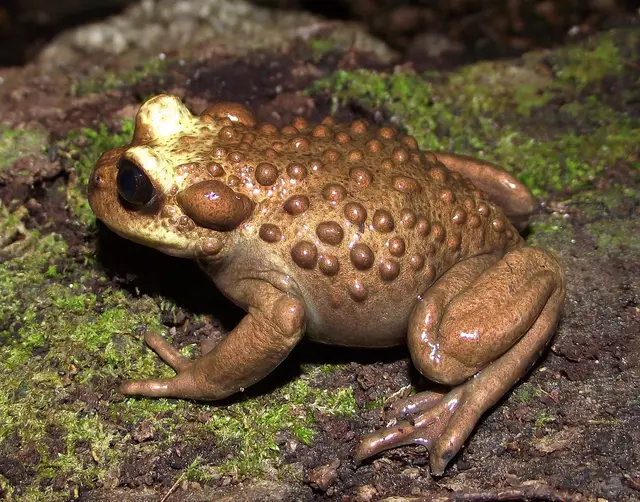
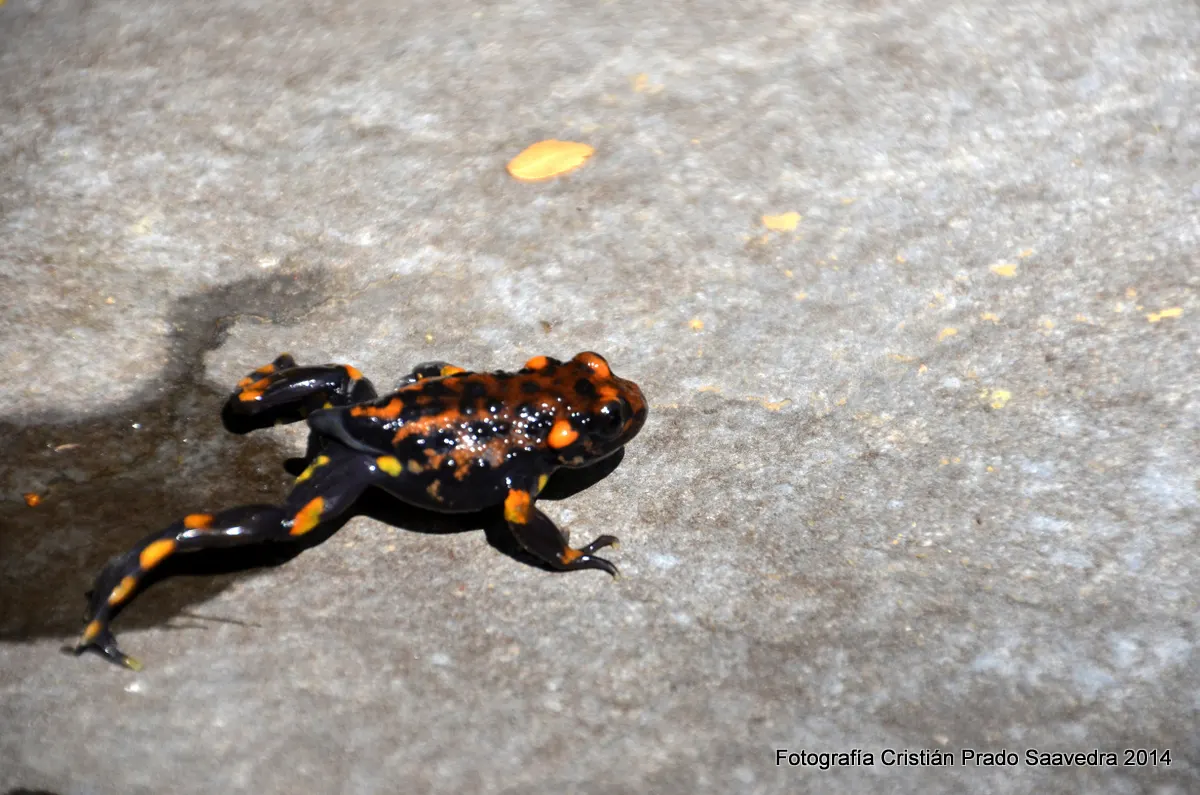
It looks a lot like a toad, with large oval glands behind the eyes, which is why Philippi first described it as a toad (Bufo venustus) in 1899. It is actually a frog in the family Calyptocephalellidae, a small group found only in Chile. The back is dark with orange-reddish spots.
Adults are roughly 6 to 7 cm long. Field workers who saw eight adults at night in 2022 estimated an average of 65 mm, judged against an object of known size, since none were caught. The tadpoles are flattened, with a thick tail base and a sucker-like mouth disc that lets them cling to rocks.
Where it lives
It is endemic to Chile, on the western slopes of the Andes. Adults sit under rocks beside cold, well-oxygenated streams in temperate forest dominated by southern beech (Nothofagus). The IUCN gives an altitude band of about 1,280 to 1,700 m, while a 2023 distribution study in Herpetozoa by Correa and colleagues proposed roughly 900 to 1,638 m.
Only a handful of places are known. That study compiled 14 localities and mapped 13, five of them in state protected areas (four in Altos de Lircay National Reserve, one in Radal Siete Tazas National Park). Almost half of the known points lie in or around Altos de Lircay, which the study notes the IUCN treats as the only stable population.
A tadpole was collected at Ralco in Bío Bío in 1983 and the species has not been reported there since. It was reportedly not found at its Chillán locality in 2014. A new site, the Pichipangue stream at about 1,150 m, was documented on 16 February 2022, with eight adults and three larvae seen.
Pins are Wikidata “endemic to” fields. Orange dots, when present, are GBIF occurrence tiles — survey bias included.
Why it is in trouble
The IUCN lists agro-industry plantations and both large and small dams as threats. Native forest turned into pine and eucalyptus plantations is the usual example. Earlier authors reported that a dam flooded the Ralco site, but Correa found no published data to confirm it.
Fires and drying streams during central Chile's megadrought are further dangers, and summer cattle grazing may affect the Pichipangue site. Introduced rainbow trout are reported to degrade larval habitat. Chytrid fungus is a possible threat but has not been detected in this species.
Because the frog lives in so few, scattered places, the IUCN records two locations and a severely fragmented population. The trend is recorded as unknown, and no population count exists.
What is being done
The frog occurs in protected areas, including Altos de Lircay National Reserve. Chile's own classification also lists it as Endangered, and the 2023 study recommends keeping the species at Endangered. The IUCN lists no conservation actions beyond area protection.
Sources
Written for this catalog in our own words from the sources below, checked against them on 12 November 2026. Population figures are estimates and carry the year they were made. Status and assessment year: IUCN. 2026. The IUCN Red List of Threatened Species. Version 2026-1. iucnredlist.org.