Endangered
Marbled water frog
Marbled water frog
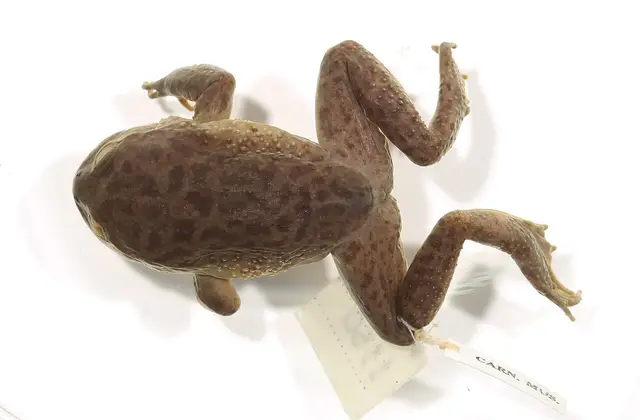
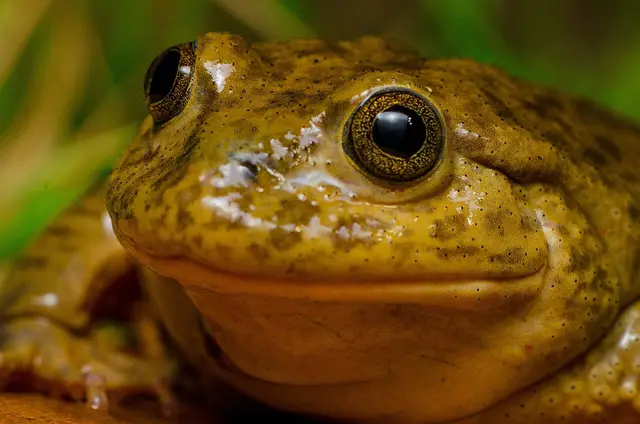
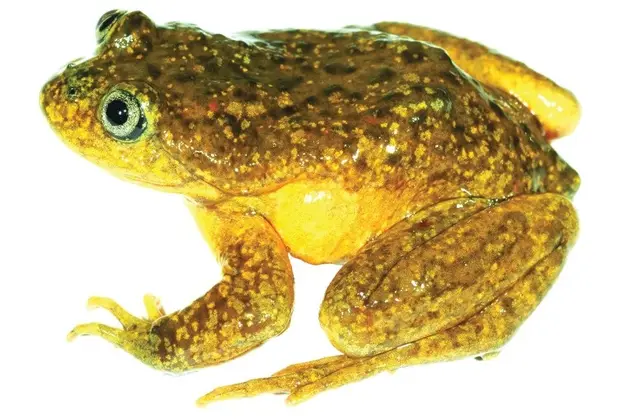
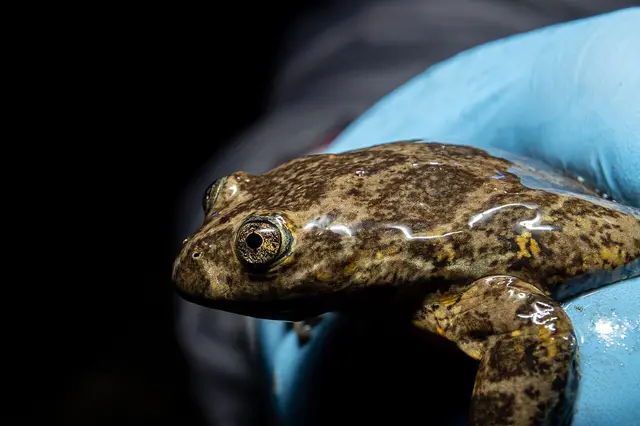
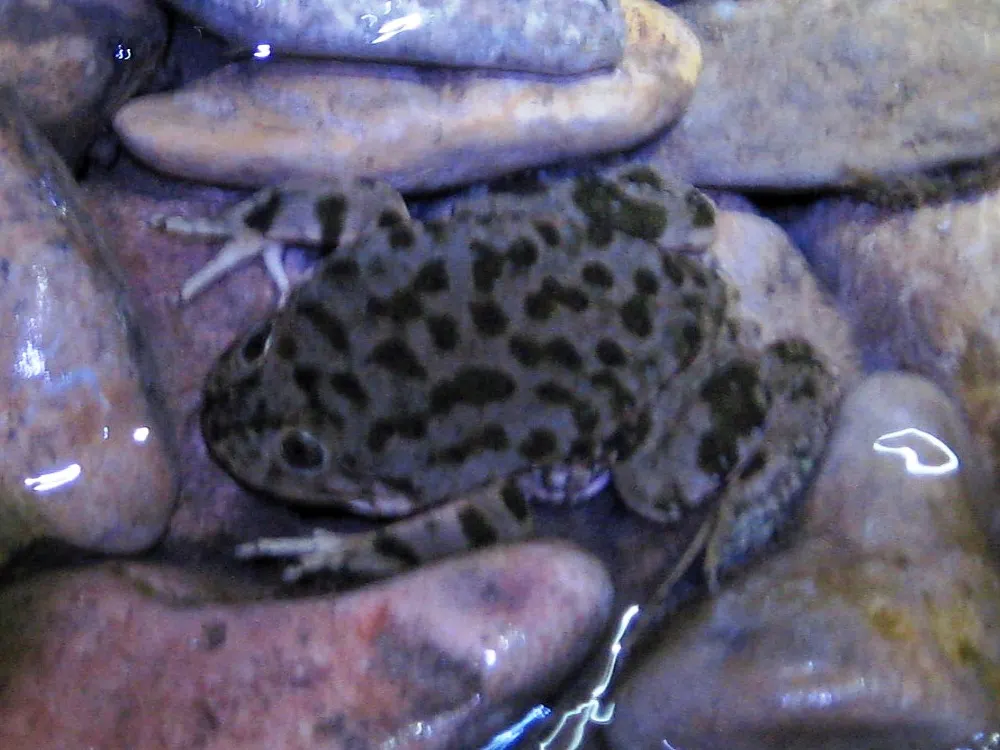
The marbled water frog (Marbled water frog) is a semiaquatic frog of the high Andes, living in streams, bogs and lakes in Bolivia, Chile and Peru. It has the widest range of any Telmatobius, but the IUCN rated it Endangered in 2020 because wild numbers are falling.
Where it lives
It is the most widespread frog in its genus. It occurs in the Andean highlands of southern Peru, western Bolivia and northern Chile, and a population in northwestern Argentina may belong here too, though its identity is unclear. Records span a huge altitude range, from about 1,800 m up to 5,244 m above sea level.
It uses flowing and still water alike: rivers, streams and creeks, seasonal pools, bogs and marshes, high-altitude grassland and shrubland, and even pastureland. It has reportedly been recorded in several national parks, including Lauca in Chile and Sajama and Cotapata in Bolivia.
Pins are Wikidata “endemic to” fields. Orange dots, when present, are GBIF occurrence tiles — survey bias included.
What is known about its life
It is a mid-sized frog. Of 16 adults reportedly measured on Isla del Sol, in Lake Titicaca, the largest was 7.5 cm from snout to vent. Young are said to appear in both the wet and dry seasons, and breeding takes place in bogs. The IUCN gives a generation length of about 6 years.
Little else has been published about its day-to-day biology. The name is also used for a species complex. A 2015 genetic study in the Journal of Heredity, based on 148 mitochondrial sequences, found four main clades, one of them the Titicaca water frog (Telmatobius culeus), and placed the Bolivian Telmatobius gigas inside the marmoratus group. Older accounts may therefore blend several closely related frogs.
Why it is in trouble
The IUCN's 2020 assessment records a past population reduction of about 50 percent, based on direct observation, habitat decline, harvest and the effects of pathogens.
Chytrid fungus (Batrachochytrium dendrobatidis) is a major concern. In the Cordillera Vilcanota of southern Peru, a decade-long monitoring study published in Ecology and Evolution in 2017 found the frog's encounter rate at one 5,244 m site fell from about 6 per person-hour in 2003 to 0.7 in 2004, when 24 dead frogs were found. In 2008, 2009 and 2012 combined, researchers found only two animals in nearly 56 hours of searching. Encounters rose again in 2013 and 2015, and the fungus was detected at all seven study areas.
People also take the frog. In Peru and Bolivia it is reportedly caught for food, juice and traditional medicine, and Telmatobius frogs are sold alive in markets. A 2016 PLoS One study tested 87 marbled water frogs bought in Cusco's San Pedro market between June 2012 and July 2013: about 92 percent carried chytrid and about 53 percent carried ranavirus, a second pathogen. A 2010 study of Telmatobius frogs bought in the Cusco market from 2008 to 2010 had already found a high rate of chytrid infection and warned that the trade could spread the fungus.
Other pressures reportedly include water diversion, pollution from farms and households, and climate change. The IUCN records a decreasing population trend. The frog is not considered threatened within Chile.
What is being done
The frog occurs in protected areas in all three countries. The IUCN assessment lists captive breeding among the conservation actions relevant to it but does not describe a programme.
Sources
Written for this catalog in our own words from the sources below, checked against them on 12 November 2026. Population figures are estimates and carry the year they were made. Status and assessment year: IUCN. 2026. The IUCN Red List of Threatened Species. Version 2026-1. iucnredlist.org.
- IUCN Red List assessment, Marbled water frog (2020)
- Wikipedia, Marbled water frog
- Seimon et al. 2017, Ecology and Evolution (Cordillera Vilcanota monitoring)
- Warne et al. 2016, PLoS One (Cusco market frogs)
- Lehr, Catenazzi and Vredenburg 2010, Diseases of Aquatic Organisms
- Victoriano et al. 2015, Journal of Heredity (Europe PMC record)