Endangered
Telmatobius chusmisensis
Telmatobius chusmisensis
Telmatobius chusmisensis is an aquatic frog of the high Andean streams of the Tarapacá Region in northern Chile. The IUCN Red List rated it Endangered in 2019, after earlier Data Deficient listings. It is known from only eight locations, where water extraction and mining are degrading its habitat.
How to recognise it
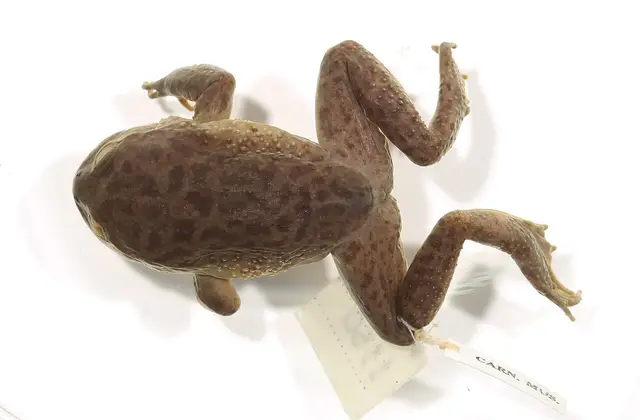
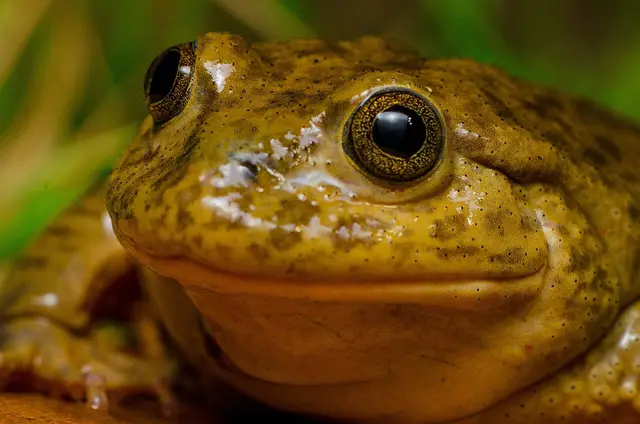
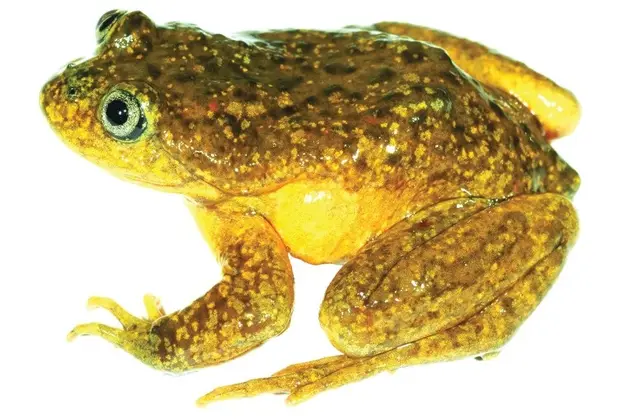
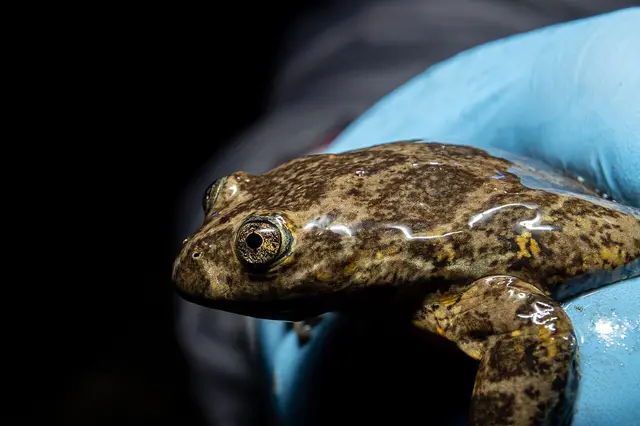
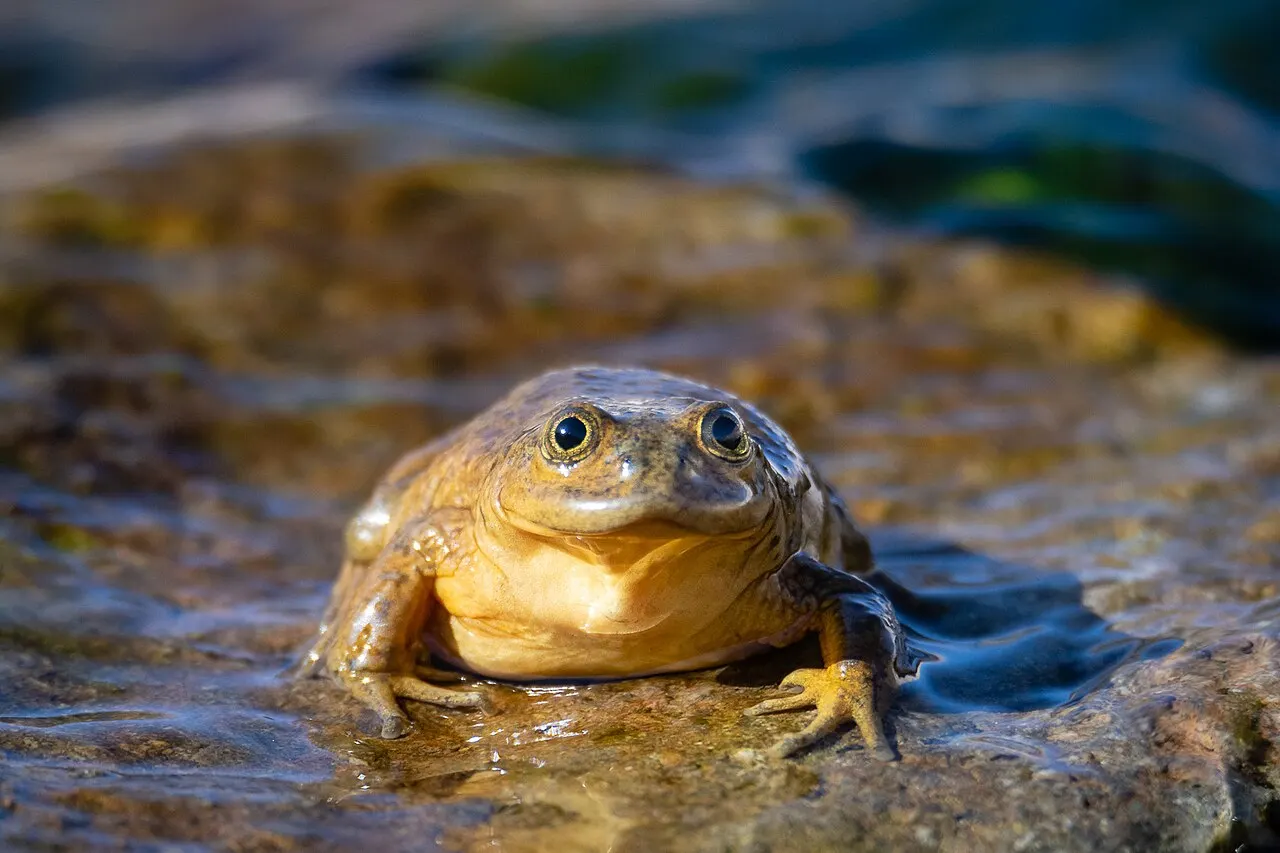
This is a medium-sized water frog. Males measure about 50 to 53 mm from snout to vent and females 57 to 63 mm. The back is light brown or greenish brown, covered in tiny black specks, with irregular apricot-coloured blotches on the back and on the underside of the thighs. The belly is white or pale yellow.
The hind legs are long with webbed toes, and the skin on the back, flanks and limbs carries small spiny granules. Tadpoles grow large, with measured specimens ranging from 38 to 99 mm in total length.
Where it lives
The frog is endemic to northern Chile and was described in 2006 from a small stream near the village of Chusmisa, which gave the species its name. Besides the type locality, the IUCN lists Loanzana, Quebrada Choja, Quebrada Chijlla, Copaquire, Huasco, Piga and Lirima, all in Tarapacá, at about 1,800 to 4,500 m above sea level. It counts eight locations, an area of occupancy of 499 square km and an extent of occurrence of about 8,720 square km.
The frog lives in permanent streams and in high-altitude grassland, in an arid region. Because it needs flowing water, its range is naturally broken into separate pockets, and the IUCN describes the population as severely fragmented, with no exchange of animals between known subpopulations.
A 2017 Universidad de Chile thesis sampled 205 frogs at 13 sites. It found five genetic groups in mitochondrial DNA and six in nuclear markers, split roughly north to south, and proposed a distinct group in the middle Loa sub-basin that matters for conservation.
Pins are Wikidata “endemic to” fields. Orange dots, when present, are GBIF occurrence tiles — survey bias included.
How it lives
At the type locality, adults were found under stones on the bed of a slow stream about 1 m wide, and tadpoles under aquatic plants along the banks. A 2021 study in the South American Journal of Herpetology by Lobos and colleagues found the species only in streams with low electrical conductivity. At the site studied, the frog density suggested a small population, and the diet was mainly tiny crustaceans (microcrustaceans). The IUCN classes the species as not a migrant.
Why it is in trouble
The IUCN lists abstraction of stream water for farming and household use, small-holder farming, and mining and quarrying as the pressures, each scored as low impact. The assessment adds that water is also taken for wetting roads. Water bodies are disappearing faster as the human population, agriculture and mining grow, so the population is suspected to be decreasing and the area it occupies is still shrinking.
The Lobos study also named climate-related natural disasters as a serious risk. The species was listed as Data Deficient in 2008 and 2010, and reassessed as Endangered in 2019 because its area of occupancy is small, its population is severely fragmented and every known site is losing habitat quality and quantity.
What is being done
The frog does not occur in any protected area, and the IUCN knows of no conservation measures for it. The assessment calls for protected areas covering at least one subpopulation, monitoring of water use and pollution from farming, households and mining, and policy to keep minimum water flow and quality in the streams. It also says the frog's abundance and population trend still need to be established.
Sources
Written for this catalog in our own words from the sources below, checked against them on 12 November 2026. Population figures are estimates and carry the year they were made. Status and assessment year: IUCN. 2026. The IUCN Red List of Threatened Species. Version 2026-1. iucnredlist.org.
- IUCN Red List assessment 79814046 (2019), via IUCN Red List API
- IUCN Red List API taxon record
- Wikipedia, Telmatobius chusmisensis
- GBIF species record
- Crossref record of Lobos et al., Ecological features of Telmatobius chusmisensis (South American Journal of Herpetology, 2021)
- Universidad de Chile thesis repository record (2017)