Endangered
Telestes ukliva
Telestes ukliva
The Cetina dace (Telestes ukliva), also called the Ukliva dace, is a slim river minnow found only in the Cetina River system of Croatia. Scientists once thought it extinct, then found it again in 1997. The IUCN Red List rated it Endangered in 2024, and dams, pollution and other changes to its water weigh on it.
How to recognise it
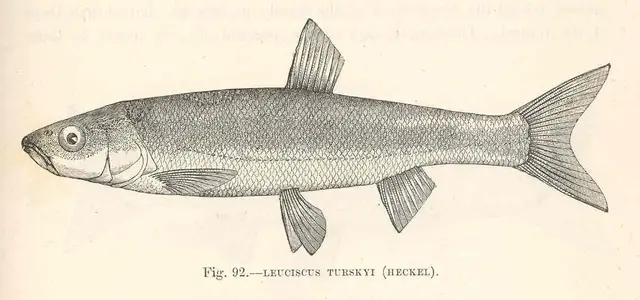
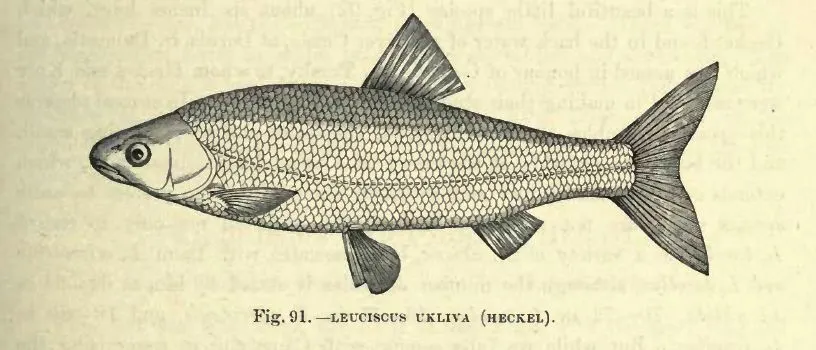
It's an elongated fish with a conspicuous dark stripe along the middle of each side. The snout is rounded and blunt and projects slightly past the upper lip. Scales along the lateral line number 58 to 66 (plus three more at the tail base), and the anal fin usually has nine and a half branched rays.
FishBase gives a maximum length of 25 cm, which is the largest size recorded for the species rather than a typical fish.
Where it lives
The dace is endemic to the Cetina drainage in Dalmatia, Croatia, and the IUCN lists Croatia as the only country. It favours slow or still water with little current. The IUCN habitat list covers permanent rivers and streams, freshwater springs, and karst and other underground water systems.
The 2024 assessment gives an extent of occurrence of about 1,963 square kilometres and counts three locations. The area it occupies is still shrinking.
Pins are Wikidata “endemic to” fields. Orange dots, when present, are GBIF occurrence tiles — survey bias included.
A species written off, then found again
Earlier authors mistook the Cetina dace for the alien Telestes muticellus, and that confusion led them to conclude the native fish had died out. It was reported extinct in the 1990s, and one listing gives 1988 as the last record. The IUCN assessments of 1996 (Critically Endangered) and 2006 (Extinct) predate the correction.
Fish were collected again in 1997, and a 2008 paper in the Journal of Fish Biology described its recovery. The Red List now treats it as a living, Endangered species, though the trend in its numbers is listed as unknown.
Why it is in trouble
The 2024 IUCN assessment names small and large dams, sedimentation and soil erosion, herbicides and pesticides, nutrient loads and sewage, groundwater abstraction and renewable energy projects among the threats. It also lists four named species as a pressure, and all of these threats are recorded as ongoing.
A Balkan river conservation database counts at least eleven planned hydropower schemes in the Cetina catchment. It rates the dace as highly sensitive to hydropower and extremely sensitive to introduced invasive fish and water extraction, and warns that new dams would help invaders spread and disrupt surface and underground flows.
What is being done
Conservation sites have been identified over part of its range, and it occurs in at least one protected area. The assessment records no recovery plan, no systematic monitoring scheme, no invasive species control and no captive breeding programme, so protection aimed at the fish itself is still thin.
Sources
Written for this catalog in our own words from the sources below, checked against them on 12 November 2026. Population figures are estimates and carry the year they were made. Status and assessment year: IUCN. 2026. The IUCN Red List of Threatened Species. Version 2026-1. iucnredlist.org.