Endangered
Telestes turskyi
Telestes turskyi
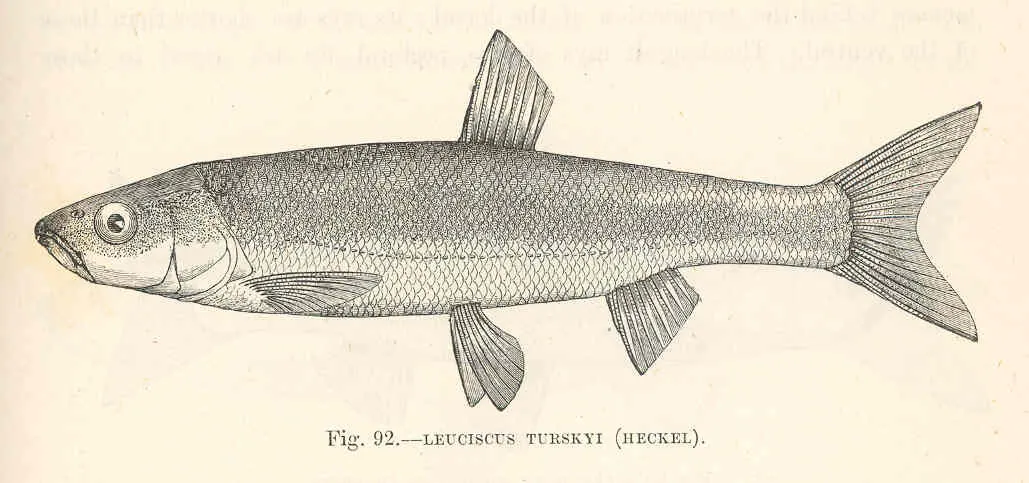
Tursky's dace (Telestes turskyi) is a small freshwater fish known from the Čikola River and the Krka drainage in Croatia. Once thought to be extinct, it was rediscovered in 2002. The IUCN Red List classes it as Endangered (assessed 2024), with water abstraction, drought and pollution among the threats.
How to recognise it
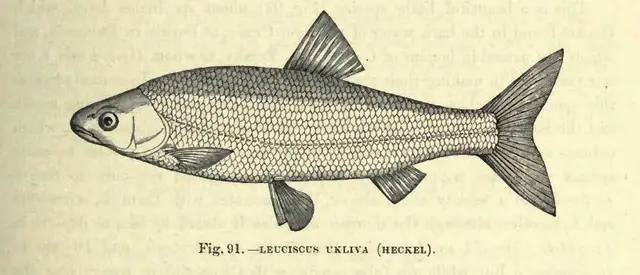
This is a dace in the family Leuciscidae, reaching about 25 cm in total length. Preserved specimens show a conspicuous black stripe along the middle of each side. Counts used to identify it include 71 to 79 scales along the lateral line and 8 to 9 gill rakers.
The species was described by Johann Jakob Heckel in 1843 and has also been listed under the names Squalius turskyi and Leuciscus turskyi.
Where it lives
The Red List records it only from Croatia. It's known from the Čikola, a tributary in the Krka catchment, and its extent of occurrence is estimated at 615 square kilometres across two locations. Some references also give Buško Lake in Bosnia and Herzegovina, where a population was studied in 1988, and others name the Vrb.
It prefers slow-flowing or still water, including springs, lowland watercourses with little current and lakes. It may retreat into underground waters in winter or during droughts, and the Red List includes karst underground systems among its habitats.
Pins are Wikidata “endemic to” fields. Orange dots, when present, are GBIF occurrence tiles — survey bias included.
How it lives
Tursky's dace feeds mainly on small invertebrates. It is not a migrant, and the Red List describes it as grouping together year-round, with all individuals treated as one subpopulation.
Why it is in trouble
The 2024 assessment, under criterion B1ab(iii), records a continuing decline in habitat area. Water is the central problem. The listed threats include taking water for farms and households, small dams, sewage, nutrient run-off, pesticides and herbicides, and sediment. Two introduced fish, eastern mosquitofish (Gambusia holbrooki) and rainbow trout (Oncorhynchus mykiss), are named too. Drought is also reported to be shrinking its habitat.
A 2014 review in the Croatian Journal of Fisheries named the fish's very limited range, river regulation, water extraction and pollution as the main threats. A Balkan rivers database reports three hydropower plants planned on the Čikola. The population trend is recorded as unknown.
What is being done
The dace is protected under Croatian law and is listed in Appendix III of the Bern Convention. The Red List records that it occurs in at least one protected area and is covered by international legislation, but no recovery plan, monitoring scheme or captive programme is in place. It lists research on population size, life history, threats and conservation actions as needs.
The 2014 review urged habitat protection, bans on altering watercourses and limits on introducing non-native fish.
Sources
Written for this catalog in our own words from the sources below, checked against them on 12 November 2026. Population figures are estimates and carry the year they were made. Status and assessment year: IUCN. 2026. The IUCN Red List of Threatened Species. Version 2026-1. iucnredlist.org.