Endangered
Taruga fastigo
Taruga fastigo
Taruga fastigo, the Rakwana whipping frog, is a sharp-snouted tree frog found only in the wet hill forests of southern Sri Lanka. The IUCN Red List assessed it as Endangered in 2020, with a decreasing population. It was described only in 2001 and is known from very few places.
How to recognise it
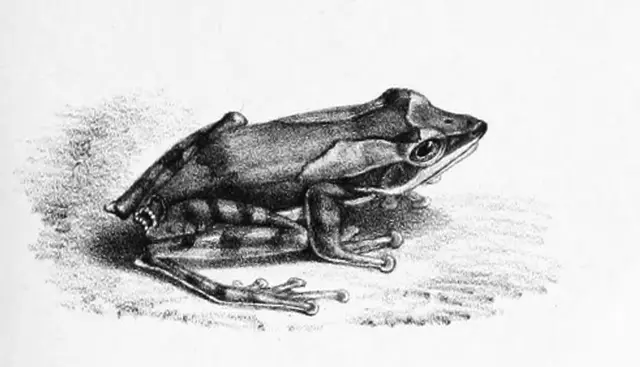
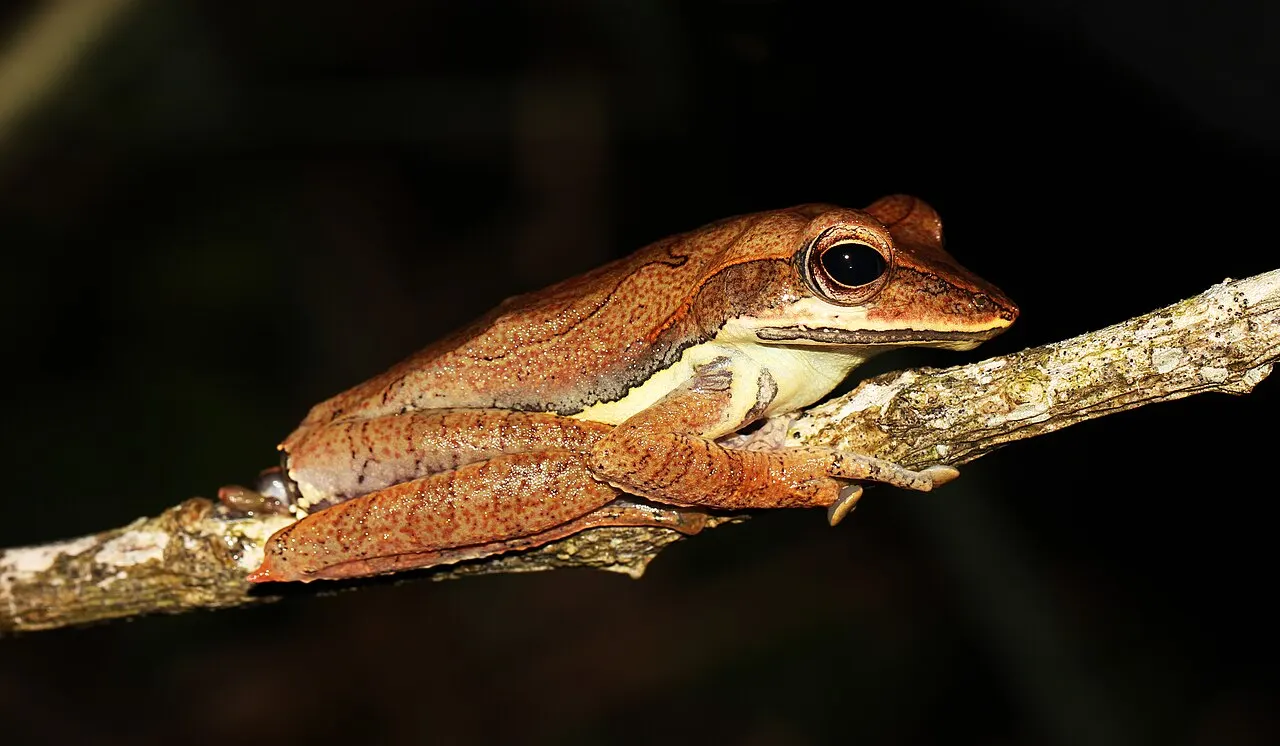
This is a slim, tree-dwelling frog with a pointed snout and sharp ridges running from the snout to the eye. Females are much bigger than males. Males measure about 35 to 40 mm from snout to vent, females about 55 to 64 mm.
The back is brown or olive green, usually with an incomplete dark brown hourglass shape. A black line runs along the lower flank from armpit to groin. The ridge over the eye and the fold above the eardrum are red, the lips have black edges, and the belly is white or pale yellow. The fingers are unwebbed but the toes are webbed, and both end in well-developed discs. Prominent white bumps sit around the vent and under the thighs.
The species name comes from a Latin word for sharpened, a nod to the snout. Before 2001 it was mistaken for the frog now called Taruga eques.
Where it lives
Taruga fastigo is endemic to Sri Lanka. It was described from Morningside Estate near Rakwana,, at about 1,060 m above sea level, and it also occurs in the Morningside Forest Reserve. The IUCN assessment gives an elevation range of 1,060 to 1,300 m and counts a single location.
Records on GBIF suggest the real range may be a little wider than that. Nine research-grade citizen-science observations from 2018 to 2026 sit mostly in Ratnapura District, with one further point in Matara District, and a handful of museum specimens are also listed. The IUCN assessment still treats the species as confined to one location.
Pins are Wikidata “endemic to” fields. Orange dots, when present, are GBIF occurrence tiles — survey bias included.
How it lives
Adults are arboreal. They are usually found on twigs and leaves of bushes up to about 2 m off the ground, in montane tropical moist forest, close to shallow still pools. The IUCN lists both permanent and seasonal small freshwater pools and marshes, as well as the forest itself, as habitat.
Breeding has not been watched. It is assumed to happen at those pools because tadpoles have been found there, and a foam nest is presumed, as in related frogs. The only tadpole description is of a late-stage larva about 40 mm long in total, with a body of 17 mm.
Why it is in trouble
The Endangered listing rests on a tiny, fragmented range and continuing habitat decline (criterion B1ab(iii)). The IUCN scores each threat as low impact on its own: small-holder farming and plantations, housing, mining and quarrying, herbicides and pesticides, and unintended effects of small-scale harvesting. Together they chip away at forest and pools in a very small area.
Land-use pressure is present even inside the Morningside Forest Reserve, where the frog occurs.
What is being done
The frog lives in at least one protected area. The IUCN lists site protection, site management and habitat protection as conservation actions, and calls for more research on its threats, life history and ecology, and population size, distribution and trends. No population estimate exists.
Sources
Written for this catalog in our own words from the sources below, checked against them on 12 November 2026. Population figures are estimates and carry the year they were made. Status and assessment year: IUCN. 2026. The IUCN Red List of Threatened Species. Version 2026-1. iucnredlist.org.