Endangered
Montane hour-glass tree-frog
Montane hour-glass tree-frog
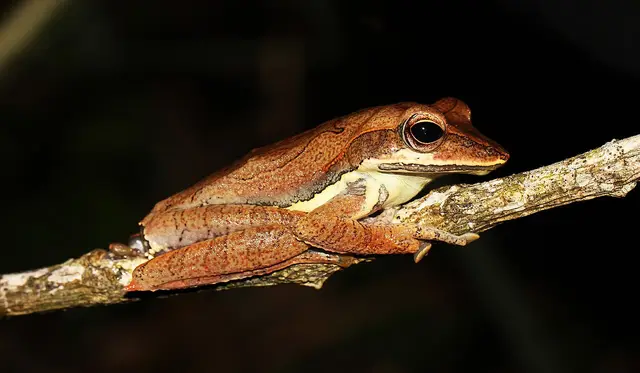
Montane hour-glass tree-frog, the montane hourglass tree frog (also called the spurred tree-frog), is a sizeable tree frog found only in the central hills of Sri Lanka. The IUCN Red List rated it Endangered in 2020. It lives in cool, misty highland forest and grassland and lays its eggs in foam nests above ponds.
How to recognise it
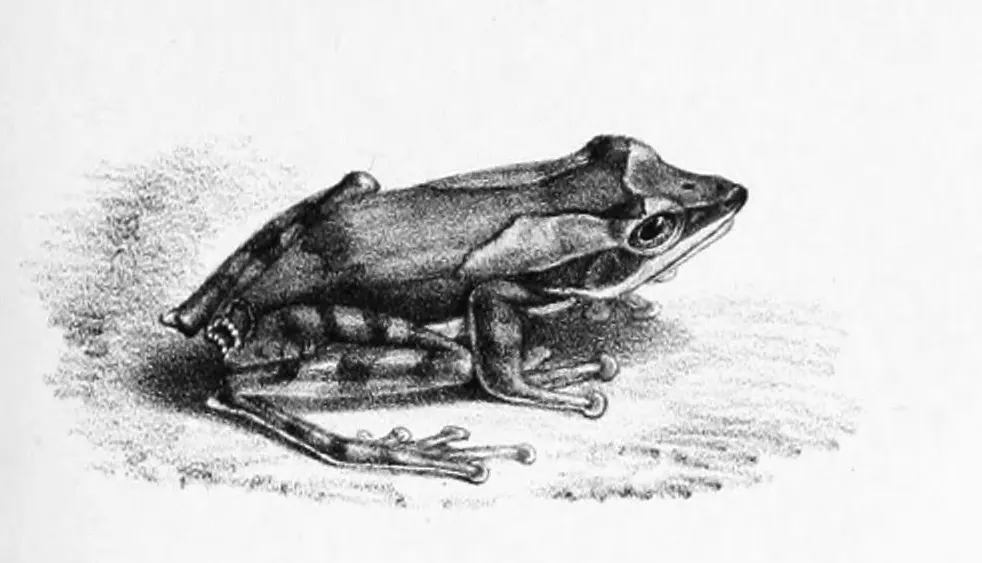
Females are much bigger than males. Adult males measure about 33 to 43 mm from snout to vent, and females 59 to 71 mm. The snout is long, pointed and triangular, and a small spur (calcar) on the heel separates it from other frogs placed in the genus Polypedates.
Colour is very variable. Males are brown, dark brown or grey, while females range from red to yellow-orange. The back may carry a dark hourglass shape, which gives the animal its common name, or just brown spots. A 2017 survey by Silva and Mahaulpatha, reported by Mongabay in 2020, looked at nearly 500 frogs. It found a distinct hourglass on 77 percent of frogs inside Horton Plains against 52 percent outside the park. Inside the park, 93 percent were green, and outside nearly two-thirds were dark brown. The researchers concluded that the hourglass is only one of many possible markings and that the common name is not well supported.
Where it lives
The species is endemic to Sri Lanka's central hills. It has been recorded in Horton Plains National Park, Hakgala Strict Nature Reserve, Knuckles Mountain Forest Reserve and the Peak Wilderness Sanctuary. The IUCN gives an elevation range of 1,000 to 2,300 m and counts two to five locations, with an extent of occurrence of about 3,000 square kilometres. Another account gives 1,200 to 2,135 m.
The IUCN lists montane moist forest, high-altitude grassland, bogs and marshes, and permanent and seasonal pools as its habitats. It is found in tree canopies, on trunks and in grasses at pond edges, and reportedly does not occur in habitats modified by people.
Günther described it in 1858 as Polypedates eques. A 2010 study led by Madhava Meegaskumbura set up the genus Taruga, which gave the current name. The IUCN lists Polypedates eques and Rhacophorus eques among its synonyms, and a 2024 reference still uses Polypedates (Taruga) eques, so the genus placement varies between authors.
Pins are Wikidata “endemic to” fields. Orange dots, when present, are GBIF occurrence tiles — survey bias included.
How it lives
By day it hides in dense herbs such as soft rush (Juncus effusus), which keep it from drying out. It comes out in mid-afternoon and calls until around midnight. It favours still water and humidity above about 65 percent.
Pairs climb shrubs or rushes over water. The female whips mucus into a white foam while the male fertilises the eggs, and the nest hangs above the pond, on average about 15 cm up. The outer foam layer dries quickly, forming a protective crust. Tadpoles drop into the water below. In a Horton Plains study by Shashi Madhushanka and Kelum Manamendra-Arachchi, published in 2022, males outnumbered females about 9 to 1 during surveys, and herbs were the commonest microhabitat.
Why it is in trouble
The IUCN records a decreasing population and continuing loss of habitat. Listed threats include small-holder farming, herbicides and pesticides, housing and tourism development, recreation, more frequent fires, droughts and acid rain, each scored as a low impact on its own. In Knuckles reserve, tea and cardamom plantations and unregulated construction have also been named as threats.
Its dependence on rush beds and cool, damp ground is considered a serious risk factor. Thasun Amarasinghe, a climate researcher not involved in the 2017 survey, told Mongabay in 2020 that highland species of this kind are very sensitive to rising temperature and to humidity.
What is being done
The IUCN notes that the species occurs in at least one protected area and lists site protection, site management and habitat protection as the actions needed. Several of its known sites, among them Horton Plains and Hakgala, lie inside parks and reserves.
Sources
Written for this catalog in our own words from the sources below, checked against them on 12 November 2026. Population figures are estimates and carry the year they were made. Status and assessment year: IUCN. 2026. The IUCN Red List of Threatened Species. Version 2026-1. iucnredlist.org.