Endangered
Grey-bellied comet
Taphrolesbia griseiventris
The grey-bellied comet (Taphrolesbia griseiventris) is a large, long-tailed hummingbird found only in northern Peru. It lives on steep, dry Andean slopes between roughly 2,650 and 3,850 metres. The Red List rated it Endangered in 2020, with 250 to 999 mature birds and a decreasing trend.
How to recognise it
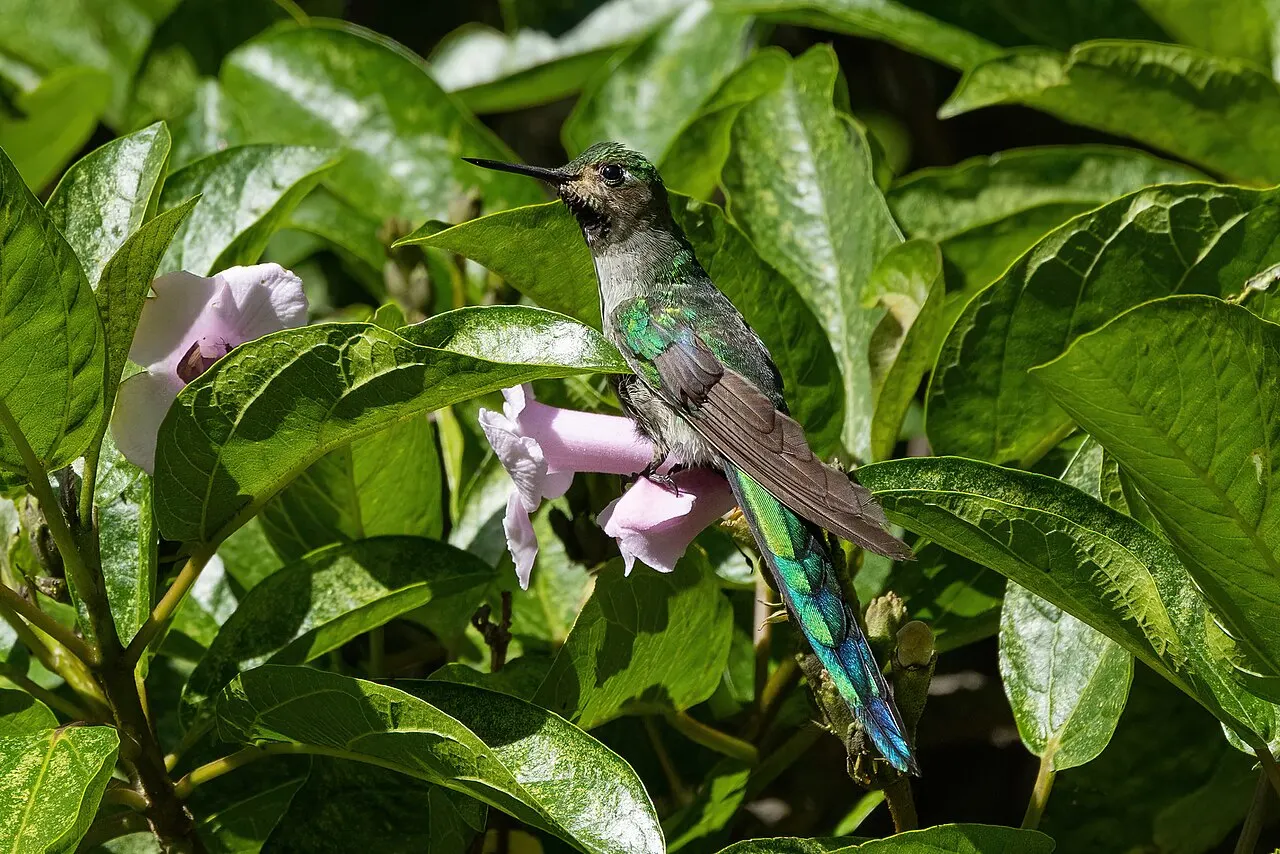
This is a big hummingbird, 14 to 17 centimetres long, with a deeply forked tail. The upperparts are bronzy green with a small white spot behind the eye, and the long tail feathers are tipped orange-gold. The underparts are plain grey. Males have a blue throat and a longer tail, while females lack the blue and have a shorter, less forked tail. The Red List calls it unmistakable within its range.
Where it lives
Records come from the departments of Cajamarca, La Libertad, Ancash and Huánuco. The Red List counts five locations and puts the extent of occurrence at 28,000 square kilometres. A 2023 study by Sandra Cuadros and Fernando Angulo in Bird Conservation International proposed a much smaller range of about 5,962 square kilometres, of which only 1,894 is judged to be occupied now.
In their study area, slopes ran from 30 to 90 degrees, with 71% at 60 degrees or steeper, and the birds were often in canyons close to water. The main natural habitat is Andean scrub, and the Red List also lists arable land among the habitats it uses.
Pins are Wikidata “endemic to” fields. Orange dots, when present, are GBIF occurrence tiles — survey bias included.
How it lives
Comets feed on flowers, and in surveys the bromeliad Tillandsia was the most common bloom they used. In La Libertad they also visited Oreocallis grandiflora, and they take Eucalyptus flowers. In Cajamarca they were seen at Delostoma integrifolium only after Black-throated Flowerpiercers had cut open the blooms.
Very little is known about nesting. Two nests were found near Cajamarca in hilly ground with agave and cactus, and little else is recorded.
Why it is in trouble
Its home is a patchwork dominated by farming, which makes up 56% of the land within 5 kilometres of the records. The Red List names farming, grazing and ranching, small dams, and more frequent fire as threats. Fires peak in August and then September and are most widespread in La Libertad. The study also found vegetation loss between 2004 and 2019 in Cajamarca, La Libertad and Ancash.
The comet is hard to find. The 2023 model used only 14 records spanning 1883 to 2021, and field teams spent 452 hours at 99 sites. Four visits over three years to Huascarán National Park in Ancash found no birds, though that does not rule out their presence. Five new records at two sites in La Libertad confirmed a population there. An estimate of 375 to 1,499 birds from 2012 is reportedly still quoted.
What is being done
The Red List says conservation sites cover its whole range and that it occurs in at least one protected area. It is listed in CITES Appendix II, and Peru's national list from 2018 rates it Critically Endangered. The assessment calls for protecting known sites, a schools campaign in Cajamarca, and farmers planting the flowers the birds prefer. Cuadros and Angulo recommend a reserve in La Libertad and a new Key Biodiversity Area named Huamachuco.
Sources
Written for this catalog in our own words from the sources below, checked against them on 12 November 2026. Population figures are estimates and carry the year they were made. Status and assessment year: IUCN. 2026. The IUCN Red List of Threatened Species. Version 2026-1. iucnredlist.org.




