Critically Endangered
Sulu Bleeding-heart
Gallicolumba menagei
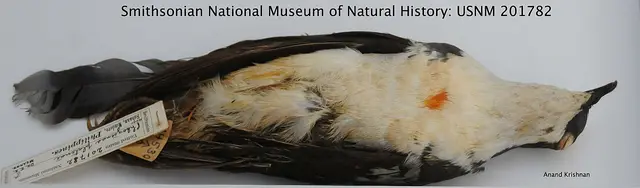
The Sulu bleeding-heart (Gallicolumba menagei) is a ground-dwelling pigeon from Tawi-Tawi, in the Philippines' Sulu Archipelago. Known from two specimens collected in 1891 and not recorded with certainty since, it is rated Critically Endangered in the 2021 assessment, which puts the population at 1 to 49 birds.
How to recognise it
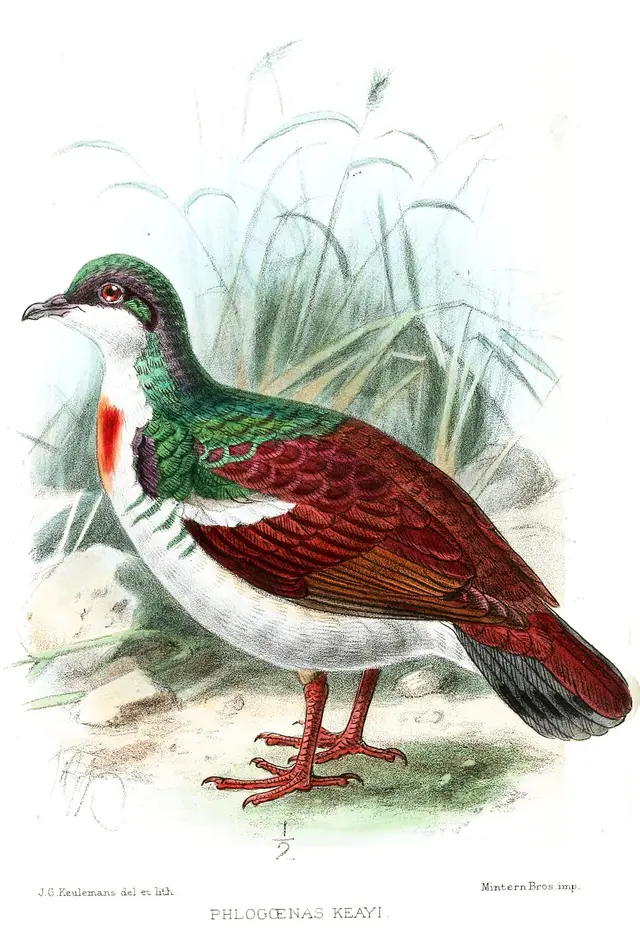
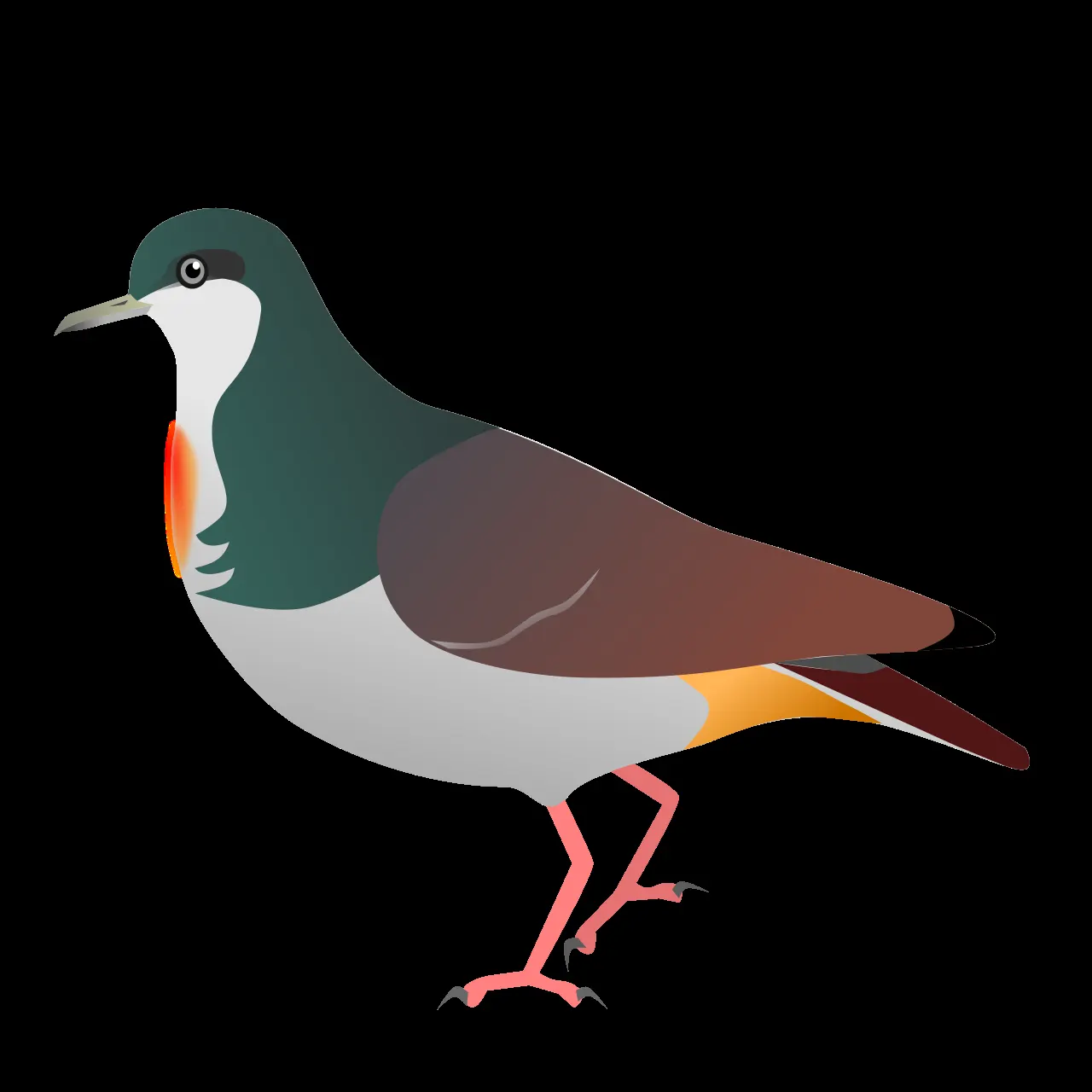
It is a medium-sized pigeon with a short tail, about 25 to 30 cm long depending on the source. Iridescent green covers the nape and upper back, and a bright orange patch on an otherwise white breast gives the bleeding-heart name. The throat is white, the belly ash grey and the wings brownish chestnut. The feet are reportedly red. Males and females look alike.
Its voice has never been documented, and the plumage of young birds has not been described.
Where it lives
Only two specimens exist, collected in October 1891. One account places them on Tataan, a small islet near Tawi-Tawi, and others give Tawi-Tawi itself. Bourns and Worcester described the bird in 1894.
It is thought to live in closed-canopy forest, primary or secondary, and in beach forest on small islets. The Red List gives its habitat as tropical moist lowland forest and estimates its extent of occurrence at 780 square kilometres. It is believed to have disappeared from the main island of Tawi-Tawi.
Like other bleeding-hearts, it presumably feeds on the forest floor and flies only short distances.
Pins are Wikidata “endemic to” fields. Orange dots, when present, are GBIF occurrence tiles — survey bias included.
The search for it
A 22-day search in December 1971 found nothing, and neither did a brief visit in September 1991. A 1995 ethnobiological survey heard that the bird had been common until the 1970s and still lived on nearby islets, including Tandubatu, Dundangan and Baliungan. Other local reports have come from Siasi and Simunul.
A 2009 expedition found no sign of it, and surveys had not rediscovered it by June 2009. A reputed sighting from Jolo has never been confirmed.
Why it is in trouble
Most of Tawi-Tawi's forest was reportedly cleared by August 1994. The Red List names small-holder farming, hunting of the bird itself and accidental harvest as threats, although it records their scale as unknown, and it records a continuing decline in the bird's area. Any survivors on tiny islets may be too few to last.
Escaped pet bleeding-hearts could also be mistaken for wild birds on Tawi-Tawi, which complicates any report.
What is being done
Very little. The assessment records no protected area, no recovery plan and no monitoring scheme. It does say that conservation sites have been identified over the whole range and that awareness programs have taken place, reportedly two in the 1990s. Because the bird has not been confirmed alive, the most useful step would be a survey of the islets where residents say it survives.
Sources
Written for this catalog in our own words from the sources below, checked against them on 12 November 2026. Population figures are estimates and carry the year they were made. Status and assessment year: IUCN. 2026. The IUCN Red List of Threatened Species. Version 2026-1. iucnredlist.org.