Critically Endangered
Negros Bleeding-heart
Gallicolumba keayi
The Negros bleeding-heart (Gallicolumba keayi) is a shy, ground-dwelling pigeon found only in the forests of Negros and Panay in the Philippines. The IUCN Red List rated it Critically Endangered in 2021, with an estimated 50 to 249 mature birds left. A red patch on its white breast gives it its name.
How to recognise it
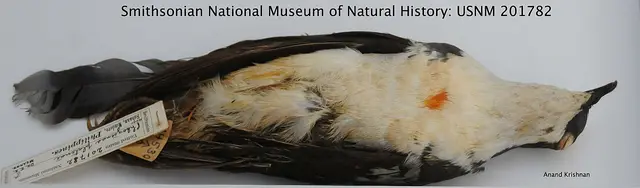
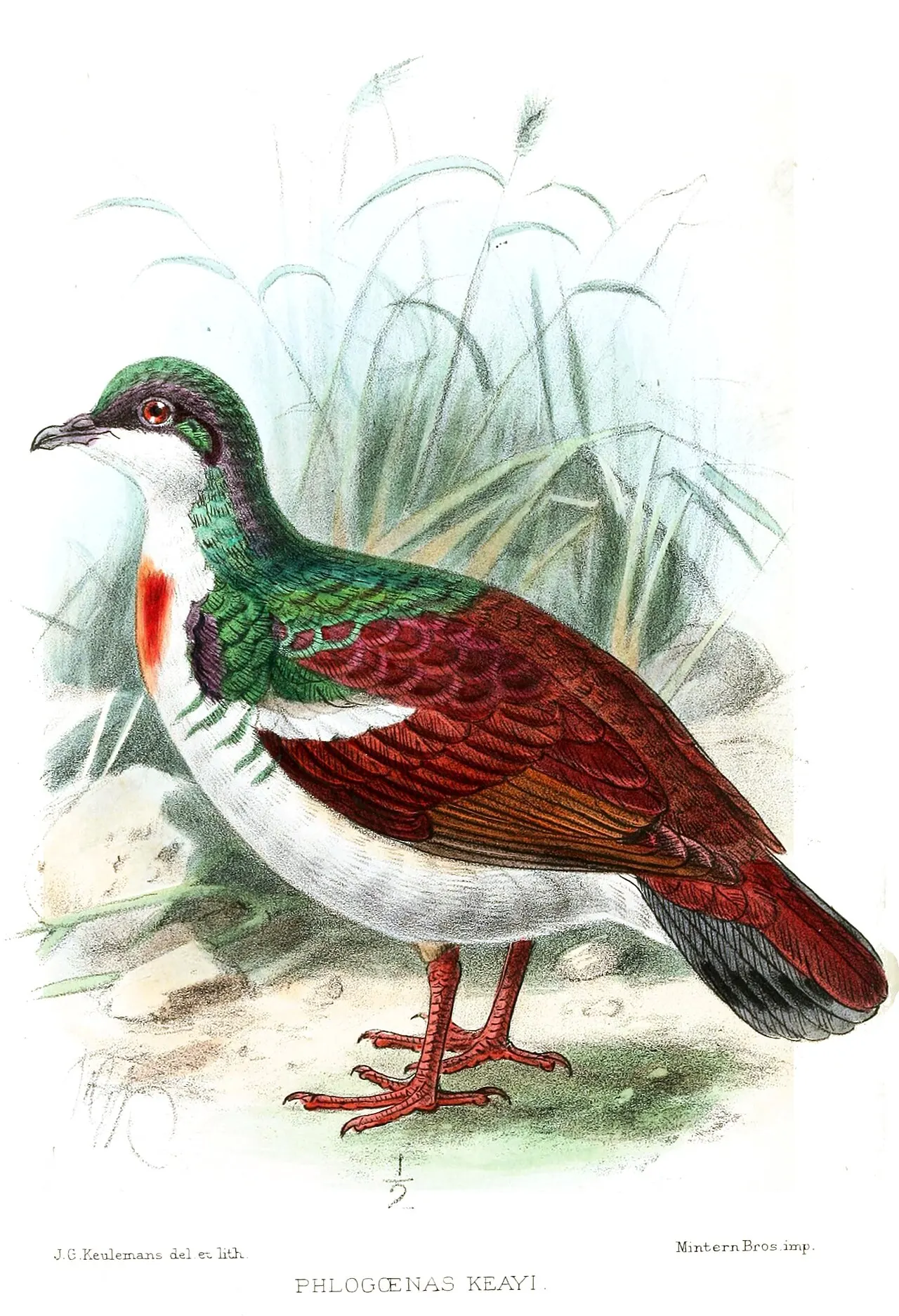
It's a plump pigeon about 25 cm long, bright green above, with a long vertical red mark down the breast, the so-called heart. A white V-shaped bar on each wing and a white bar at the side of the breast set it apart from the other bleeding-hearts of the Philippines. In captivity the male's heart looks brighter and redder in the breeding season.
Where it lives
It occurs only on Negros and Panay in the Western Visayas. The IUCN assessment gives an elevation range of 300 to 1,000 m and one habitat, tropical moist lowland forest, while another reference says primary forest up to 1,200 m. It copes poorly with disturbance, and records from regrown forest are few and thin.
The IUCN counts 2 to 5 locations and describes the population as severely fragmented.
The IUCN counts 2 to 5 locations and describes the population as severely fragmented.
Pins are Wikidata “endemic to” fields. Orange dots, when present, are GBIF occurrence tiles — survey bias included.
How it lives
Birds are usually seen alone or in pairs. They feed on the forest floor, mostly on plant matter, though they may take the odd invertebrate, and they roost and nest in bushes or vines. Nesting has been recorded from March to June. Nests sit low, often in ferns growing on branches, and are regularly raided by predators. Chicks reportedly leave the nest after about 12 days.
The IUCN puts one generation at about 5.4 years.
Why it is in trouble
Forest loss and hunting have done the damage. Logging, farmland, mining and road building have stripped the islands, and forest cover in 2007 was only about 3 percent of Negros and 6 percent of Panay, much of it high ground where the pigeon does not do well. The IUCN also lists trapping and hunting, whether the bird is the target or caught by accident, housing, agro-industry and a problem native species or disease as threats. The IUCN also lists housing, agro-industry and a problem native species or disease among the threats.
Population estimates differ. The IUCN gives 50 to 249 mature birds, assessed in 2021, and the Edge of Existence programme has quoted 70 to 400 birds in total. Both put it in a very small population, and the trend is decreasing. The Red List trend is decreasing.
What is being done
Captive breeding began at Silliman University's Center for Tropical Conservation Studies in 2007, and the Talarak Foundation on Negros now runs a programme too. Captive-bred birds have been released at the Bayawan Nature Reserve, a roughly 300 hectare forest site near Bayawan City, where they are being tracked with small radio tags.
A backup population began in September 2021, when three pairs went to Singapore. Bird Paradise there hatched 19 chicks, the first on 26 November 2021. On 15 January 2025, ten of those birds were flown back to the Philippines to Negros Forest Park in Bacolod, the species' first repatriation, with 14 more still in Singapore. The IUCN lists awareness work, habitat restoration, site protection and national action among the measures. The IUCN lists awareness work, habitat restoration, site protection and national action among the measures.
Sources
Written for this catalog in our own words from the sources below, checked against them on 12 November 2026. Population figures are estimates and carry the year they were made. Status and assessment year: IUCN. 2026. The IUCN Red List of Threatened Species. Version 2026-1. iucnredlist.org.