Critically Endangered
Sulfurhead aulonocara
Aulonocara maylandi
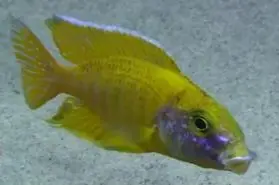
The sulfurhead aulonocara (Aulonocara maylandi), also called the sulfurhead peacock, is a small cichlid found only in Lake Malawi, and only on two reefs. The IUCN Red List rated it Critically Endangered in 2018. Breeding males carry a bright yellow band from snout to back.
How to recognise it
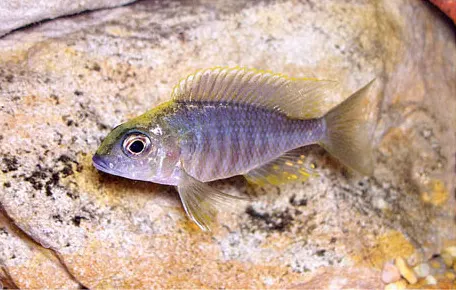
It's a modest-sized fish, reaching roughly 10 cm in standard length (about 15 cm counting the tail). Breeding males are the showy ones, with a yellow band running from the snout across the back and along the edge of the dorsal fin. Females are plainer.
A close relative, the blue orchid aulonocara (Aulonocara kandeense), looks very similar, and the two were once classed as subspecies. Males from Kande Island, off the central-western shore, show a whitish stripe instead of a yellow one. The species was described by Ethelwynn Trewavas in 1984 and named for Hans-Joachim Mayland, a cichlid author and fishkeeper who brought it to her attention.
Where it lives
The sulfurhead is endemic to Lake Malawi and has only been recorded at West Reef (now called Luwala Reef) and Eccles Reef (Chimwalani Reef), in the southeast of the lake. The IUCN counts it as a single location. Its estimated area of occupancy is just 8 square kilometres, within an extent of occurrence of about 70 square kilometres.
It favours the zone where rocky shore gives way to sand, mostly over sand directly bordering the reef. The IUCN gives an average depth of about 15 m. Males defend territories where rock meets sand.
Pins are Wikidata “endemic to” fields. Orange dots, when present, are GBIF occurrence tiles — survey bias included.
How it lives
It eats small invertebrates that live in the sand, sifting mouthfuls of substrate and also hunting by hovering until it spots tiny movements.
Like many Lake Malawi cichlids it's a maternal mouthbrooder. Only the female cares for the eggs, carrying the brood in her mouth for up to about four weeks, usually without feeding. The IUCN gives a generation length of one to two years, so numbers can swing quickly, and the assessment records extreme fluctuations.
Why it is in trouble
The Red List names harvest as the threat, and collection for the ornamental fish trade is the cause given. Traders target adults, so the adult population is slow to recover. The IUCN says the population fell by more than 70 percent between the mid-1990s and 2005, and that fewer than 2,500 mature individuals remain. The fish was once common on the bottom of both reefs.
Because the whole population sits on two small reefs in one lake, heavy collecting can do real damage. The Red List lists the population trend as decreasing, and criteria B1ac(iv)+2ac(iv) reflect the tiny range and the swings in numbers.
What is being done
The assessment records no conservation actions in place. It lists site and area protection and national-level action as relevant measures, and recommends monitoring the population trend. No recovery programme turned up for the species.
Sources
Written for this catalog in our own words from the sources below, checked against them on 12 November 2026. Population figures are estimates and carry the year they were made. Status and assessment year: IUCN. 2026. The IUCN Red List of Threatened Species. Version 2026-1. iucnredlist.org.