Critically Endangered
Nkhomo-benga Peacock
Aulonocara baenschi
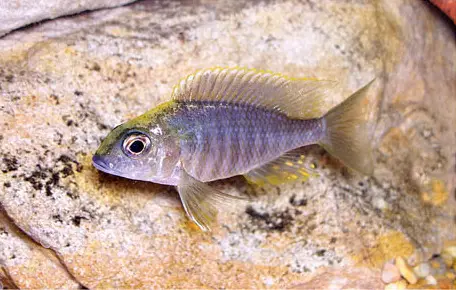
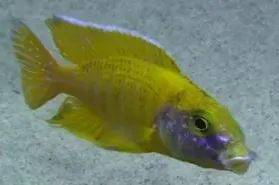
The Nkhomo-benga peacock (Aulonocara baenschi) is a small cichlid found only in Lake Malawi, living over sand with scattered rocks. The IUCN Red List rated it Critically Endangered in 2018. Males are the bright ones, and capture for the aquarium trade is its main threat.
How to recognise it
Adult males reach about 12 cm in standard length (FishBase lists 13 cm total length) and are bigger and more colourful than females, which stay near 9 cm. In the aquarium trade the fish goes by several names, including new yellow regal peacock, sunshine peacock, Baensch's peacock and yellow regal cichlid.
The scientific name honours Ulrich Baensch, who developed TetraMin flake food and founded the aquarium company Tetra. The fish was described in 1985 by Meyer and Riehl.
Where it lives
It is found nowhere but Lake Malawi, and only along the western shore, with records at Usisya, Nkhomo Reef, Benga (south of Chia lagoon), the Maleri Islands and Chipoka. The IUCN assessment counts a single location and describes the range as restricted.
It favours the lake's intermediate zones, where rocky shore gives way to sand with scattered boulders. It usually sits at 2 to 6 m depth, with records down to 16 m.
Pins are Wikidata “endemic to” fields. Orange dots, when present, are GBIF occurrence tiles — survey bias included.
How it lives
It hunts small invertebrates from the sandy bottom. Large sensory pores on its head help it pick up prey hidden in the sand, and it either sifts mouthfuls of substrate or hovers and snaps at tiny movements.
Males are territorial, show breeding colours all year and base their territory on a shelter they dig. Females gather in small schools. A male has egg-like spots on his anal fin. A female tries to pick them up in her mouth, and the male releases milt over her mouth to fertilise the eggs she is holding. She broods them in her mouth for up to about four weeks, then releases free-swimming fry.
Why it is in trouble
The IUCN names harvest, at subsistence and small scale, as the only listed threat, and records that it involves international trade. The main pressure is collection for the aquarium trade. Combined with a range of a few shoreline sites, that gives the 2018 Critically Endangered listing under criteria B1ab(v)+2ab(v), with a decreasing population.
It is a popular aquarium fish. Anyone thinking of buying one should ask where the fish came from. For the rules on keeping exotic animals, see /exotic-pet-laws-by-state/.
What is being done
The only conservation action recorded by the IUCN is at national level. The assessment also notes a successful introduction of the species, without giving details, and no population size estimate is available.
Sources
Written for this catalog in our own words from the sources below, checked against them on 12 November 2026. Population figures are estimates and carry the year they were made. Status and assessment year: IUCN. 2026. The IUCN Red List of Threatened Species. Version 2026-1. iucnredlist.org.