Critically Endangered
Straw-headed Bulbul
Pycnonotus zeylanicus
The straw-headed bulbul (Pycnonotus zeylanicus) is a large songbird of Southeast Asian rivers and lowland forest, famous for a loud, rich, warbling song. The IUCN Red List rated it Critically Endangered in 2021. Demand from the cage-bird trade has stripped it from much of its range.
How to recognise it
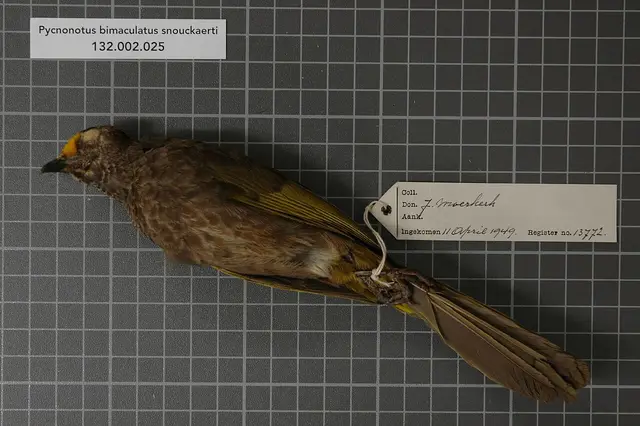
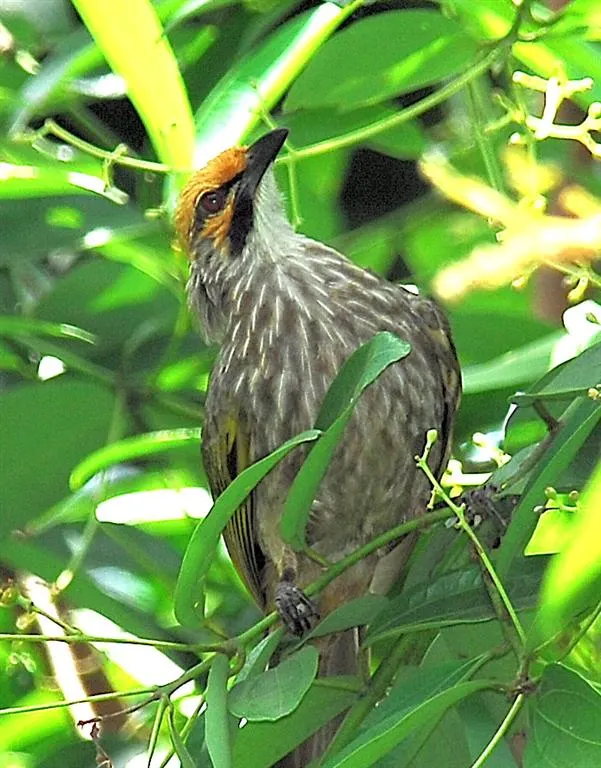
It's a big bulbul, about 29 cm long, with a golden-yellow crown and cheeks. A blackish stripe runs through the eye and another below the face, the throat is white, and the back and breast carry fine whitish streaks. Young birds have a duller, browner head.
The song is the easier clue. It's loud, rich and warbling, and the IUCN advises listening for it in marshes and along forested rivers.
Where it lives
The Red List assessment names five countries where it still occurs: Brunei, Indonesia, Malaysia, Myanmar and Singapore. It uses lowland forest, mangroves, moist shrubland, rivers and streams, and even farmland, plantations and badly degraded former forest, from sea level up to about 1,600 m.
That tolerance of human-altered ground matters in Singapore, where it occurs in a range of habitats and has held on despite heavy urbanisation. Elsewhere it has disappeared from places where it was once widespread. A TRAFFIC bulletin says it is thought extinct in Thailand and Java, with no confirmed records in Sumatra since 2009, and a small population persists in Kalimantan. Its status in Brunei is unknown and in Myanmar poorly known.
Pins are Wikidata “endemic to” fields. Orange dots, when present, are GBIF occurrence tiles — survey bias included.
How it lives
It reportedly feeds mostly on fruit, with figs a favourite, and also takes insects. It is usually seen in pairs or small groups near water.
Why it is in trouble
Trapping for the songbird trade is the main cause of decline. The straw-headed bulbul is the most sought-after songbird in its family, valued for its voice and for singing contests. It is widely sold in Indonesian bird markets, where many traders claim the birds come from Sumatra and Kalimantan. Logging roads have made it easier for trappers to reach forest that was once remote.
The Red List assessment gives a population estimate of 600 to 1,700 birds and a decreasing trend. It lists use for the pet and display trade as the ongoing threat, with housing development as a past one. The species moved from Endangered to Critically Endangered in 2018, only two years after an earlier uplisting.
Traders now breed the bird in some numbers. TRAFFIC reports concern that deliberate selection for song and cage behaviour could erode the wild type.
What is being done
Singapore is a stronghold. Its Wild Animals and Birds Act 1965 prohibits killing, trapping, or offering for sale or export any wild bird other than those listed in the Act. A 2020 distance-sampling survey in Bird Conservation International estimated 573 birds nationwide, about 217 on the main island and 356 on Pulau Ubin, and put that at roughly 23 to 57 percent of the world's wild population. The survey still warned that trapping remains a risk.
The assessment records the species as occurring in at least one protected area. It calls for tighter policing of bird markets, stronger legal protection, captive breeding to supply the market, and a genome bank to track the origin of traded birds, and notes no recovery plan or monitoring scheme. At the 2022 CITES meeting, parties agreed by consensus to move the species to Appendix I, which prohibits international commercial trade.
Sources
Written for this catalog in our own words from the sources below, checked against them on 12 November 2026. Population figures are estimates and carry the year they were made. Status and assessment year: IUCN. 2026. The IUCN Red List of Threatened Species. Version 2026-1. iucnredlist.org.
- IUCN Red List assessment, Pycnonotus zeylanicus (2021)
- Straw-headed bulbul (Wikipedia)
- TRAFFIC Bulletin, conservation status, legal protection and trade in straw-headed bulbuls in Singapore
- Bird Conservation International 2020, distance sampling survey of the Straw-headed Bulbul in Singapore
- Palm Oil Detectives, Straw-headed Bulbul
- WCS, CITES CoP19 Parties vote to protect two Asian songbirds