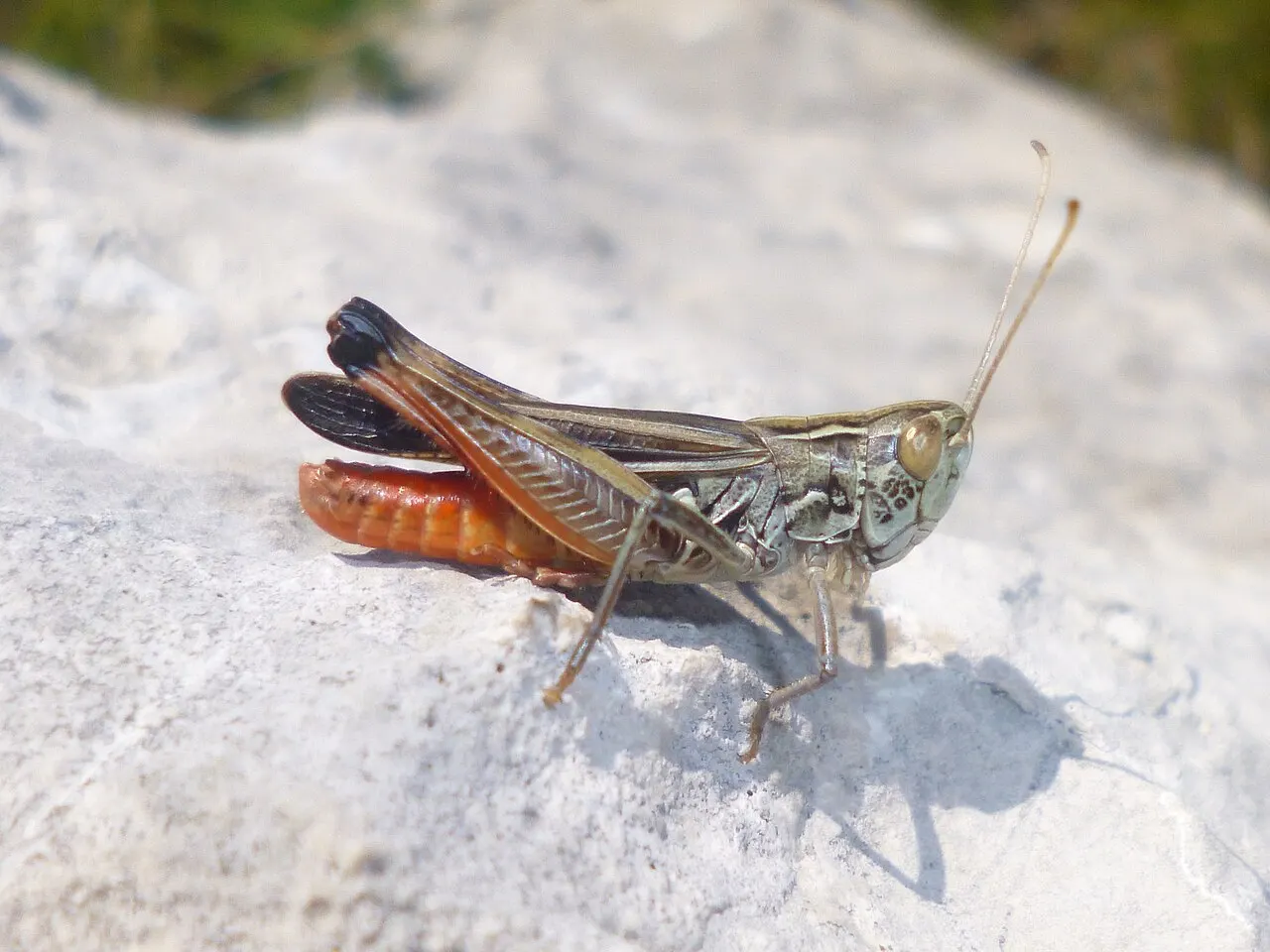
Critically Endangered
Croatian Toothed Grasshopper
Stenobothrus croaticus
Stenobothrus croaticus, the Croatian toothed grasshopper, is a small grassland insect known only from the southern slopes of Velebit, a mountain range in Croatia. It was rated Critically Endangered in 2016, with an estimated range of just 4 square kilometres and few records since its 1933 description.
What kind of insect it is
This is a short-horned grasshopper in the family Acrididae, subfamily Gomphocerinae, the group that includes many of Europe's grassland singers. Ramme described it in 1933 in the Berlin zoological museum's bulletin, Mitteilungen aus dem Zoologischen Museum in Berlin. The type locality is Senj, on the Croatian coast, and the holotype is kept at the Museum fur Naturkunde in Berlin.
The English name Croatian toothed grasshopper and the Croatian name hrvatski tamnokrili skakavac are both in use. In 1900 Padewieth reported some Croatian material as a variety of another grasshopper, Stenobothrus nigromaculatus, so older literature can be confusing.
Where it lives
The species is a stenoendemic, meaning it is found in one very small area and nowhere else. A 2018 annotated checklist of Croatian crickets and grasshoppers, by Skejo and colleagues in Zootaxa, treats it as known from the southern slopes of Velebit, with one confirmed locality, on a hillside above Jurjevo near Gornji Lopci. The second place named in Ramme's original description, a hill above Senj, has never been identified again.
The IUCN assessment estimates the area it occupies at 4 square kilometres, at elevations of 500 to 900 m. Its habitat is listed as temperate grassland. The assessment says it occurs in at least one protected area.
Pins are Wikidata “endemic to” fields. Orange dots, when present, are GBIF occurrence tiles — survey bias included.
Why it is in trouble
The only threat the IUCN assessment lists is a general one, labelled other ecosystem modifications, affecting the whole population and causing slow but significant decline. The effects it records are conversion and degradation of the habitat and reduced reproductive success. The assessment does not name a specific cause for this species.
Because the whole population sits in a few square kilometres, any local change could be serious. The assessment, published in 2016, rates it Critically Endangered under criteria B1ab(iii,v)+2ab(iii,v), which cover a tiny range, continuing decline in habitat quality and a continuing decline in numbers. Its population trend is decreasing. No population size has been estimated. A separate European Red List assessment from 2016 also treats it as Critically Endangered for Europe and the EU.
What is being done
No specific conservation action is recorded in the IUCN assessment. The one real protection is incidental, since the species is known from at least one protected area. Better knowledge of the exact sites, habitat needs and numbers would be the first step toward any management.
Sources
Written for this catalog in our own words from the sources below, checked against them on 12 November 2026. Population figures are estimates and carry the year they were made. Status and assessment year: IUCN. 2026. The IUCN Red List of Threatened Species. Version 2026-1. iucnredlist.org.




