Endangered
St. Lucia threadsnake
Tetracheilostoma breuili
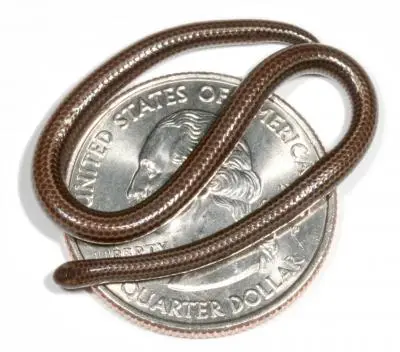
The St. Lucia threadsnake (Tetracheilostoma breuili) is a tiny, burrowing threadsnake known only from the Caribbean island of Saint Lucia and a small islet off it. The IUCN rated it Endangered in 2016. It reaches little more than 11 cm, and few details of its habits have been published.
How to recognise it
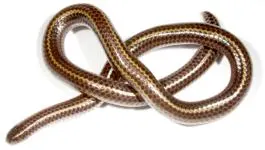
This is a thread-thin snake with a dark brown body marked by two yellowish stripes along the sides. Two spots behind the head and a dark tail separate it from two similar threadsnakes, one from Martinique and one from Barbados. It reaches a total length of up to 119 mm (4.7 in) in live animals. It lays eggs. The Reptile Database gives a maximum of 113 mm for preserved specimens.
The Barbados species was described in the same 2008 paper, and its author called it the smallest snake, at about 100 mm adult length.
Where it lives
S. Blair Hedges described the snake in 2008. The holotype, an adult male, was found under a rock on the north slope of Maria Major, a small island off southeast Saint Lucia, on 13 June 2006. Other specimens came from Anse Galet near Anse La Raye and from about 1.6 km north of Praslin. The name honours the French herpetologist Michel Breuil. Collection sites listed by the Reptile Database range from 5 m at Anse Galet to 60 m on Maria Major. One further museum specimen has no exact locality.
The IUCN lists subtropical and tropical dry forest at 40 to 60 m above sea level as its habitat, and an extent of occurrence of roughly 620 square kilometres.
Pins are Wikidata “endemic to” fields. Orange dots, when present, are GBIF occurrence tiles — survey bias included.
Why it is in trouble
The assessment describes a severely fragmented population in continuing decline, though the overall trend is recorded as unknown and no population estimate exists. Threats listed are invasive species (affecting more than 90 percent of the range), housing and urban development, roads, and tourism and recreation areas.
What is being done
The Red List lists control of invasive species and protection of its habitat as needed actions. No conservation measures are recorded as already in place.
Sources
Written for this catalog in our own words from the sources below, checked against them on 12 November 2026. Population figures are estimates and carry the year they were made. Status and assessment year: IUCN. 2026. The IUCN Red List of Threatened Species. Version 2026-1. iucnredlist.org.