Endangered
Splendid toadfish
Sanopus splendidus
The splendid toadfish (Sanopus splendidus) is a small, boldly coloured reef fish of the Mexican Caribbean and Belize. It hides in caves and under coral ledges, and was first described from Cozumel. The Red List classed it as Endangered in 2015 because its range is small and its reefs are declining.
How to recognise it
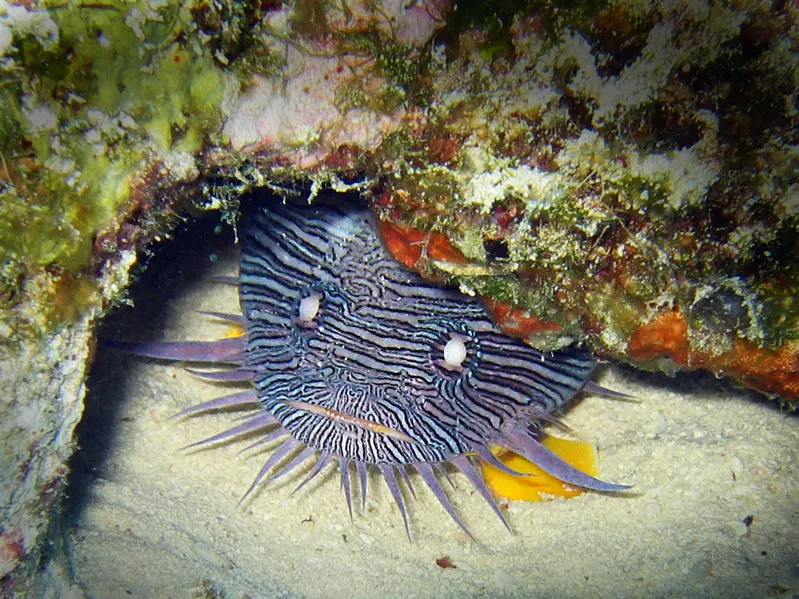
Its pelvic fins are entirely yellow, and the other fins have yellow edges. The head carries dark and white stripes. Like other toadfishes it has a broad, flattened head with eyes set on top, barbels around the mouth, and wide jaws with small sharp teeth.
FishBase gives a maximum length of 24 cm. Divers who photographed two fish near Isla Mujeres put them at 15 cm and 25 to 30 cm, so size figures vary.
Where it lives
Collette, Starck and Phillips described the species in 1974 from Cozumel Island, off Mexico's Yucatan coast, and it was long thought to live only there. The Red List gives Mexico and Belize.
In 2019, Moreno Mendoza and Barrientos Medina reported two fish photographed by sport divers on reefs in the Isla Mujeres, Punta Cancun and Punta Nizuc National Park. That is about 105 km north of Cozumel and the northernmost record.
It is a reef fish found at about 8 to 25 m, usually 10 to 15 m, mostly in or near rocky caves and under coral outcrops. The Red List puts its area of occupancy at 109 square kilometres, across two locations.
Pins are Wikidata “endemic to” fields. Orange dots, when present, are GBIF occurrence tiles — survey bias included.
How it lives
It eats small fish, snails and bristle worms, and doesn't migrate. Dens can be spotted by a sloping patch of sand, and the fish is hard to coax out. A 2021 study made the first scientific recordings of its calls, and toadfish in general rely on sound to breed.
One source reports that males guard eggs stuck to rock cavities for about three weeks. The breeding season is unknown.
Why it is in trouble
The Red List records a continuing decline in its range, occupied area and habitat quality. Its listed threats are unintentional harm where the fish is not the target, and a second one of unknown type. The population trend is unknown.
Noise may also matter. In 2021, Pyc and colleagues reported underwater sound recorded at Paraiso Reef in Cozumel during summer 2017. Cruise ships and small motorboats raised sound levels for up to 15 hours a day, in the same frequency range as the toadfish's calls. They warned that this could mask calls used in breeding.
What is being done
The 2015 assessment lists no conservation sites identified, and says it is unknown whether the species occurs in a protected area. Both the Cozumel study and the 2019 Isla Mujeres records, however, come from national park waters. Surveys are still needed to learn how many fish are left.
Sources
Written for this catalog in our own words from the sources below, checked against them on 12 November 2026. Population figures are estimates and carry the year they were made. Status and assessment year: IUCN. 2026. The IUCN Red List of Threatened Species. Version 2026-1. iucnredlist.org.
- IUCN Red List assessment, Sanopus splendidus (2015)
- FishBase, Sanopus splendidus
- Wikipedia, Splendid toadfish
- Pyc et al. (2021), Conservation Science and Practice, via JASCO summary
- Moreno Mendoza and Barrientos Medina (2019), Revista Ciencias Marinas y Costeras
- EBSCO Research Starters, Splendid toadfish




