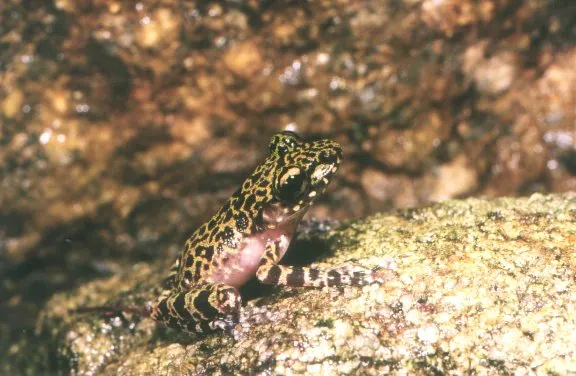
Endangered
Spinomantis brunae
Spinomantis brunae
Bruna's stream frog (Spinomantis brunae) is a small Madagascar frog known only from the Anosy Mountains in the southeast, including Andohahela National Park. The IUCN Red List assessed it as Endangered in 2016 because its forest home is shrinking. Females have never been described.
How to recognise it
Only males are known to science. They measure about 32 to 35 mm from snout to vent. The back is olive green with a net-like pattern of dark brown spots, the flanks carry white spots, and each finger and toe has enlarged, triangular disks with a pair of white spots. The iris is creamy white and the eardrum is easy to see.
The species was described in 1998 by Andreone, Glaw, Vences and Vallan, originally in the genus Mantidactylus. It now sits in Spinomantis, within the family Mantellidae.
Where it lives
The frog is endemic to Madagascar and lives in the Anosy Mountains of the southeast. It is also reported from Andohahela National Park. The IUCN records it from one to five locations, with an extent of occurrence of about 1,883 square kilometres.
The IUCN gives an elevation range of 300 to 600 m. The habitats it lists are moist lowland forest, rocky areas, and permanent streams.
Pins are Wikidata “endemic to” fields. Orange dots, when present, are GBIF occurrence tiles — survey bias included.
How it lives
The frog is reportedly a species of undisturbed forest that hides in crevices among boulders, usually close to flowing water. The breeding habitat is unknown, though flowing water is suspected. One male was recorded calling from a branch about half a metre above the ground beside a small stream. It is described as locally moderately common.
Why it is in trouble
The IUCN records a decreasing trend and a continuing decline in the area of habitat. Its threat list is dominated by farming: small-holder farming and grazing, shifting agriculture, and housing and urban expansion. One account also gives logging as a threat. All of these remove or degrade the forest the frog depends on.
What is being done
The frog occurs in at least one protected area, Andohahela National Park. The conservation actions the IUCN lists are site and area protection, site management, and protection of resources and habitat.
Sources
Written for this catalog in our own words from the sources below, checked against them on 12 November 2026. Population figures are estimates and carry the year they were made. Status and assessment year: IUCN. 2026. The IUCN Red List of Threatened Species. Version 2026-1. iucnredlist.org.




