Endangered
Smoothtooth blacktip shark
Carcharhinus leiodon
The smoothtooth blacktip shark is a stocky, greenish requiem shark of the Arabian seas, with confirmed catches from Kuwait and eastern Yemen. The IUCN lists it as Endangered (2017 assessment). Its smooth-edged teeth set it apart, and for over a century science knew it from a single museum specimen.
How to recognise it
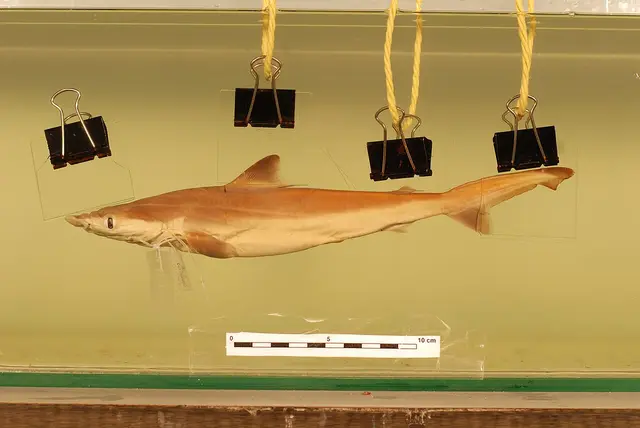
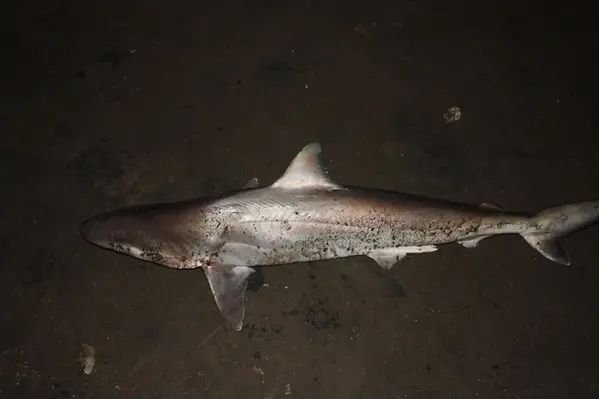
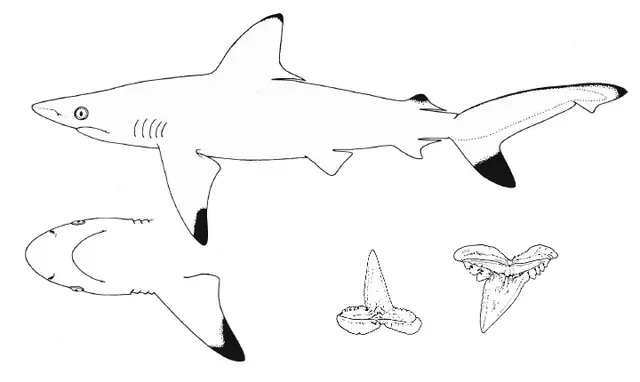
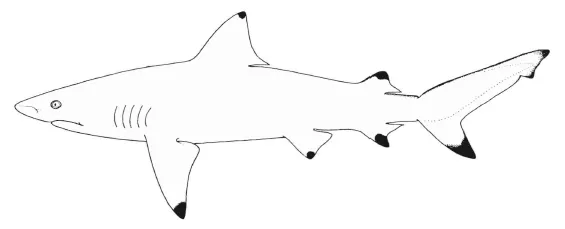
It is a heavy-bodied shark with a short, blunt snout. Fresh specimens from Kuwait were greyish green to greenish yellow on the back and paler below. All the fins have blackish tips, and a broad dark stripe crosses the back between the second dorsal fin and the tail.
The teeth are the giveaway. They are narrow, with smooth-edged cusps, which is how the species got its name. The largest Kuwaiti specimens measured in a 2011 study were about 1.24 m long, and the Red List gives a maximum of 165 cm. It looks a lot like the blacktip, the spottail and the graceful shark, and the Red List assessment says it has probably been confused with them across its range.
A shark rediscovered
Jack Garrick described the species in 1985 from one young male, about 75 cm long, collected in 1902 and held in a Vienna museum. The label gave the place as Gischin, which researchers later concluded means Qishn, on the Gulf of Aden coast of Yemen.
Nothing more turned up for more than a century. In April 2008 a survey of fish markets in Kuwait found 25 of them among roughly 1,200 sharks recorded at the Sharq and Fahaheel markets, about 2 per cent. Comparison with the Vienna specimen and mitochondrial DNA confirmed the identity. Surveys of markets in Qatar (2009) and Abu Dhabi (2010) found none.
Where it lives
The Red List treats it as endemic to the Arabian seas, with records from the Gulf (United Arab Emirates, Kuwait, Bahrain), the Sea of Oman and the Arabian Sea (Oman and Yemen). It cites later confirmed records across the Gulf and in Oman as well. It is a marine fish of shallow, sandy-mud sea floor, from the surface down to about 40 m.
The two original sites are about 3,000 km apart and look very different. The Gulf of Aden coast has a narrow shelf and deep water offshore. The northwestern Persian Gulf is shallow and takes in fresh water from the Tigris and Euphrates. Despite the wide spread of records, the assessment calls the species rare and localised.
Pins are Wikidata “endemic to” fields. Orange dots, when present, are GBIF occurrence tiles — survey bias included.
How it lives
Very little is known. Stomachs of two fresh Kuwaiti specimens each held a marine catfish, and it probably takes other small bony fish. Like other requiem sharks it gives birth to live young, nourished through a placental link. The Red List reports litters of 4 to 6 embryos, with evidence of spring births in the northwestern Gulf, and females mature at 131 cm or more.
Males in the 2011 sample were juvenile up to about 89 cm and adult at about 1.23 m, so maturity probably comes somewhere between. No ageing data exist. The Red List estimates generation length at 8.25 years, borrowed from the spottail shark, a similar-sized relative.
Why it is in trouble
Everything known about it comes from fishery catches. The Kuwaiti sharks were probably taken in gillnets set from small boats near shore, and most were small. The Red List expects the shark to be caught in inshore gillnet, line and trawl fisheries, and names fishing for food, oil spills, oil and gas drilling and coastal housing development as threats. Near Kuwait, dredging, reclamation and changes to river flow add to the pressure.
No population count exists. The 2017 assessment infers past declines of 50 to 80 per cent over about 25 years from the fall in similar shark species in the region and from heavy shark fishing in southern Oman and eastern Yemen. It suspects a further decline to 2042. The species has not been recorded in Yemen since 1902, so its status there is uncertain. The 2011 study suggested the Kuwaiti population could be Critically Endangered if the species is truly absent from Yemen.
What is being done
There are no measures aimed at this species. Some countries in the region have banned targeted shark fishing (Kuwait and Saudi Arabia), and the UAE, Qatar and Oman have banned trawling in their waters. Gillnets still catch sharks incidentally, and the Red List says some trade in the fins and meat of this species continues.
The assessment calls for research on distribution, numbers and trends, better fisheries monitoring, well-run marine protected areas and education for fishers on bycatch.
Sources
Written for this catalog in our own words from the sources below, checked against them on 12 November 2026. Population figures are estimates and carry the year they were made. Status and assessment year: IUCN. 2026. The IUCN Red List of Threatened Species. Version 2026-1. iucnredlist.org.