Critically Endangered
Pacific smalltail shark
Carcharhinus cerdale
The Pacific smalltail shark (Carcharhinus cerdale) is a slender, light-brown requiem shark of muddy inshore waters and estuaries in the eastern Pacific, from the Gulf of California to Peru. The IUCN Red List rated it Critically Endangered in 2020, mainly because of fishing pressure.
How to recognise it
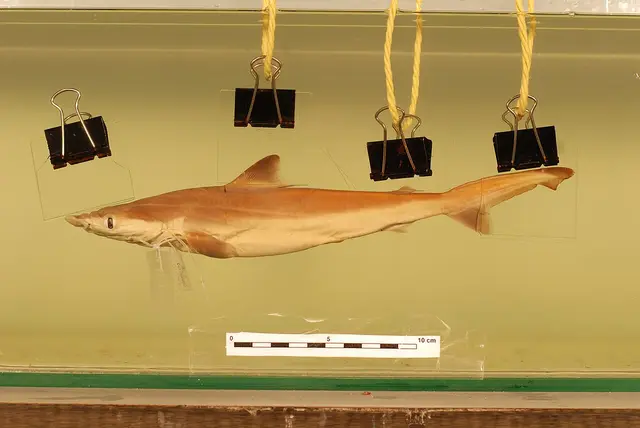
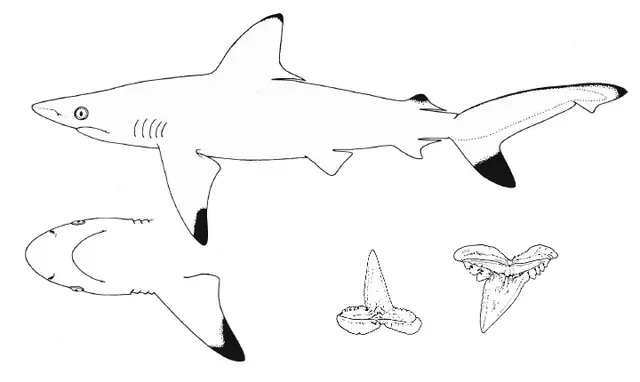
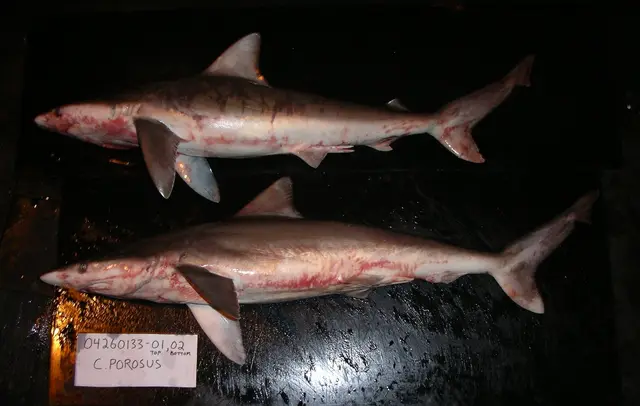
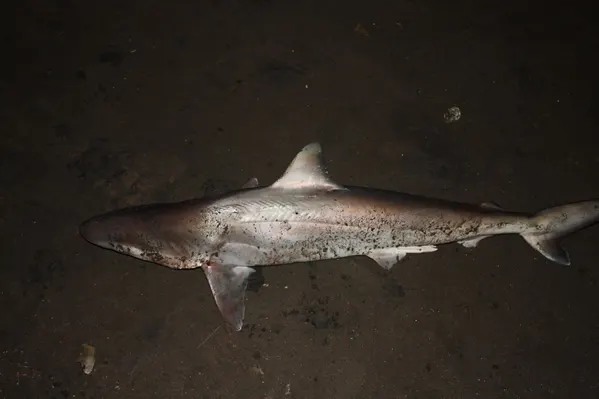
It's a small, slender shark with a long, pointed snout and large eyes. The back and sides are grey to light brown and the belly is white. The fins usually have dark or dusky edges, and the second dorsal fin sits over or behind the middle of the anal fin base. The back is smooth, though some specimens have a weak ridge between the dorsal fins. Five gill slits sit in front of the pectoral fins.
Adults reach about 140 cm. Newborns have a black border on the tail fin and a wide white rear edge on the pectoral fins.
A species rediscovered on paper
Charles Gilbert described the shark in 1898 and recorded it as abundant at Panama. It was later merged into the Atlantic smalltail shark (Carcharhinus porosus) and stayed hidden inside that species for about six decades. A 2011 paper by Castro brought the name back as a separate Pacific species.
Not much is known about it, and published detail on its biology is thin.
Where it lives
The IUCN assessment lists ten countries: Mexico, Guatemala, El Salvador, Honduras, Nicaragua, Costa Rica, Panama, Colombia, Ecuador and Peru. In Mexico it occurs in the Gulf of California and along the mainland coast, and it's absent from the Pacific side of Baja California.
It stays close to shore over mud and sandy mud, often entering shallow estuaries, at depths from the surface down to about 40 m.
Pins are Wikidata “endemic to” fields. Orange dots, when present, are GBIF occurrence tiles — survey bias included.
How it lives
It eats rays, bony fish, crustaceans and cephalopods, and some adults reportedly take young sharks. It is viviparous, and pups are born as miniature adults. Little has been published on its age, growth, lifespan, movements or breeding. The IUCN assessment gives a generation length of 9 years. No attacks on people have been recorded.
Why it is in trouble
Fishing is the threat. The assessment names ongoing, unintentional catch in both large-scale and small-scale fisheries, plus small-scale fishing that targets it, and it lists human food as a use. Each affects most of the population and drives slow but significant declines.
The 2020 assessment estimated a reduction of about 80 percent in the past, based on an abundance index, shrinking habitat quality and exploitation levels. It judged the causes understood and reversible, but not stopped. As of that assessment there was no species recovery plan, monitoring scheme or harvest management plan, and the shark was not covered by international trade controls. Needed actions include harvest and trade management, protected areas and national measures.
Sources
Written for this catalog in our own words from the sources below, checked against them on 12 November 2026. Population figures are estimates and carry the year they were made. Status and assessment year: IUCN. 2026. The IUCN Red List of Threatened Species. Version 2026-1. iucnredlist.org.