Critically Endangered
Siau Scops Owl
Otus siaoensis
The Siau scops owl (Otus siaoensis) is known from a single museum specimen collected in the 1860s, said to come from Siau, a small volcanic island north of Sulawesi in Indonesia. The IUCN assessed it as Critically Endangered in 2018. No living bird has been confirmed since, and a 2026 study doubts it is a valid species.
A single specimen
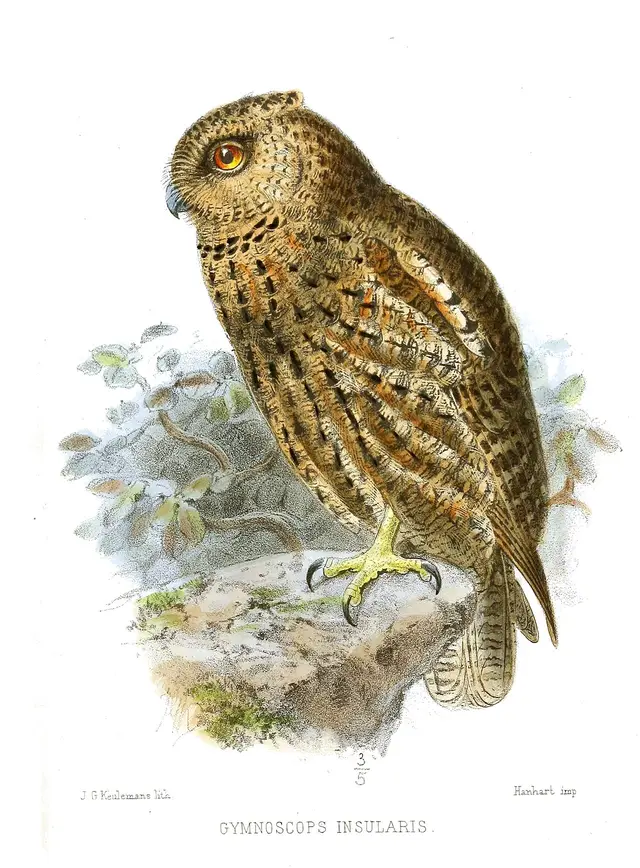
Everything known about this owl rests on one bird. A Dutch collector obtained it on a visit to Siau, and Hermann Schlegel described it as a species in 1873 on the strength of that single skin. It is held at the Naturalis Biodiversity Center in the Netherlands. Its call has never been recorded, and nobody can say what its voice, diet or nesting habits are. Older accounts date the collection to 1866, but a 2026 study gives 1865.
Where it belongs is also unsettled. The International Ornithologists' Union treats it as a distinct species, but other authorities place it as a subspecies of the Sulawesi or Moluccan scops owl. In 2026 Berryman and Eaton published a study in Ibis that re-examined the specimen, its museum records and 19th-century correspondence. They concluded that the skin's origin is doubtful, found no feature that separates it from neighbouring scops owls, and recommended that it no longer be recognised as a species and that no more searches be made for it.
Where it was said to live
Siau is a small island in North Sulawesi, about 20 km around, within the Wallacea biodiversity hotspot. Mount Karangetang, an active volcano on its north side, rises to about 1,827 metres. Much of the island's forest was cleared under Dutch colonial rule for clove, nutmeg and coconut plantations, and the forest that remains is in small patches.
The IUCN assessment lists the owl's habitat as moist lowland forest and heavily degraded former forest, with records up to 1,500 metres, and treats Siau as its single location.
Pins are Wikidata “endemic to” fields. Orange dots, when present, are GBIF occurrence tiles — survey bias included.
Searches and sightings
The last comprehensive survey of the island was in 1995, and it did not go above about 350 metres. A video of an owl in a building, made by a community member in 2017, divided experts, and no conclusion on its identity was reached at the time.
A search led by Burung Indonesia, with the island's forest management unit and a local guide, was planned for three forest areas between 600 and 800 metres, using spotlights, recorded calls of related owls and thermal imaging scopes. Proof would need a photograph or an unmistakable sound recording. Heavy rain was a concern, and no confirmed record has been announced.
Why it is in trouble, and what is being done
The IUCN's Critically Endangered listing (criterion D, a very small population) rests on an estimate of 1 to 49 mature individuals, if any remain. The assessment lists small-scale harvesting of forest products as a threat, and records no recovery plan, no monitoring scheme and no protected area. The only conservation action listed is species recovery, in the form of search work.
The owl is one of the ten most wanted birds in the Search for Lost Birds, a partnership of American Bird Conservancy, BirdLife International and Re:wild launched in 2021. Siau is also an Important Bird Area and an Alliance for Zero Extinction site.
Sources
Written for this catalog in our own words from the sources below, checked against them on 12 November 2026. Population figures are estimates and carry the year they were made. Status and assessment year: IUCN. 2026. The IUCN Red List of Threatened Species. Version 2026-1. iucnredlist.org.