Critically Endangered
Seychelles Scops Owl
Otus insularis
The Seychelles scops owl (Otus insularis), called the syer in Creole, is a small, rasping-voiced forest owl found only on Mahé in the Seychelles. The IUCN Red List rated it Critically Endangered in 2021, with a population estimated at 200 to 280 birds.
How to recognise it
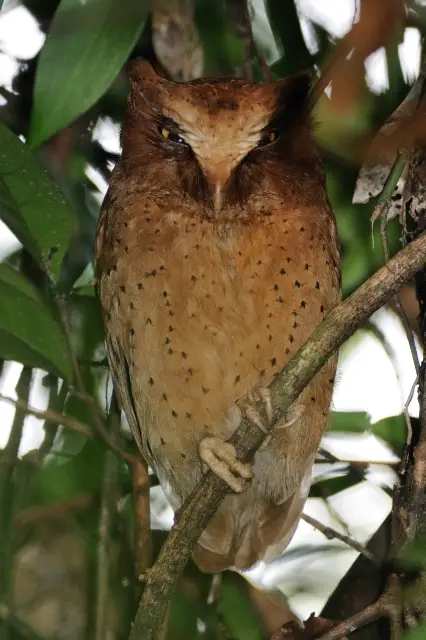
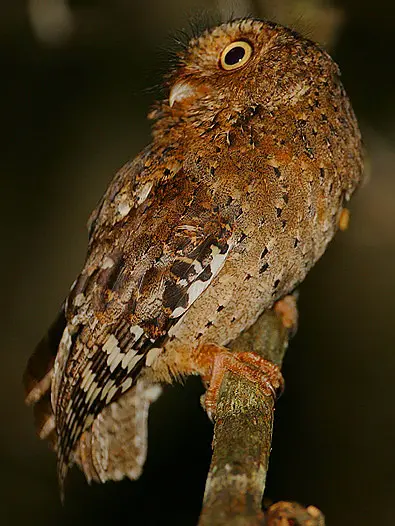
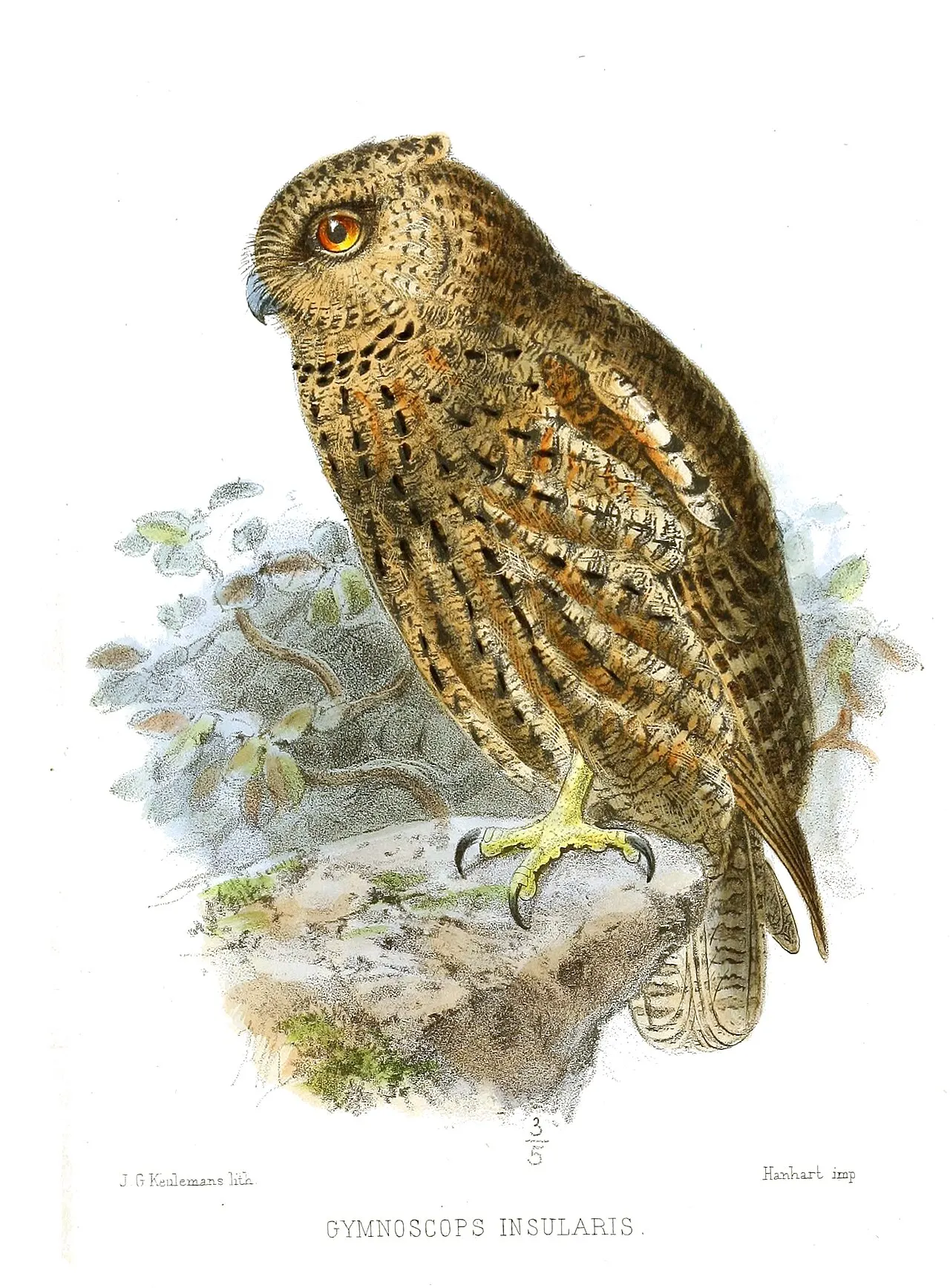
This is a small eared owl, about 20 cm long. The plumage is greyish brown, barred and streaked, with rufous colour on the underparts and around the face. The ear tufts are tiny, the eyes are large and bright yellow to orange-red, and the legs and toes are bare of feathers, which gives it its other name, the bare-legged scops owl.
It is easier to hear than to see. The call is a loud, far-carrying, rasping note repeated over and over, mixed with shorter 'tok' sounds. The best way to find one is by listening at dusk or dawn.
Where it lives
The owl is restricted to the island of Mahé. Tristram described it in 1880, and it reportedly once lived on Praslin and Silhouette too. Now it survives only in the hills of Mahé, mostly inside Morne Seychellois National Park. The Red List gives its elevation range as 100 to 700 m and its area of occupancy as about 84 square kilometres.
Its main habitat is moist tropical forest, though the Red List also records it in plantations and rural gardens. The whole population is treated as a single group at one location.
Pins are Wikidata “endemic to” fields. Orange dots, when present, are GBIF occurrence tiles — survey bias included.
How it lives
For decades almost nothing was known about its breeding. The owl was reportedly thought extinct by 1906 and was found again on Mahé in 1959. A study that began in April 1999, and ran to May 2001, recorded the first nest on record and found eight nests in all, in tree cavities 7 to 25 m up, each holding a single egg or chick.
Breeding seems to go on all year, with peaks around May and October. Incubation took three to four weeks and the young needed four to six weeks to fledge (measured at two nests). Success was low: two of eight nests produced young, about 0.5 fledglings per territory per year. The owl eats insects and spiders, and possibly frogs and small lizards.
Why it is in trouble
A population of 200 to 280 birds on one small island is vulnerable to almost anything. The Red List lists introduced species, storms and flooding, housing and urban development, recreational activity and habitat change among the threats, and records an ongoing decline in its area. Introduced rats, cats and barn owls are reportedly among the causes of its decline, and the breeding study suggested that alien predators may have limited nesting success.
Estimates have also shifted. Nature Seychelles quotes 249 to 300 birds, and one account gives about 318 in 2002. The newest range is lower, and the assessment says the population is still decreasing.
What is being done
Most of the owl's habitat lies inside Morne Seychellois National Park, where it is relatively protected, and the species is listed on CITES Appendix II. The Red List records that conservation sites have been identified across its whole range.
It also records gaps: no recovery plan, no systematic monitoring, no captive population and no control or prevention of invasive species. The needs it lists include site and habitat protection and management, habitat restoration, awareness work, and more research on population, ecology and threats.
Sources
Written for this catalog in our own words from the sources below, checked against them on 12 November 2026. Population figures are estimates and carry the year they were made. Status and assessment year: IUCN. 2026. The IUCN Red List of Threatened Species. Version 2026-1. iucnredlist.org.