Critically Endangered
Siamophryne
Siamophryne troglodytes
The Tenasserim cave frog (Siamophryne troglodytes) is a small brown frog known from a single limestone cave system in western Thailand. It was only described in 2018, and the IUCN Red List rated it Critically Endangered in 2021. Its tadpoles develop in small water-filled hollows in the cave floor.
How to recognise it
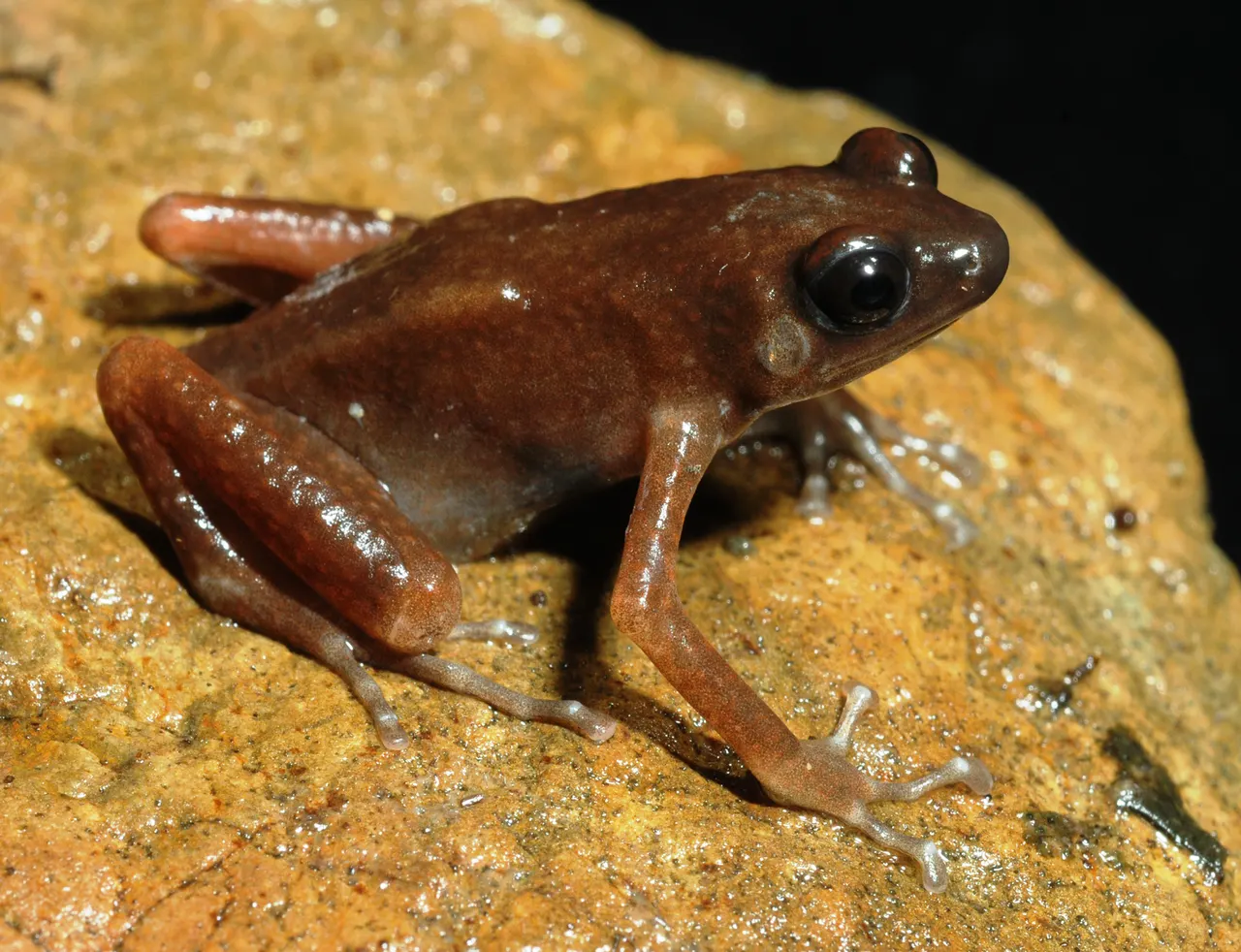
This is a small, slender frog with long limbs. In the original description, six males measured 19.1 to 24.9 mm from snout to vent and five females were larger, at 25.0 to 27.8 mm. The head and back of the holotype were chocolate brown in life, the limbs ochre-brown, and the throat and underside of the limbs a light orange-pink. The skin is smooth and the eyes are large and bulging.
The fingertips expand into broad discs, wider than the toe discs. The tadpoles are unusual. They are elongated and guitar-shaped, translucent in the cave, and a tadpole at stage 36 measured 35.1 mm in total length.
Where it lives
Only one place is known: a limestone cave system in Sai Yok District, Kanchanaburi Province, at about 440 m above sea level, set in tropical forest. The IUCN lists Myanmar among its countries, and the describers say nearby areas of Myanmar's Tanintharyi Division need fieldwork, but no record from there is cited. Searches in neighbouring limestone areas have not turned up another population, and the precise cave location has been kept private.
Surveys in 2016 (1 August and 27 October) found adults more than 25 m inside the cave, on walls, in small caverns and under flat stones, active around 23:00 to midnight in warm air (26 to 28 degrees C) at 100 percent humidity. Tadpoles came from water-filled hollows in the cave floor, one about 4 to 5 cm deep. The describers call the species cave-loving, and gravid females were collected, but no calling was heard on either visit.
Pins are Wikidata “endemic to” fields. Orange dots, when present, are GBIF occurrence tiles — survey bias included.
Where it fits
The frog belongs to the subfamily Asterophryinae, which is mostly Australasian. It is the only member with a documented free-living tadpole stage, and its presence on the Southeast Asian mainland extends the subfamily's known range. The 2018 analysis placed its closest relative as Gastrophrynoides, a genus of Sundaland. The species name means cave-dweller in Greek.
Why it is in trouble
Several bat species roost in the cave, and local people mine the guano that piles up on the floor. The describers reported illegal guano mining with explosives, which affects the cave ecosystem. Because the whole known population sits in one cave, a single bad episode could be enough to wipe it out. The IUCN 2021 assessment records the population as decreasing, with continuing loss of habitat, and lists mining and quarrying as the threat.
What is being done
The IUCN records that the species occurs in at least one protected area and names site protection as the conservation action needed. No population count exists, and no captive breeding is reported.
Sources
Written for this catalog in our own words from the sources below, checked against them on 12 November 2026. Population figures are estimates and carry the year they were made. Status and assessment year: IUCN. 2026. The IUCN Red List of Threatened Species. Version 2026-1. iucnredlist.org.




