Endangered
Seychelles house snake
Lamprophis geometricus
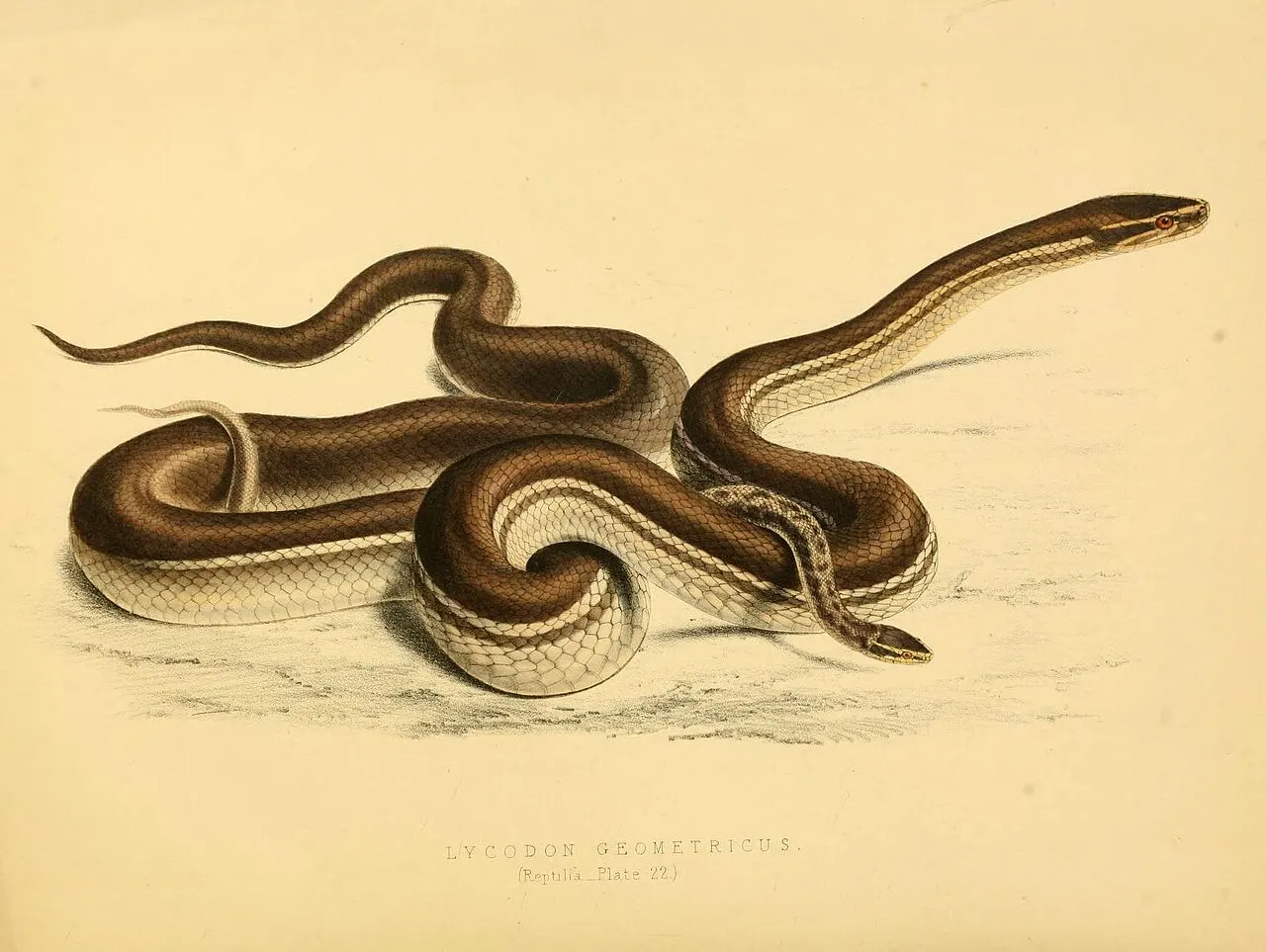
The Seychelles house snake is a brown, mostly nocturnal snake found only in the Seychelles. It lives in a handful of forest, scrub and plantation areas on the granitic islands. The IUCN Red List rated it Endangered in 2025, with a decreasing population. It is met far less often than the thin-bodied wolf snake.
How to recognise it
It's a mid-brown snake with darker stripes running along the body, and in good light it shows a purple sheen. Adults can reach about 1.2 metres, and the body is much thicker than that of the Seychelles wolf snake, the other snake you might meet on the granitic islands. The longest museum syntype measures 1,040 millimetres.
It can bite, but Nature Seychelles describes the bite as not dangerous. It lays eggs.
Where it lives
The snake is recorded from the main granitic island group of the Seychelles. La Digue is a recent addition: a first record from the island was reported in 2016, and a 2022 paper reported a further record confirming that it occurs there.
The IUCN counts five locations and gives an area of occupancy of 276 square kilometres, with records from sea level up to 430 metres. Habitats include moist lowland forest, dry forest and rural gardens. Despite its name, it isn't usually found around houses. Woodland, scrub and plantations suit it better.
Pins are Wikidata “endemic to” fields. Orange dots, when present, are GBIF occurrence tiles — survey bias included.
How it lives
It is mainly active at night, though people occasionally see one in the late afternoon. Little else has been published about its daily life, and there is no good account of what it eats.
Why it is in trouble
The Red List assessment (criteria B1ab(iii)+2ab(iii)) points to a small range that is still shrinking. The listed pressures are degradation of its forest habitat, persecution, and impacts from other species. The population trend is recorded as decreasing.
Its origin and name are also unsettled. An 1854 account gave the Cape of Good Hope as its home, and the Reptile Database describes the species' current name and status as unclear. Recent lists place it in Boaedon, while older ones use Lamprophis.
What is being done
The snake occurs in at least one protected area. The IUCN lists site protection and management, habitat protection, control of problem species and awareness work as the actions needed.
Sources
Written for this catalog in our own words from the sources below, checked against them on 12 November 2026. Population figures are estimates and carry the year they were made. Status and assessment year: IUCN. 2026. The IUCN Red List of Threatened Species. Version 2026-1. iucnredlist.org.




