Endangered
Seychelles Crow
Euploea mitra
The Seychelles crow (Euploea mitra) is a butterfly, not a bird. It belongs to the milkweed butterflies and lives only on two granitic islands of the Seychelles, Mahe and Silhouette. The IUCN Red List rates it Endangered, but that assessment dates from 1996, and little has been published about it since.
What it is
Despite the name, this is an insect. The Seychelles crow is a brush-footed butterfly (family Nymphalidae) in the subfamily Danainae, the milkweed butterflies. The genus Euploea is commonly called the crows, because many of its species are dark. It is largely Indo-Australian, and only two Euploea species live in the Afrotropical region. This is the Seychelles one. The other, Euploea euphon, lives on the Mascarene Islands.
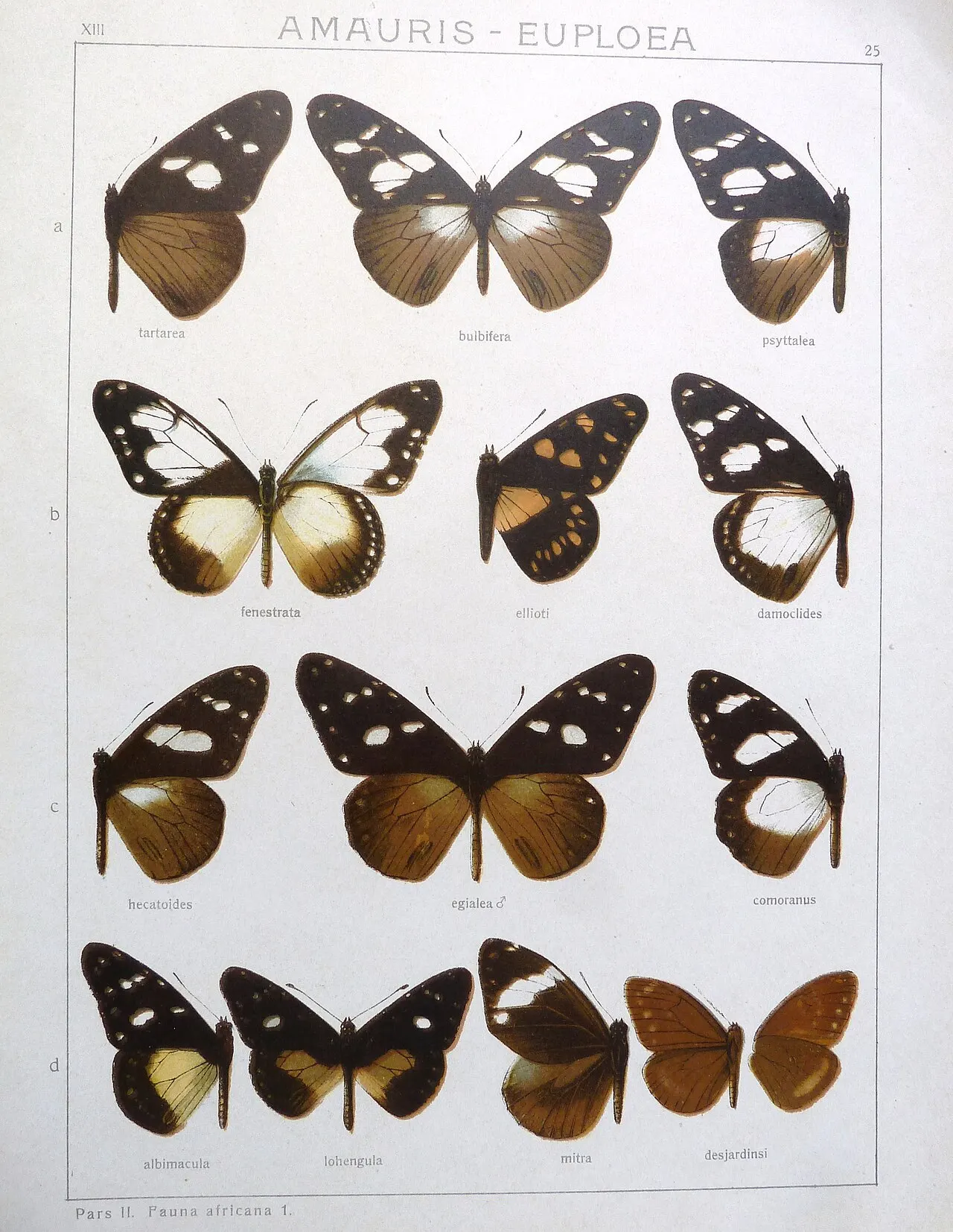
It was described by Frederic Moore in the 1850s. Catalogue dates differ, and GBIF gives 1858 while other references give 1857. A plate in Seitz's Fauna Africana labels it Amauris mitra, an older genus placement. The forewing has white cells, and measurements from published illustrations show its forewing is longer in proportion to the hindwing than in the Mascarene crows.
Where it lives
It is endemic to the Seychelles and confined to the granitic islands of Mahe and Silhouette. An old record from Aldabra is believed to be a mistake. A 2013 study of Marianne North's Seychelles paintings, which depict the butterfly, described it as apparently confined to the central ridge of Mahe.
A 2022 conservation profile for the region lists the butterfly among the invertebrates tied to Morne Seychellois National Park on Mahe. The Red List gives no habitat details, elevation or number of locations for it, and its caterpillar food plant is not documented.
Pins are Wikidata “endemic to” fields. Orange dots, when present, are GBIF occurrence tiles — survey bias included.
A puzzle in the records
Another butterfly name, Euploea rogeri, has long been linked to the Seychelles. It is known only from two paintings published in 1837, and the specimen behind them is lost. Some authors have treated it as an odd form of the Seychelles crow.
A 2009 comparison of wing proportions in the illustrations found that rogeri's ratio is close to that of the Mascarene crows and quite different from the Seychelles crow's, so it is unlikely to be a mere aberration of it. Its true identity remains open, and without the original specimen it may never be settled.
How it is doing
The Red List lists the butterfly as Endangered under criteria B1+2c, based on a 1996 assessment by the Lepidoptera Specialist Group. The assessment record gives no population trend, threats or conservation actions, and no recent survey figures are published. A 2022 conservation planning profile for Madagascar and the Indian Ocean islands still names it among the threatened Seychelles invertebrates.
Sources
Written for this catalog in our own words from the sources below, checked against them on 12 November 2026. Population figures are estimates and carry the year they were made. Status and assessment year: IUCN. 2026. The IUCN Red List of Threatened Species. Version 2026-1. iucnredlist.org.