Critically Endangered
Scriptaphyosemion schmitti
Scriptaphyosemion schmitti
Scriptaphyosemion schmitti is a slender killifish from small forest streams in eastern Liberia, described by Romand in 1979. The IUCN Red List rated it Critically Endangered in 2020 because it occurs at a single location where stream habitat is declining. It is kept by killifish hobbyists, which is part of why it survives in captivity.
How to recognise it
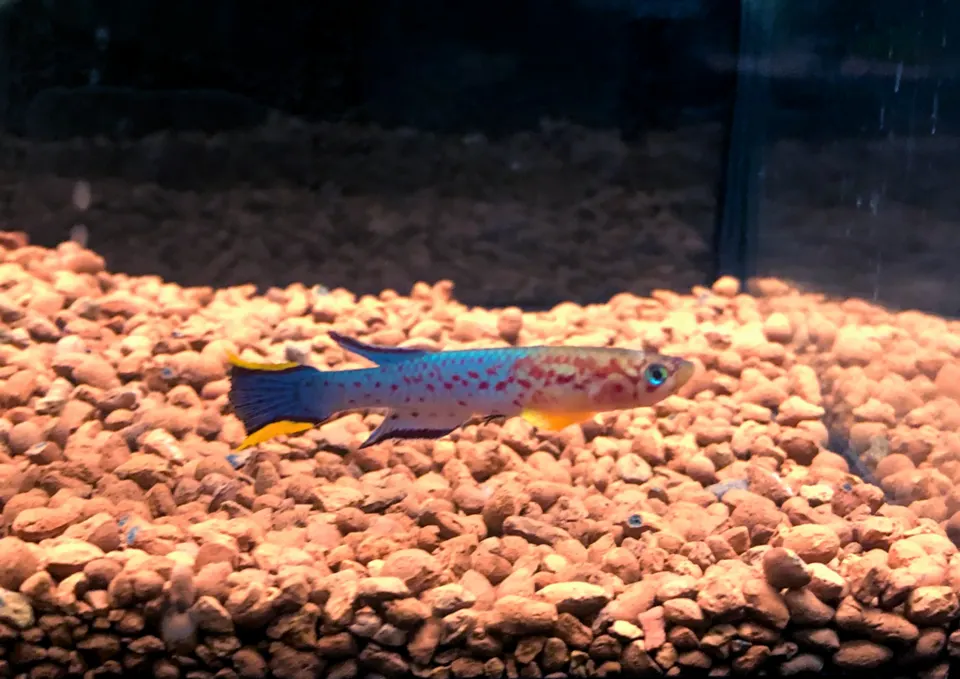
Males are slim, elongated fish with a metallic golden-blue body marked by red dots in four horizontal rows. The head is brown with an orange-yellow tint that is stronger in wild fish, the back is orange and the iris is gold. The tail has two yellow bands along its edge and two burgundy lines just inside them.
Females are also slender but plainer, brown with small red dots along the side. A French killifish club puts adult males at about 6 to 8 cm and gives no size for females.
Where it lives
The species is native to eastern Liberia, in dense forest between the Cavally, Nipoue and Cess rivers. Known collecting sites are Greenville, Juarzon and Tchien, and fish from all three look the same. It is named for Gerard Schmitt, who found it in 1977 with Dr. Romand. It was first described as Roloffia schmitti.
It lives in narrow, slow, clear streams. The water is slightly amber, very soft, with a pH near 6 and a temperature around 24 C. Its southern limit is about 20 km inland from the coast, where other killifish take over the coastal waters. Near Tchien in the north it is replaced by another killifish, Scriptaphyosemion viridis.
Pins are Wikidata “endemic to” fields. Orange dots, when present, are GBIF occurrence tiles — survey bias included.
How it lives
It stays near the bottom in shallow water close to the banks, over dark, root-filled laterite. Populations are patchy, with groups of several dozen fish spaced apart, and a surface-dwelling killifish, Epiplatys olbrechtsi, shares the same streams.
In aquariums the eggs are sticky, about 1.1 to 1.2 mm across, and take roughly three weeks to hatch in damp peat. Fry grow slowly, needing about three months to reach 2 cm, and siblings hatched on the same day can differ in size by up to double. A breeder writing for the club recommends keeping more females than males.
Why it is in trouble
The IUCN assessment lists small-holder farming and sewage as ongoing threats, each rated low impact. It treats the species as occurring at a single location, with an estimated area of occupancy of 4 square km, and records ongoing decline in habitat area. Whether the fish themselves are increasing or decreasing is unknown.
Records are few. The Global Biodiversity Information Facility holds only 16 for the species. Nine are preserved specimens, the dated ones from Juarzon and Zwedru in 1977 and 1978. Three 2021 observations logged by naturalists, placed only to within about 30 km near Liberia's south-east coast, suggest it was still being found.
What is being done
The only conservation action the IUCN records is awareness and communication. No protected area, monitoring scheme or recovery plan is listed. The fish survive in captivity thanks to hobbyists: the Juarzon strain has been a regular lot at British Killifish Association auctions, and one breeder rated its quality as excellent.
Sources
Written for this catalog in our own words from the sources below, checked against them on 12 November 2026. Population figures are estimates and carry the year they were made. Status and assessment year: IUCN. 2026. The IUCN Red List of Threatened Species. Version 2026-1. iucnredlist.org.



