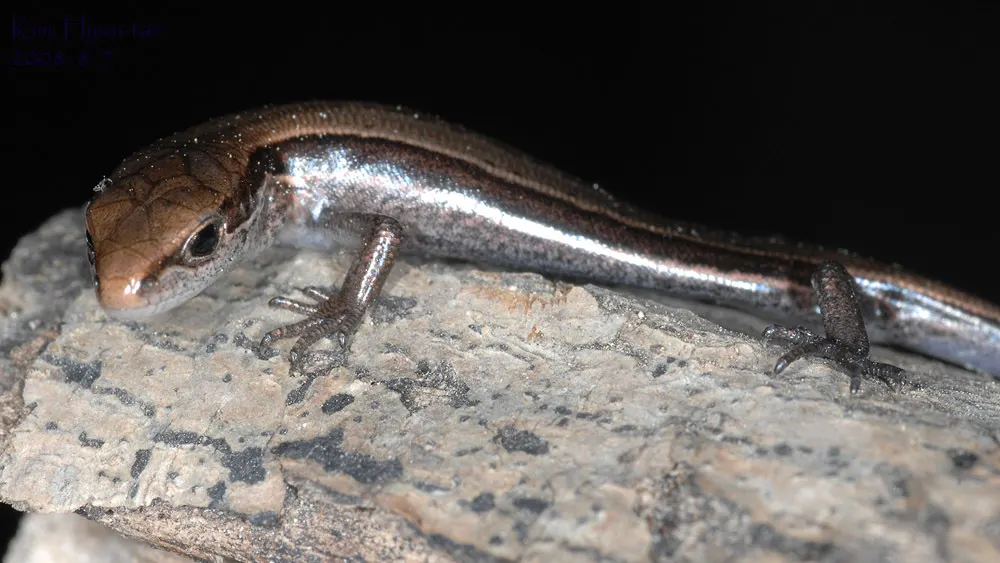
Critically Endangered
Huaren Ground Skink
Scincella huanrenensis
The Huanren ground skink (Scincella huanrenensis) is a small forest skink of north-east China and the Korean peninsula. The IUCN's 2019 assessment lists it as Critically Endangered, but a 2021 study argues that its true range is far larger than the assessment assumed, so its global status is contested.
How to recognise it
It is a small, ground-dwelling skink in the family Scincidae. It looks much like two relatives, Scincella tsinlingensis and S. vandenburghi, and is separated from them mainly by details of its scales. Like Scincella reevesii, but unlike most other East Asian Scincella skinks, it gives birth to live young rather than laying eggs.
Zhao and Huang described the species in 1982 from Huanren County in Liaoning Province, the source of its name. The original description rests on 66 specimens from that area, including a holotype adult male held at the Dalian Museum of Natural History.
Where it lives
The skink occurs in Liaoning in north-east China and on the Korean peninsula, mostly in mid-elevation mountains. In South Korea it is recorded chiefly in the eastern mountains. Its habitat includes valleys, rocky outcrops, small farm fields next to forest, mountain trails and mid-elevation basins.
The IUCN assessment lists it from a single locality in Huanren County, Liaoning, at 590 to 700 m above sea level, and describes it as living in stone piles near rocky hills. A South Korean study cited in 2021 gave an average elevation of about 620 m. Modelling in the same 2021 paper put the most suitable habitat between 400 and 1,500 m.
Pins are Wikidata “endemic to” fields. Orange dots, when present, are GBIF occurrence tiles — survey bias included.
How it lives
It lives close to the ground and uses rocks, fallen logs and leaf litter as its main shelter. Females bear live young. Litter size differs between regions in the published records: two to five young in China, four to five in North Korea and five to ten in South Korea.
The IUCN calls the species quite rare. Its secretive nature and the little that has been written about its daily habits make it hard to survey.
Why it is in trouble
The IUCN assessment lists the species as decreasing and as known from a single location, and records harvesting of the animal itself as the threat. Its account says the skink is used in traditional Chinese medicine and links the observed decline to overharvesting. The assessment gives a very small range of 50 to 99 square kilometres, which is why it qualifies as Critically Endangered under range-size criterion B1ab(v).
A 2021 paper in the journal Conservation by Yucheol Shin and colleagues reached a different conclusion. Mapping 40 occurrence points and modelling suitable habitat, they estimated a range of roughly 26,700 to 87,600 square kilometres across China and Korea, too large to qualify as threatened worldwide. They still described a marked decline from forest loss and said the 2019 listing fits the Chinese populations, which they called threatened with extinction. South Korea lists the species as Near Threatened.
No vouchered specimen from North Korea is available, so the true range remains uncertain.
What is being done
The IUCN assessment lists site and area protection, site management and harvest management as needed actions, and records the species as not known from a protected area. It notes that the skink appears on China's national list of terrestrial wild animals of economic or scientific value under the wildlife protection law.
Shin and colleagues, using a protected-area database, reported that it occurs in several protected areas, including Odaesan National Park in South Korea, Mount Kumgang National Park in North Korea and Dayahe Drifting Scenic Area in China. They recommended field surveys to pin down the real range and protecting forest between 400 and 1,500 m, and called for international teams to carry out assessments of a species that spans borders.
Sources
Written for this catalog in our own words from the sources below, checked against them on 12 November 2026. Population figures are estimates and carry the year they were made. Status and assessment year: IUCN. 2026. The IUCN Red List of Threatened Species. Version 2026-1. iucnredlist.org.




