Critically Endangered
Smith's Dwarf Burrowing Skink
Scelotes inornatus
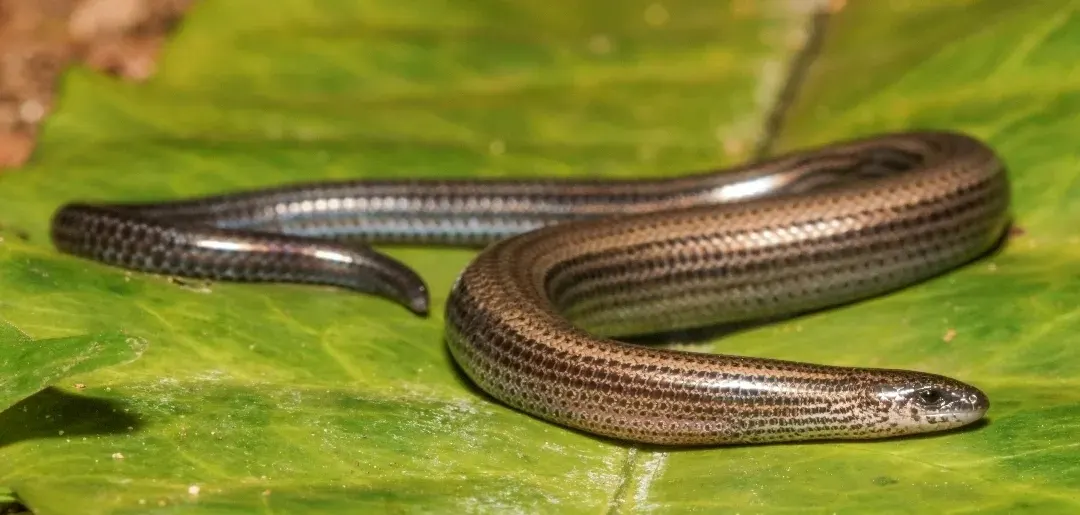
The Durban dwarf burrowing skink (Scelotes inornatus) is a legless, glossy lizard that rarely exceeds 9 cm without its tail and spends nearly all its life underground, in a narrow coastal strip of KwaZulu-Natal around Durban. The IUCN Red List rated it Critically Endangered in 2022, and its remaining habitat is split into small, scattered fragments.
How to recognise it
Its scientific name refers to a plain, unornamented lizard, and it lives up to it. The body is cylindrical, covered in smooth, glossy scales, drab in colour, with no legs at all. It seldom exceeds 9 cm in length, not counting the tail, and it sheds its skin regularly.
Spotting one is the hard part, because it spends virtually its whole life beneath the soil surface and does not travel far. Pitfall arrays work poorly for it, and the Endangered Wildlife Trust notes that tags and marks are no use on an animal this small that sheds its skin.
Where it lives
The skink is limited to the greater Durban area, a coastal strip described as about 2 by 50 km. Records run from the Durban harbour area in the north to Scottburgh in the south, and inland as far as Woodlands and Montclair. A population north of the harbour at Stamford Hill is considered locally extinct. Published records from both banks of the Umgeni River are judged incorrect, since no specimens exist and they probably refer to another skink, Scelotes mossambicus.
It is a specialist of loose coastal soils, living in coastal forest on Berea Red Sand below 70 m and within 4 km of the sea. The assessment counts 11 locations, and the surviving habitat is a scatter of ten fragments between 0.01 and 1.7 square km, about 5 square km in all. Treasure Beach and Bluff Nature Reserve in Durban are protected sites where it occurs. In a 2021 survey of both, skinks turned up at forest edges and in the grassy side of the forest and grassland boundary, and none were caught inside the forest.
Pins are Wikidata “endemic to” fields. Orange dots, when present, are GBIF occurrence tiles — survey bias included.
How many there are
Nobody has a population figure. The 2021 survey used 12 sites and several trapping methods and recorded only seven skinks. It was the fifth most commonly caught of ten reptile and amphibian species. Since an Endangered Wildlife Trust project began in August 2024, nearly 40 new records were added in the first two months, including some from two protected areas where the species was not known before.
The assessment describes severely fragmented subpopulations and a continuing decline. Its estimated extent of occurrence has shrunk from about 280 square km historically to 133 in 1990 and 99 today, and natural land cover within its range fell by 14 percent between 1990 and 2013.
Why it is in trouble
Durban's coast has been heavily built over. Roads, housing, industry and farmland have destroyed and fragmented the habitat, and the assessment expects fragmentation to continue as the coast urbanises. The Endangered Wildlife Trust says most of the skink's natural ground has been transformed beyond rehabilitation and names habitat loss as the main threat. Secondary threats are severe fragmentation, domestic and feral cats and dogs, plastic pollution and invasive alien plants.
What is being done
The Endangered Wildlife Trust launched a project in August 2024 at Treasure Beach with the Mohamed bin Zayed Species Conservation Fund, eThekwini Municipality, Johannesburg Zoo, Wits University and Ezemvelo KZN Wildlife. Planned work includes clearing alien plants and rubbish, securing the Treasure Beach population and setting up long-term monitoring.
After the 2021 survey, five skinks were added to an insurance and breeding population at Johannesburg Zoo. The survey's abstract says none of the sampling methods suits long-term monitoring and suggests testing terracotta cover tiles instead. The Red List assessment calls for urgent protection of the remaining habitat patches.
Sources
Written for this catalog in our own words from the sources below, checked against them on 12 November 2026. Population figures are estimates and carry the year they were made. Status and assessment year: IUCN. 2026. The IUCN Red List of Threatened Species. Version 2026-1. iucnredlist.org.




