Endangered
Oily Gudgeon
Sarcocheilichthys biwaensis
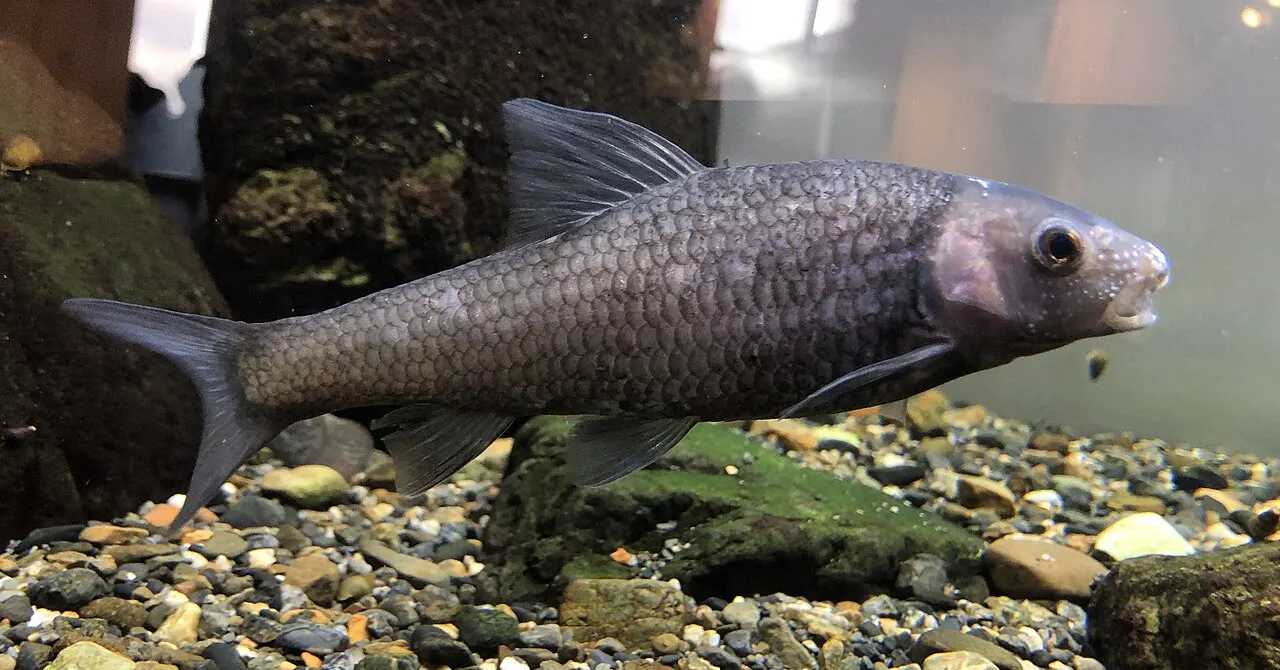
The Biwa gudgeon, also called the oily gudgeon (Sarcocheilichthys biwaensis), is a small freshwater fish found only in Lake Biwa, Japan's largest lake. It lives around rocky shores. The IUCN Red List rated it Endangered in 2019 and records its population as decreasing, with two introduced fish among the named threats.
How to recognise it
This is a member of the gudgeon family (Gobionidae), described to science in 1982 by Kazumi Hosoya. It has a brownish body and fins, which is the main visible difference from its closest relative in the lake, Sarcocheilichthys variegatus microoculus, a grayish fish.
The two are hard to separate genetically. A 2011 PLOS ONE study by Komiya, Fujita and Watanabe found no clear DNA differences and called the Biwa gudgeon a genetically indefinable form. It raised several possibilities: a recently diverged form, a colour variant adapted to rocky areas, or a form blurred by hybridisation. Both fishes have coarse gill rakers, a trait linked to feeding on the bottom.
Where it lives
It is endemic to Lake Biwa, in Shiga Prefecture on Honshu. The same PLOS ONE study describes it as a rock-dwelling specialist that strictly inhabits areas in and around rocky zones of the lake. FishBase classes it as a freshwater fish of the bottom and middle water layers.
The IUCN assessment records just two locations and two subpopulations, with an area of occupancy of about 80 and an extent of occurrence of about 230 (square kilometres, presumably). Both numbers are small for a species that depends on a single lake.
Pins are Wikidata “endemic to” fields. Orange dots, when present, are GBIF occurrence tiles — survey bias included.
Why it is in trouble
The IUCN names two introduced North American fish as ongoing threats, the bluegill (Lepomis macrochirus) and the largemouth bass (Micropterus salmoides). It scores each as low impact. It also lists accidental mortality from small-scale fishing, such as bycatch, as an ongoing threat.
No total population figure has been published. The assessment records a continuing decline in the number of mature individuals, but it does not give a rate.
What is being done
The IUCN records that some stock is held in ex-situ conservation, meaning outside the wild. It calls for invasive species control, site and habitat protection and captive breeding.
It also records that no recovery plan and no systematic monitoring scheme are in place, so the size and trend of the wild population are poorly tracked.
Sources
Written for this catalog in our own words from the sources below, checked against them on 12 November 2026. Population figures are estimates and carry the year they were made. Status and assessment year: IUCN. 2026. The IUCN Red List of Threatened Species. Version 2026-1. iucnredlist.org.




