Critically Endangered
Sarada superba
Sarada superba
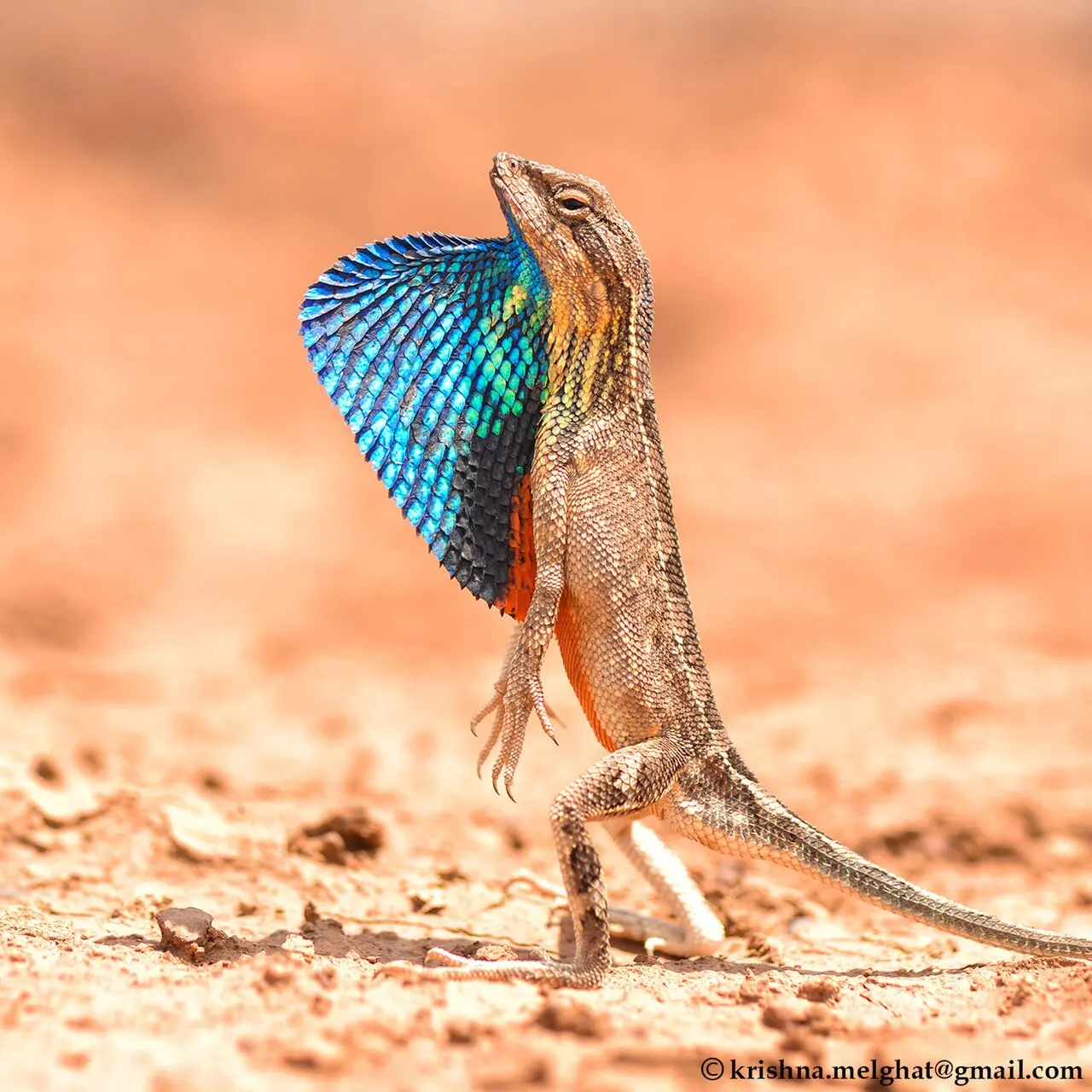
The superb large fan-throated lizard (Sarada superba) is a plateau-dwelling agamid known from a single place, the Chalkewadi plateau in Maharashtra, India. It was only described in 2016. The Red List rated it Critically Endangered in 2021 because its known range covers roughly 11 square km.
How to recognise it
Sarada superba belongs to Sarada, a genus of three fan-throated agamids whose males carry very large throat fans, or dewlaps. It is the largest member of the genus, and the fan and bright breeding colours are what the species name celebrates. Of its two relatives, S. deccanensis and S. darwini, it is told apart mainly by relatively short feet.
Before 2016 it was reportedly grouped with the Sitana ponticeriana complex. A revision of fan-throated lizards in Contributions to Zoology split that group up and gave this lineage its own genus. The species name comes from the Latin superbus, meaning magnificent.
Where it lives
Only one place is known. The type locality is Chalkewadi in Satara District, at about 1,100 to 1,300 m. The Red List counts a single location and an extent of occurrence of about 11 square km. Other lizards in the genus live elsewhere in Maharashtra and northern Karnataka, but this species has not been recorded beyond the Satara plateau.
It lives on the lateritic plateau, a high, flat habitat of exposed rock, using cracks in the hard red substrate.
Pins are Wikidata “endemic to” fields. Orange dots, when present, are GBIF occurrence tiles — survey bias included.
How it lives
Little has been published on its daily life. The species lays eggs. One female examined for the original description held a clutch of 15 well-developed eggs, and hatchlings measuring 23 to 30 mm from snout to vent were seen at the type locality on 25 October 2013.
The plateau has one of the region's largest and longest-running wind farms, and this lizard became the subject of a 2018 study there led by Maria Thaker of the Indian Institute of Science, published in Nature Ecology and Evolution. Researchers counted almost four times more predatory birds in turbine-free areas than around the turbines. Lizards near the turbines were more numerous, had lower stress hormone levels and let people approach closer before fleeing. The team attributed this to fewer bird attacks near the turbines. Adding or removing a top predator can have wide effects on an ecosystem, and wind energy is known to disturb birds.
Why it is in trouble
The danger comes from having so little room. With one location, a single change in land use could affect the whole population. The Red List names large-scale farming and renewable energy development as threats, though their scope and severity are listed as unknown. It records a continuing decline in the area the species occupies, while giving the overall population trend as stable.
According to the Red List, the lizard's known range is not inside a protected area.
What is being done
The assessment calls for protection and management of the site, and for research into threats and population trends. No recovery programme is recorded. Beyond the original description and the wind farm study, little is published on how many of these lizards there are, so basic counts are still missing.
Sources
Written for this catalog in our own words from the sources below, checked against them on 12 November 2026. Population figures are estimates and carry the year they were made. Status and assessment year: IUCN. 2026. The IUCN Red List of Threatened Species. Version 2026-1. iucnredlist.org.




