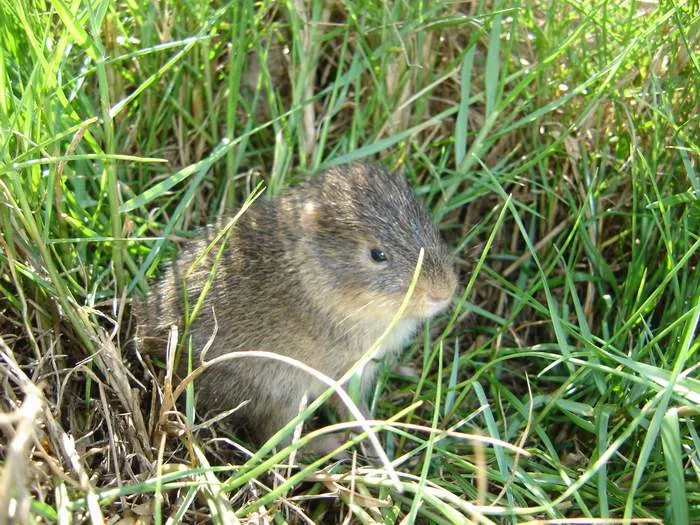
Critically Endangered
Santa Catarina's guinea pig
Cavia intermedia
Santa Catarina's guinea pig (Cavia intermedia), also called the Moleques do Sul cavy, lives on a single tiny island off southern Brazil. Its whole range is only a few hectares, among the smallest known for any mammal. The IUCN Red List entry published in 2025 classes it as Critically Endangered, with a decreasing trend.
How to recognise it
It's a wild cavy, a member of the same family as the pet guinea pig, with coarse, long fur (longest on the neck), bare ears and no visible tail. Body length is given as roughly 20 to 40 cm. Unlike most cavies, males and females look alike, with males not noticeably larger.
The species was only described in 1999, which makes it a very recent addition to the scientific record.
Where it lives
It occurs only in the Moleques do Sul archipelago, off the coast of Santa Catarina state in southern Brazil. The archipelago has three islands totalling about 10.5 hectares, and the cavy lives on the largest, which covers about 9.9 hectares. The IUCN puts its extent of occurrence at 0.04 square km (about 4 hectares) and its area of occupancy at 0.105 square km.
Habitat is temperate grassland, which the IUCN lists as of major importance, along with shrubland. The animals graze mainly on grasses.
Pins are Wikidata “endemic to” fields. Orange dots, when present, are GBIF occurrence tiles — survey bias included.
How it lives
The cavy probably split from the larger Cavia magna of the nearby mainland about 8,000 years ago, when rising seas cut the archipelago off. Island life seems to have shaped it. Compared with mainland relatives it reportedly survives well, keeps a small home range and breeds slowly.
Breeding reportedly happens year-round, with a gestation of about 60 days and one or two young per litter.
Why it is in trouble
Numbers are the problem. Surveys in 2004 to 2005 estimated fewer than 50 animals, an average of 42 is the figure usually cited, and the IUCN uses a population size of 24 to 60. With everything on one island, a single fire, disease or visit by people could do serious damage.
The IUCN lists three ongoing threats, each rated low impact: hunting for food, recreational activities and other work activities on the island. Conservationists also point to fire, poaching and illegal overnight stays by fishermen. A 2015 parasite study in the International Journal for Parasitology: Parasites and Wildlife warned that exotic or migratory animals could bring in parasites.
What is being done
The island lies within a protected area, Serra do Tabuleiro State Park. A species action plan prioritises monitoring, curbing illegal use of the island and raising awareness, and the IUCN lists site management and awareness work among its actions. Researcher Carlos Henrique Salvador, who led the 2004 to 2005 survey, now monitors the population with trail and security cameras.
Sources
Written for this catalog in our own words from the sources below, checked against them on 12 November 2026. Population figures are estimates and carry the year they were made. Status and assessment year: IUCN. 2026. The IUCN Red List of Threatened Species. Version 2026-1. iucnredlist.org.




