Endangered
Santa Ana Sucker
Catostomus santaanae
The Santa Ana sucker (Pantosteus santaanae) is a freshwater ray-finned fish, endemic to California.
Appearance
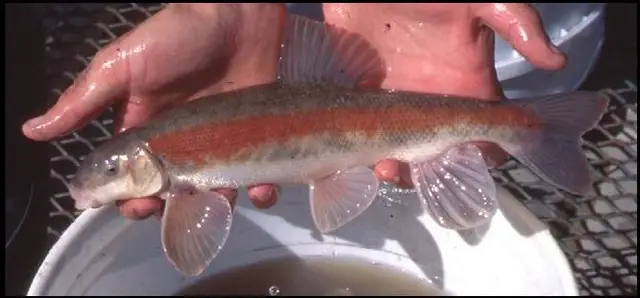
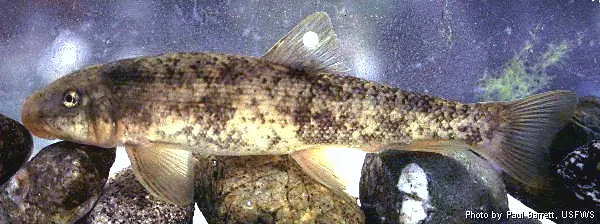
Color is dark grey above and silvery-white below. The sides have a faint pattern of darker blotches and stripes. The dorsal fins have 9 to 11 rays, while the pelvic fins have 8 to 10 rays. In contrast to the mountain sucker, the membrane between the rays of the tail fin is pigmented.
Length has been recorded up to 25 cm (9.8 in), but less than 16 cm (6.3 in) is more typical.
Range and habitat
The rivers they swim in are at cool temperatures (average of less than 22 °C or 72 °F), with variable flow as the suckers are well adapted to survive in the most intense flood conditions. The Pantosteus santaanae range is extremely restricted. They are native only to the Los Angeles, San Gabriel, Santa Ana, and Santa Clara River systems in Southern California. Populations have been lost from several parts of the rivers, so that they now only live in Big Tujunga Creek in the Los Angeles River Basin, the headwaters of the San Gabriel River in the San Gabriel Mountains in Angeles National Forest in Los Angeles County, parts of the Santa Clara River system in Los Angeles and Ventura counties, and the lower part of the Santa Ana River in Orange County, especially areas with additional water effluent from sewage treatment plants.
Pins are Wikidata “endemic to” fields. Orange dots, when present, are GBIF occurrence tiles — survey bias included.
In crisis
Because of its small area of occupancy and vulnerability, the International Union for Conservation of Nature has rated this fish as "endangered". Since Santa Ana suckers were first listed as a federally threatened species (effective May 2000), the Santa Ana Watershed Project Authority has been actively working towards conservation efforts through direct administrative action and educational opportunities for the public to become aware of. Watershed conservation efforts are key in saving these suckers as their biggest threat posed is of habitat loss where it is recorded that they currently have lost over 95% of their natural habitat.
Although some stretches of the rivers are 'wild' and protected by being within the Angeles National Forest area of the San Gabriel Mountains, the coincidence of this fish's range and the Greater Los Angeles metropolitan area, and flowing in concrete lined flood control channels, means that it is a species vulnerable to extinction. The International Union for Conservation of Nature has rated this fish as an "endangered species" because of its decreasing area of occupancy and declining population.
Santa Ana Sucker is Endangered on the IUCN Red List (assessed 2014, criteria B1ab(ii,iii,v)c(iv)). Confirm the official criteria and any later count on the assessment page.
Sources
Adapted from the English Wikipedia article on Santa Ana Sucker (CC BY-SA 4.0; authors are listed in the article history; changes were made), Wikidata item Q3756653. Family and order context is original field-guide writing about the group, not a copied assessment of this one species. Not an IUCN assessment. Counts, when quoted, can change — confirm them on the recovery programme and on iucnredlist.org. Status and assessment year: IUCN. 2026. The IUCN Red List of Threatened Species. Version 2026-1. iucnredlist.org.