Endangered
Warner sucker
Catostomus warnerensis
The Warner sucker is a freshwater fish found only in the closed Warner Basin of southeastern Oregon, with a small reach into Nevada and California. The IUCN Red List rated it Endangered in 2014. It lives in lakes and creeks that dry up in bad years, and it is also federally listed as threatened in the United States.
How to recognise it
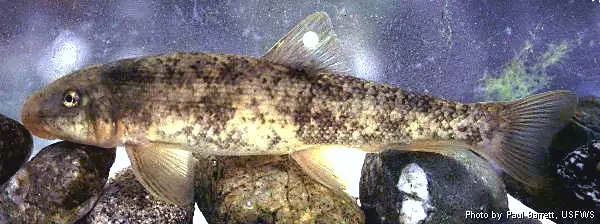
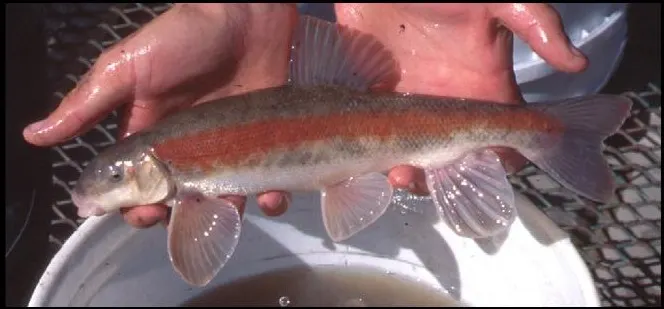
The Warner sucker is a medium-sized, bottom-feeding fish with a dark back and sides and a white belly. Most sources give a maximum length of about 40 cm (16 inches), though one encyclopedia entry says up to 51 cm. In spring, males and some females pick up a bright red wash along the sides.
There are two forms. One is a larger fish that lives in the lakes. The other stays in the streams after spawning. A fish can live to around 20 years and becomes mature at three or four.
Where it lives
The species is native only to the Warner Basin, a closed basin in Lake County, Oregon, where water has no outlet to the sea. A few fish have been recorded just across the line in Twelvemile Creek, Nevada, and West Barrel Creek, California.
It uses shallow lakes and their marshes, creeks, canals and drainage ditches, and reservoirs. Adults favour pools in streams. The basin's lakes are not permanent in dry years. Hart and Crump Lakes dried up in 1992 and were recolonized afterward.
Pins are Wikidata “endemic to” fields. Orange dots, when present, are GBIF occurrence tiles — survey bias included.
How it lives
In spring, when creeks run full, the suckers move upstream to spawn. They also spawn in canals and along lake shores. A tagging study from 2006 to 2010 recorded large upstream movements at Twentymile Creek and found that some spawning fish were lost in irrigation canals.
Young fish are eaten by predators, and introduced game fish such as crappie are one of them. Oregon wildlife planners also list spawning habitat and genetics as things still not well studied.
Why it is in trouble
Water is the problem. Small dams on creeks divert water for farming, which blocks migration and cuts stream flow. Silt and polluted spawning grounds add to it, and drought makes things worse when irrigation demand is high. The IUCN lists drought, surface water abstraction for agriculture, silt and dams among the pressures.
Counts have been uneven. A Desert Fishes Council abstract on work from 2006 to 2010 found that lake abundance estimates for Hart and Crump Lakes in 2006 and 2008 were among the lowest on record. It saw little sign of young fish joining the lake populations, and nonnative fish made up a growing share of the catch. In the streams, a 2007 survey estimated about 6,900 fish basin-wide, though with low precision, and a 2009 mark-recapture study put about 4,600 in the Twentymile Creek subbasin. The IUCN records the overall population trend as unknown.
What is being done
The fish was listed as threatened under the US Endangered Species Act on 27 September 1985, with critical habitat designated, and a federal recovery plan covers it. Work has included replanting creekside vegetation and building a fishway at a dam on a major creek.
During one drought, some suckers were moved to Summer Lake Wildlife Management Area. They died there eventually, but not before breeding. Oregon's wildlife strategy calls for restoring springs, wetlands and migration routes and for raising flows in the lower stretches of tributaries.
Sources
Written for this catalog in our own words from the sources below, checked against them on 12 November 2026. Population figures are estimates and carry the year they were made. Status and assessment year: IUCN. 2026. The IUCN Red List of Threatened Species. Version 2026-1. iucnredlist.org.
- IUCN Red List assessment (2014)
- Warner sucker, Wikipedia
- Warner Sucker, Oregon Conservation Strategy
- Status of Warner suckers in the Warner Basin, Oregon (Desert Fishes Council abstract, 2009)
- Warner sucker investigations in the Warner Basin, Oregon (Desert Fishes Council abstract, 2010)
- Warner Sucker, Encyclopedia.com