Critically Endangered
San Quintin kangaroo rat
Dipodomys gravipes
San Quintin kangaroo rat is a rodent in the family Heteromyidae (order Rodentia) — Dipodomys gravipes, recorded as Critically Endangered.
Appearance
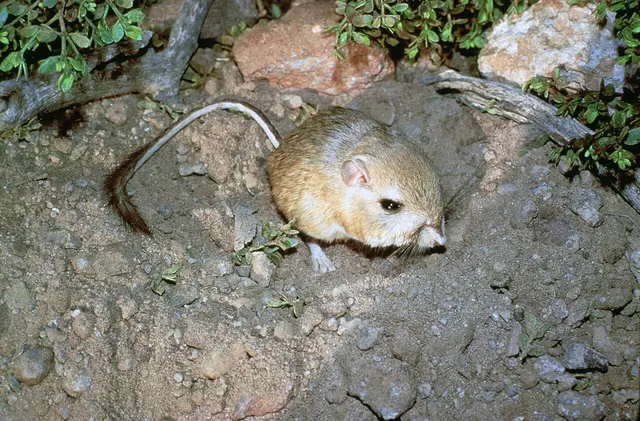
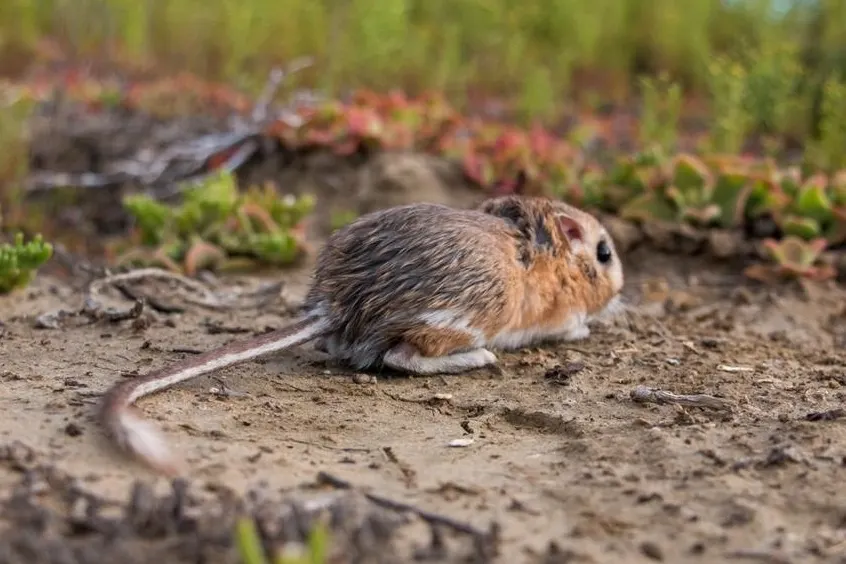
The fur on the head and back is a pale pinkish-buff, with some longer black hairs. The underparts are white and a white spot is above the eye, and white stripes run down either side of the tail. The upper surface of the hind feet is white, while the under surface is black.
The San Quintin kangaroo rat is a small species of kangaroo rat with a head-and-body length of about 13 cm (5 in) and a weight of 80 to 90 g (2.8 to 3.2 oz).
Range and habitat
The San Quintin kangaroo rat has a limited range in the state of Baja California, Mexico. The northern population occupies cactus-covered slopes and adjacent areas with short vegetation, while the southern population is found in floodplains and flat places with sparse vegetation among low hills. The flatter parts of its range are increasingly being cultivated for the production of food for human consumption.
Even so, in 2017, the species was rediscovered in the Valle Tranquilo Nature Preserve by researchers from the San Diego Natural History Museum. These findings were detailed in a report published in 2018.
Pins are Wikidata “endemic to” fields. Orange dots, when present, are GBIF occurrence tiles — survey bias included.
Diet and breeding
The diet of this kangaroo rat is probably seeds and green shoots. This animal is nocturnal, and young have been seen at several different times of year, but mainly in the winter and spring.
In crisis
At that time, two large colonies of this kangaroo rat were known, but since then, the area they occupied has been converted to farmland. Until 2017, no specimens had been found since 1986 and the IUCN listed the species as "critically endangered" and possibly extinct.
San Quintin kangaroo rat is Critically Endangered on the IUCN Red List (assessed 2026, criteria C2a(i,ii); D). Confirm the official criteria and any later count on the assessment page.
Sources
Adapted from the English Wikipedia article on San Quintin kangaroo rat (CC BY-SA 4.0; authors are listed in the article history; changes were made), Wikidata item Q306148. Family and order context is original field-guide writing about the group, not a copied assessment of this one species. Not an IUCN assessment. Counts, when quoted, can change — confirm them on the recovery programme and on iucnredlist.org. Status and assessment year: IUCN. 2026. The IUCN Red List of Threatened Species. Version 2026-1. iucnredlist.org.