Endangered
Giant kangaroo rat
Dipodomys ingens
The giant kangaroo rat (Dipodomys ingens) is the largest kangaroo rat, a big-headed, long-tailed rodent found only in California's dry grasslands. The IUCN Red List rates it Endangered (2018 assessment) and lists its population trend as decreasing. Its burrows and seed habits shape the grassland around it.
How to recognise it
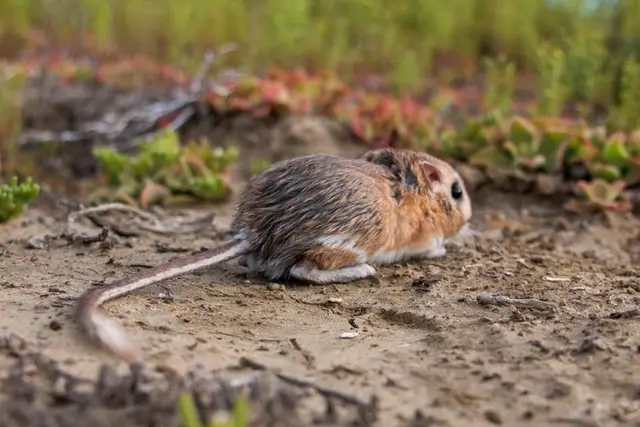
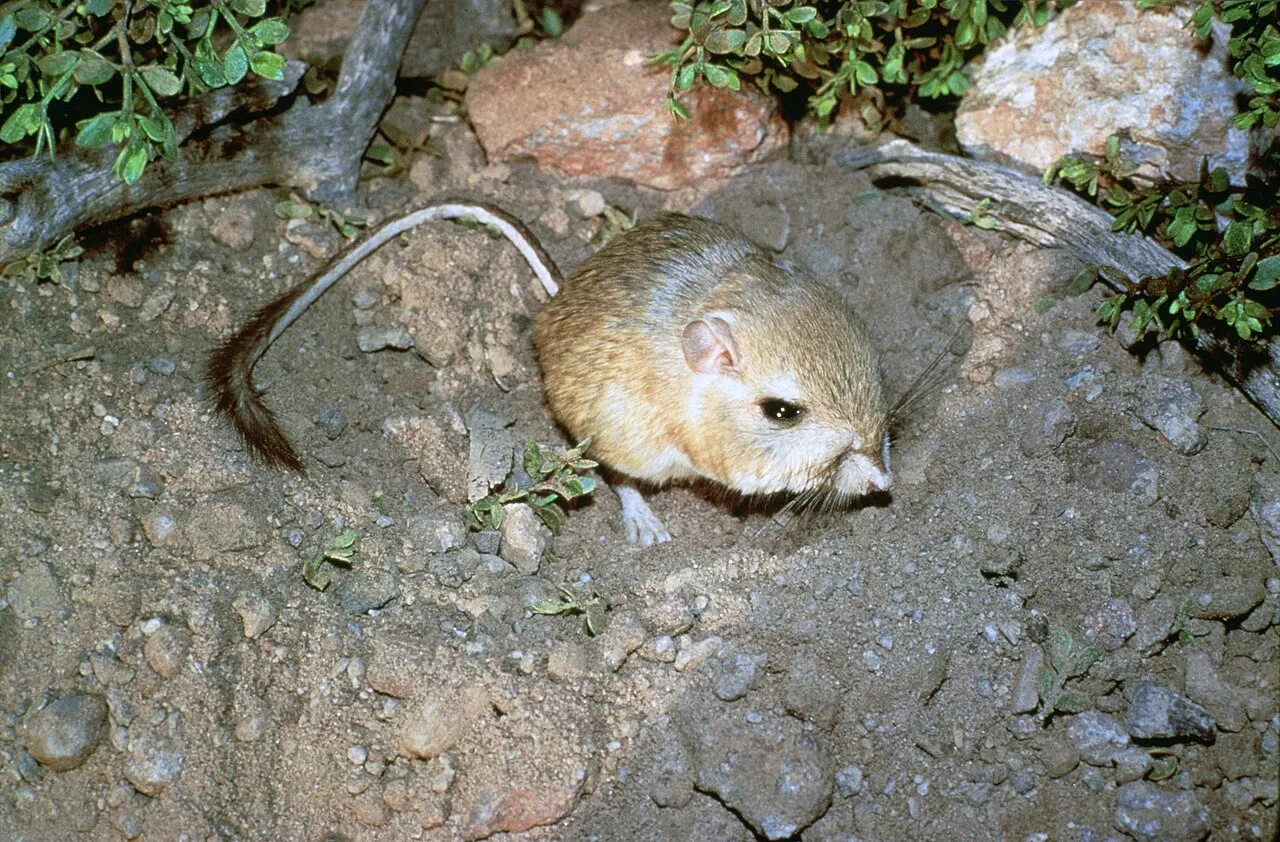
It is the largest of more than 20 kangaroo rat species. Adults measure about 31 to 35 cm from nose to tail tip and weigh roughly 130 to 180 g. The back is tan or brown and the underside is white. The head is large, the hind legs are long and the forelegs short, which is why it hops on two legs. Cheek pouches carry seed.
The tail is longer than the head and body together and ends in a tuft.
Where it lives
The species is found only in California, on dry grassland with loose, easily dug soil, mostly on level or gently sloping ground. Records come from six counties around the western edge of the San Joaquin Valley (San Benito, San Luis Obispo, Kings, Kern, Fresno and Santa Barbara), at about 120 to 870 m above sea level.
What is left is scattered. Populations survive on the Carrizo Plain, the Elkhorn Plain and in the Kettleman Hills, among other places. The IUCN gives an extent of occurrence of about 14,000 square kilometres but an area actually occupied of only about 111 square kilometres, and describes the population as severely fragmented.
Pins are Wikidata “endemic to” fields. Orange dots, when present, are GBIF occurrence tiles — survey bias included.
How it lives
Each animal digs a burrow system and spends most of its time underground, coming out mainly at night. In spring and summer it forages above ground for a little under two hours a night. It eats mostly seeds, plus some green plants and occasional insects, and stuffs seed heads into its cheek pouches to bury in caches near the burrow. Those stores help it through droughts.
The rats clip the vegetation around their burrow mounds, leaving bare patches so large that they show up in satellite images. Researchers have used that to map habitat. The animals also drum their hind feet on the ground to warn of danger or to claim territory.
Litters are usually 3 to 6 pups, averaging about 4, and females have about two litters a year. Breeding probably runs from January to May. Most rats live about two years, though a few reach six. Rattlesnakes, gopher snakes and San Joaquin kit foxes all hunt them.
Why it is in trouble
Farming took most of its habitat. Numbers fell sharply in the 1960s after the California State Water Project accelerated farming in the valley. Depending on the source, the species now holds somewhere between about 2% and 6% of its former range. The IUCN lists housing, commercial development, farming and ranching, mining and quarrying, roads, utility lines and rodent control as ongoing threats, and records a continuing decline in the area it occupies.
Drought adds to the strain. A 2014 report on the Carrizo Plain said about four-fifths of the soil in the national monument was bare in 2013, up from under 10% four years earlier, leaving the rats with less food and cover. Habitat outside the monument has been fragmented by solar development and farming, so there are few nearby populations to recolonise lost ground.
What is being done
The giant kangaroo rat was reportedly listed as endangered under both federal and California law in the 1980s. Almost 250,000 acres of the Carrizo Plain are protected as a national monument managed by the Bureau of Land Management, established in 2001. The IUCN notes a systematic monitoring scheme and conservation sites identified across the whole range, and lists site protection, site management and habitat restoration among conservation actions. One study has reportedly found that moving animals raised genetic diversity and numbers in small populations.
Reports on the trend differ. The IUCN's 2018 assessment lists the global trend as decreasing. A 2026 High Country News article says the Carrizo Plain population has grown from an estimated few thousand in the 1990s to millions.
Sources
Written for this catalog in our own words from the sources below, checked against them on 12 November 2026. Population figures are estimates and carry the year they were made. Status and assessment year: IUCN. 2026. The IUCN Red List of Threatened Species. Version 2026-1. iucnredlist.org.