Endangered
Salangathelphusa anophrys
Salangathelphusa anophrys
Salangathelphusa anophrys is a small freshwater crab known only from southern Thailand, described by Kemp in 1923. It has been found in streams and waterfalls on the peninsular side of the country. The IUCN Red List classed it as Endangered in 2008, mainly because its range is tiny and its habitat is under pressure.
How to recognise it
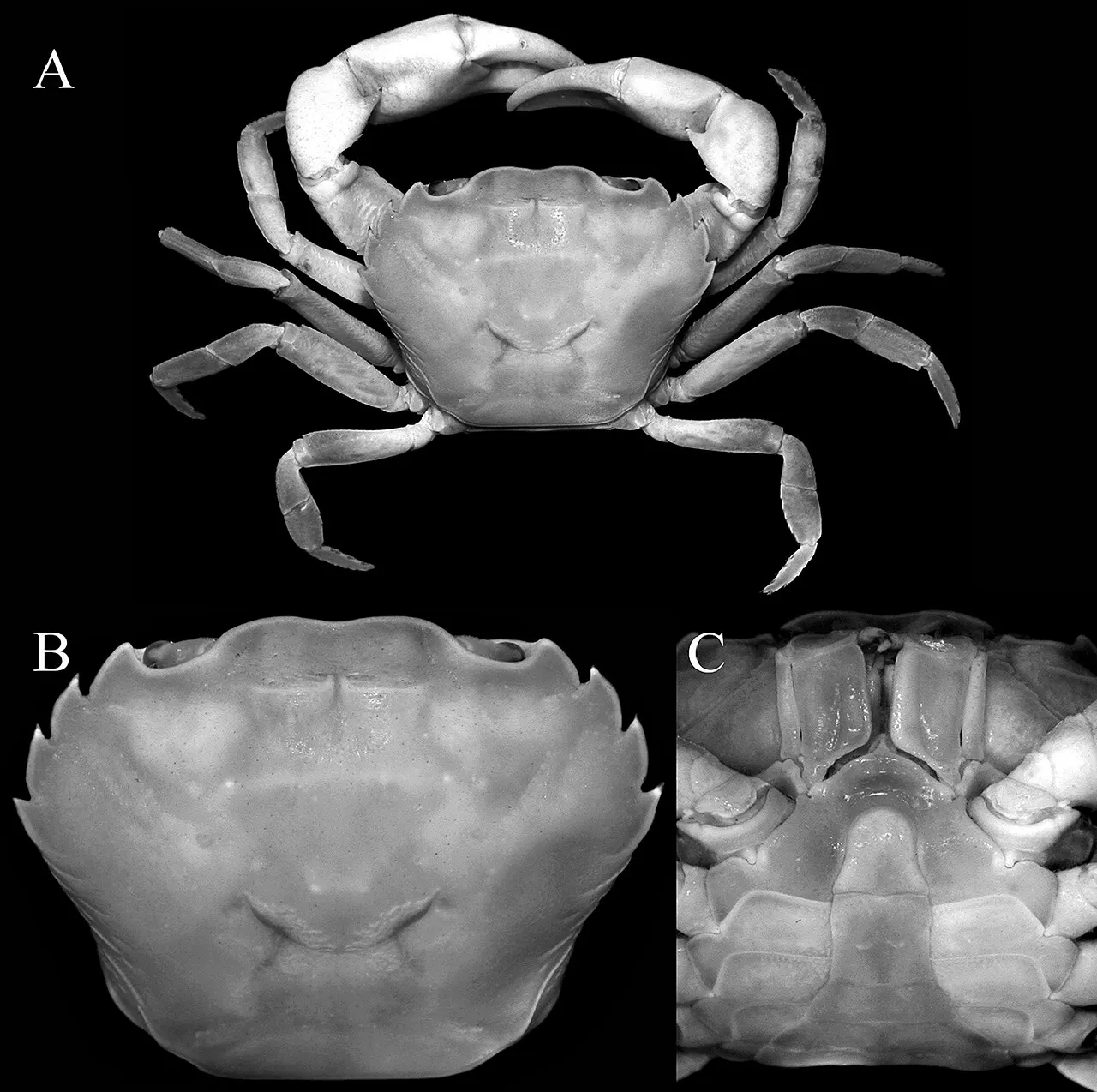
Kemp described the crab in 1923 as Paratelphusa anophrys. It now belongs to the genus Salangathelphusa in the family Gecarcinucidae, a group of true freshwater crabs.
Only two specimens have published measurements, both males. The original male measured 25.4 mm across the carapace and 19.0 mm along it. A male collected in Trang in 1988 measured 26.9 by 20.7 mm. So these crabs are roughly 2.5 to 2.7 cm wide.
A 2017 ZooKeys paper on a close relative, S. peractio from Langkawi in Malaysia, compared the two. The Langkawi crab has a more squarish carapace, and the male's first gonopod (a reproductive limb) differs most clearly. In S. anophrys the gonopod's subterminal segment is stouter and the tip is shorter and more strongly curved.
Where it lives
The original specimen came from Khao Ram, at 366 m in the Nakhon Si Thammarat mountains of peninsular Thailand. It was collected by M. Smith, and no date is given. The Trang male was taken at Sai Rung waterfall on 27 October 1988 by P. Naiyanetr.
The Red List counts two locations and gives its habitat as permanent rivers, streams and creeks, including waterfalls.
Recent records suggest it is still around. GBIF lists six iNaturalist observations from 2020 to 2025, from Nakhon Si Thammarat, Phatthalung, Trang and Krabi provinces. The coordinates are blurred by about 31 km, so exact sites are hidden.
Pins are Wikidata “endemic to” fields. Orange dots, when present, are GBIF occurrence tiles — survey bias included.
Why it is in trouble
The Red List names housing and urban areas, and commercial and industrial development, as ongoing threats. It was assessed under criteria B1ab(iii)+2ab(iii), which cover a small range and a declining habitat.
The population is poorly known. The assessment gives no population size and records the trend as unknown. It dates from 2008.
Taxonomy adds another layer of doubt. Bott synonymised the species with S. brevicarinata in 1970, while Ng and colleagues listed it as valid in 2008. The 2017 paper says the genus needs revision because there are clearly more than the two species then recognised, and that S. brevicarinata is probably a complex of several species.
What is being done
The Red List records no conservation actions in place for this crab. A revision of the genus, which the 2017 paper says is planned, should clarify which crabs belong to the species.
Sources
Written for this catalog in our own words from the sources below, checked against them on 12 November 2026. Population figures are estimates and carry the year they were made. Status and assessment year: IUCN. 2026. The IUCN Red List of Threatened Species. Version 2026-1. iucnredlist.org.




