Endangered
Sachatamia electrops
Sachatamia electrops
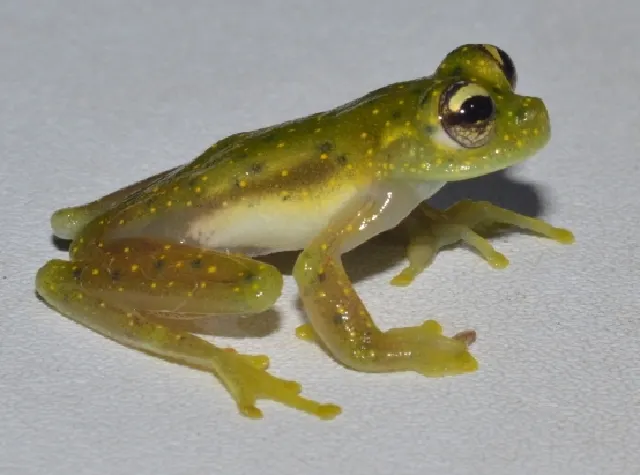
Sachatamia electrops is a glass frog from the Central Andes of Colombia, formally described only in 2017. The IUCN Red List lists it as Endangered (assessed 2019). It is green with yellow and blue dots and a white blotch on the upper iris, which gave it its name.
How to recognise it
The species is named for its eye. In life, the iris carries a semicircular white blotch on its upper part, and the name combines Greek words for electric and eye. The back is green with yellow and blue dots. Those features set it apart from its closest relatives in the genus, Sachatamia albomaculata and S. punctulata.
A female paratype in the original description measured 21.6 mm from snout to vent.
Where it lives
Rada and colleagues described the species in the South American Journal of Herpetology in 2017, from the eastern slope of Colombia's Central Andes (Cordillera Central). The holotype, an adult male, came from forest at Vereda El Respaldo in the municipality of Alejandria, Antioquia, at about 1,285 m, and was collected in 2014. DNA evidence supported its place in Sachatamia and its status as a separate species. Its description raised the genus to five species. All 104 GBIF occurrence records are from Colombia.
The Red List counts just two locations, at elevations from about 800 to 1,630 m. Its habitats are moist montane and lowland forest and forested rivers and streams, including waterfalls.
Pins are Wikidata “endemic to” fields. Orange dots, when present, are GBIF occurrence tiles — survey bias included.
Why it is in trouble
The Red List records that the frog's numbers are decreasing and its habitat is still shrinking. The pressures it names are small-holder farming and grazing, housing and urban growth, large dams, and mining and quarrying, all of which clear or degrade the forest and streams around it. With only two locations and a small range, the 2019 assessment placed the species in the Endangered category under criterion B1ab(iii).
What is being done
The frog occurs in at least one protected area. The Red List lists site and area management and protection of resources and habitat as conservation actions. No breeding programme or species-specific recovery plan is recorded.
Sources
Written for this catalog in our own words from the sources below, checked against them on 12 November 2026. Population figures are estimates and carry the year they were made. Status and assessment year: IUCN. 2026. The IUCN Red List of Threatened Species. Version 2026-1. iucnredlist.org.




