Endangered
São Tomé Green Pigeon
Treron sanctithomae
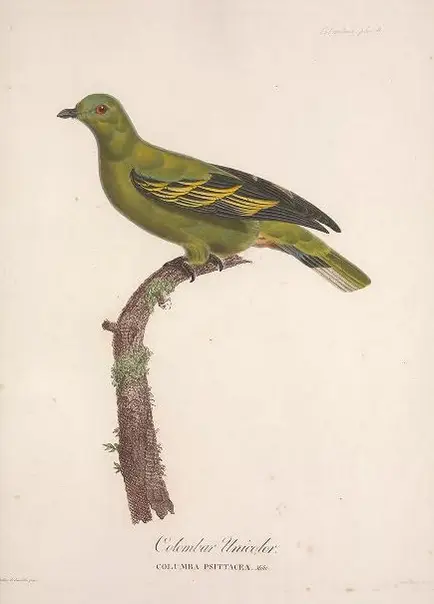
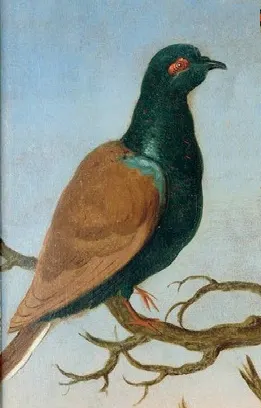
The São Tomé green pigeon (Treron sanctithomae) is a fruit-eating forest pigeon found only on São Tomé, the main island of the small African nation of São Tomé and Príncipe. The IUCN Red List assessed it as Endangered in 2021, with hunting the main pressure on a population of a few tens of thousands.
Where it lives
This pigeon belongs to the green pigeons (genus Treron), and the German naturalist Johann Friedrich Gmelin described it in 1789. It occurs nowhere but São Tomé island in the Gulf of Guinea, and the Red List treats all of it as a single population in a single location. It lives in moist lowland forest and also uses plantations and heavily degraded former forest, from sea level up to about 1,800 m.
It has already vanished from the small islet of Ilhéu das Rolas, where its habitat was lost. The area it occupies on the main island is estimated at about 792 square km, and that area is still shrinking.
Pins are Wikidata “endemic to” fields. Orange dots, when present, are GBIF occurrence tiles — survey bias included.
How it lives
São Tomé has four forest pigeons and doves. A survey of 35 km of walked transects, carried out in 2010 and published in Bird Conservation International in 2014, found the green pigeon less common and more restricted in range than the Lemon Dove, which was the most abundant and the only one of the four that is not hunted. The green pigeon and the Maroon Pigeon were both strongly tied to old-growth forest, while the Bronze-naped Pigeon did better in shade forest and non-forested areas. Fruit availability was linked to where the three hunted species were found.
Why it is in trouble
Hunting for food is the main threat. The Red List says people deliberately target the species and that this affects most of the population, with rapid declines. The 2014 survey found that a hunting-pressure index, built from accessibility, human population and signs of hunting, was linked to lower abundance of some of the pigeons. Small-scale farming that clears forest adds to the loss, though the assessment rates it as a lesser threat.
Population figures are rough. A 2015 estimate of 37,007 to 109,255 individuals, quoted in the 2021 assessment, converts to roughly 24,670 to 72,840 mature individuals. The generation length is only about 4.5 years. The assessment estimates that numbers fell by 30 to 49 percent in the past, and expects a loss of the same size to continue.
What is being done
Protection on paper is thin. The assessment notes that conservation sites have been identified across its entire range, but it records no action plan, no systematic monitoring scheme, no captive population and no awareness programme aimed at the species. It also records no occurrence in a protected area. Awareness and policy work at national level are listed among the actions needed.
The 2014 survey recommended protecting both old-growth and secondary forest, and it called controlling hunting crucial. Its other suggestions included enforcing existing hunting law, restricting hunting by area and season, and cutting demand in restaurants.
Sources
Written for this catalog in our own words from the sources below, checked against them on 12 November 2026. Population figures are estimates and carry the year they were made. Status and assessment year: IUCN. 2026. The IUCN Red List of Threatened Species. Version 2026-1. iucnredlist.org.