Endangered
Robust Redhorse
Moxostoma robustum
Moxostoma robustum, a redhorse, is a big, thick-bodied sucker of southeastern US rivers. Cope described it in 1870, then it vanished from the record for more than a century. It is listed as Endangered on the IUCN Red List (assessed 2013), and only a few river populations remain.
How to recognise it
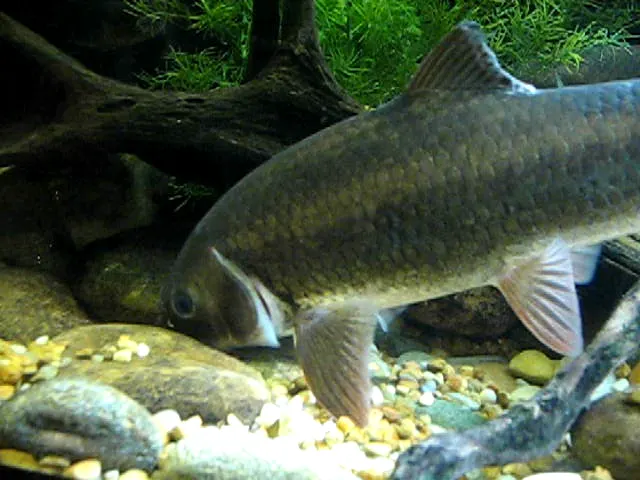
It's the largest of the redhorse suckers: heavy through the body, with big scales, a fleshy lower lip and rose to reddish-orange lower fins. The back is golden brown to coppery, fading to a paler belly. Breeding males grow small bumps called tubercles on the snout, cheeks and some fins.
Typical adults run about 25 inches (64 cm) and 9 pounds (4.1 kg). The biggest reach roughly 30 inches and 17 pounds (7.7 kg). Its large molar-like teeth crush the mollusks, insects and crustaceans it eats.
Where it lives
The species belongs to rivers draining the southern Atlantic slope. Wild fish are known from the lower Pee Dee River in North Carolina and South Carolina, the Savannah River, and the Oconee and Ocmulgee rivers in Georgia. Stocked fish live in the Broad and Ogeechee rivers in Georgia and the Broad and Wateree rivers in South Carolina. Its range is reported to run from the Cape Fear drainage in North Carolina south to the Altamaha system in Georgia.
It likes large rivers with rock and gravel shoals. Outside the breeding season it shifts to deep, slow water near bends and big woody debris.
Pins are Wikidata “endemic to” fields. Orange dots, when present, are GBIF occurrence tiles — survey bias included.
How it lives
Spawning happens over gravel shoals once the water nears 17 C, usually late April or early May. Fish mature at about 5 to 6 years old. The oldest one recorded was 27.
Some fish stay near their spawning shoals all year. Others have been tracked more than 100 river kilometers downstream toward the coastal plain.
A fish that went missing
Cope's original 6-pound specimen came from the Yadkin River in North Carolina and was later lost. By the late 1800s the species had dropped out of the literature and was assumed gone. Unidentified fish turned up in the Savannah and Pee Dee rivers in 1980 and 1985. In August 1991, Georgia biologists collected five in the Oconee River and the species was recognised again, after about 122 years.
Why it is in trouble
Dams and impoundments cut up its habitat. The Red List assessment names sediment from soil erosion, nutrient loads, herbicides and pesticides, surface water withdrawal and non-native species as further threats. The population trend is listed as unknown.
Numbers are small where they've been counted. On the Pee Dee, a 2009 figure put breeding fish at fewer than 100.
What is being done
The species has its own Conservation Committee, formed in 1995 as a partnership of agencies, power companies, aquariums and universities. It adopted a conservation strategy in 1998 and updated it in 2003. Stocked populations now exist in several rivers.
In the Pee Dee, more than 60 fish have been netted and tagged since 2000, some with radio tags, to find spawning shoals and wintering areas. North Carolina published a conservation plan for the species in 2020, and a Candidate Conservation Agreement with Assurances covers the Ocmulgee in Georgia.
Sources
Written for this catalog in our own words from the sources below, checked against them on 12 November 2026. Population figures are estimates and carry the year they were made. Status and assessment year: IUCN. 2026. The IUCN Red List of Threatened Species. Version 2026-1. iucnredlist.org.

