Endangered
Copper redhorse
Moxostoma hubbsi
The copper redhorse (Moxostoma hubbsi) is a big, long-lived sucker fish found nowhere outside southern Quebec, and only two spawning sites are known, both on the Richelieu River. The IUCN Red List assessed it as Endangered in 2014. It is the subject of one of Canada's longest-running fish recovery efforts.
How to recognise it
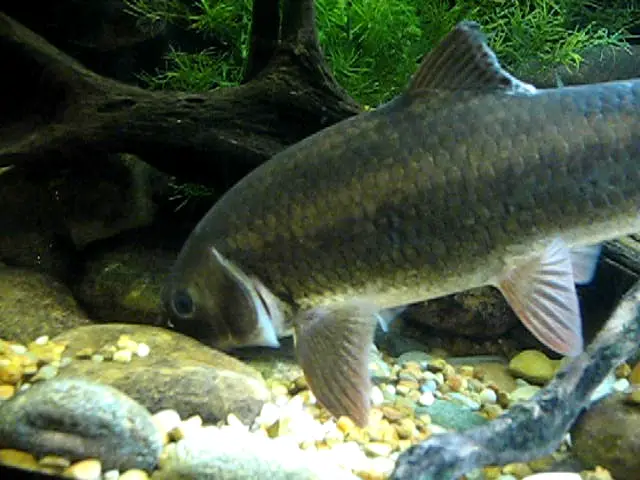
A copper redhorse is a deep-bodied fish with a humped back and a fairly small head. The back and sides run from coppery to olive, with a paler belly. Fin colour is reported variously as coppery or dusky, and some accounts describe a bright red tail.
It can pass 70 cm in length, according to Canada's 2014 status report, making it the largest of the redhorses that share its waters. It can live more than 30 years. The mouth has no teeth, but a row of large molar-shaped teeth in the throat is used to crush shellfish.
Where it lives
It is restricted to Quebec, the only fish whose whole range falls inside that one province. Adults depend on both the St. Lawrence River and the Richelieu River, and fish have also been recorded in the Rivière des Mille Îles. The Yamaska and Noire rivers once held populations that are now thought to be gone, the last records dating from 1992 and 1964.
Reproduction has been confirmed only in the Richelieu. The two known spawning grounds are the Chambly rapids archipelago and the stretch below the Saint-Ours dam. Spawners gather over gravel, pebble and cobble in water mostly 0.75 to 4 m deep, in late June and early July, at 18 to 26 degrees C. Young fish stay near shore in shallow, weedy water during their first growing season.
Pins are Wikidata “endemic to” fields. Orange dots, when present, are GBIF occurrence tiles — survey bias included.
How it lives
Adults feed almost entirely on molluscs, which made up more than 90 percent of the prey counted in one Canadian study. Young of the year eat tiny crustaceans instead. The species matures late, at about 10 years, and the generation time is roughly 20 to 25 years, so a bad run of breeding years takes decades to repair.
Adults are migratory, moving between the St. Lawrence and the Richelieu, and they are counted at the Vianney-Legendre fishway at the Saint-Ours dam on the way upstream.
Why it is in trouble
The Red List estimates a decline of about 50 percent from a past reduction in habitat area, quality and range. Canada's 2014 status report put the number of mature fish at several thousand at the most, with an ageing population and very few young. Where juveniles were caught, young of the year made up less than 0.5 percent of redhorse abundance without stocking.
Threats include siltation, farm and urban runoff, contaminants, dams, boat traffic at the Chambly spawning site, bycatch and invasive species such as tench, round goby and zebra mussels. McGill University work since 2018 found that eggs exposed to Richelieu pollutants hatch early and produce fewer surviving larvae.
What is being done
Canada listed the fish as endangered under its Species at Risk Act in December 2007, and legal protection of critical habitat took effect on 6 May 2021. An artificial reproduction and stocking program began in 2004. By 2014, nearly 3.3 million larvae and 168,400 fall fry had been released into the Richelieu, and a captive broodstock program started in 2020. In 2022, 15,000 one-year-old fish were stocked.
Counts at the Vianney-Legendre fishway rose from 15 adults in 2019 to 36 in 2023, though no counts were made in 2020 or 2021. Recovery work also covers more than 328,000 square metres of restored shoreline and new vessel limits on the Richelieu in 2023. The target is 4,000 mature fish over 20 years, and a progress report covering 2019 to 2023 rated several goals as not yet met.
Sources
Written for this catalog in our own words from the sources below, checked against them on 12 November 2026. Population figures are estimates and carry the year they were made. Status and assessment year: IUCN. 2026. The IUCN Red List of Threatened Species. Version 2026-1. iucnredlist.org.