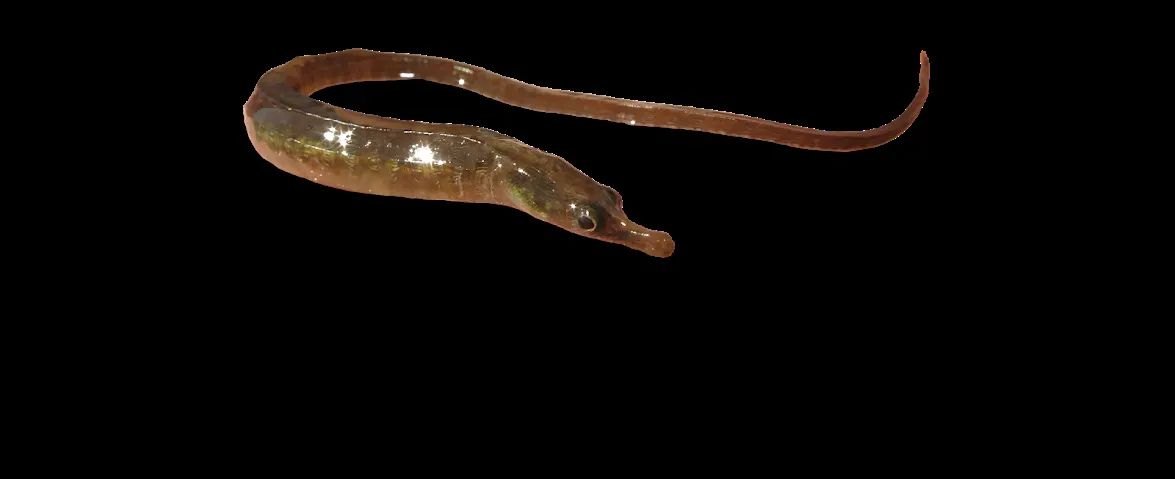
Endangered
River pipefish
Syngnathus watermeyeri
The river pipefish, also called the estuarine pipefish (Syngnathus watermeyeri), is a slim relative of seahorses found only in a few estuaries on South Africa's Eastern Cape. It was once declared extinct, turned up again, and is listed as Endangered by the IUCN in 2025, after earlier Critically Endangered assessments.
How to recognise it
Like other pipefish it is a long, thin, armoured fish that drifts among plants. The easiest way to tell it from the other pipefish in its estuaries, Syngnathus temminckii, is the snout, which is much shorter in this species.
The fish was described by J. L. B. Smith in 1963 from a 110 mm female collected in the Bushmans River. It is named for F. L. E. Watermeyer, who sent Smith the specimen.
Where it lives
It is endemic to South Africa. Historical records come from the estuarine reaches of five rivers: the Kariega, Bushmans, Kasouga, East Kleinemonde and West Kleinemonde. The IUCN's latest assessment counts two subpopulations, an extent of occurrence of 206 square kilometres and an area of occupancy of 44 square kilometres.
It lives in shallow water, with the assessment recording depths down to about 5 m, in estuaries and kelp or algal beds. It is most often found in beds of the eelgrass Zostera capensis, which is itself scarce: it has been reported in only 62 of 290 South African estuaries, in beds totalling roughly 7 to 20 square kilometres. The Red List records none of the population as inside a protected area.
Pins are Wikidata “endemic to” fields. Orange dots, when present, are GBIF occurrence tiles — survey bias included.
A history of disappearing and returning
After Smith's description the species went unrecorded for decades. It was listed as threatened in 1987, and the Red List moved it from Vulnerable to Extinct in 1994. The fish then turned up in the East Kleinemonde estuary, though accounts disagree on the year: the Seahorse Specialist Group gives 1996 and a 2021 genetic study gives 1997.
Twelve fish were later moved from East to West Kleinemonde. A flood in May 2003 then wiped the species out of both Kleinemonde estuaries. It was found in the Bushmans estuary in 2005 and the Kariega in 2006.
The Bushmans and Kariega populations are all that is known today. A survey in October 2019 dragged seine nets through eelgrass at 23 sites in each of those two estuaries and caught just eight fish, two in the Kariega and six in the Bushmans.
Why it is in trouble
Population estimates vary widely. An older Red List figure gave 100 to 250 individuals, whereas a 2017 study (Whitfield and colleagues) suggested tens of thousands if all known estuaries are occupied. The 2025 assessment lists 10,000. A genetic study published in Frontiers in Marine Science put the effective population at roughly 114 to 199 fish, and found both populations inbred and not genetically distinct, so they behave as one.
The Red List scores storms and flooding, and habitat shifting and alteration, as the biggest threats, each with very rapid declines expected. Other pressures include nutrient loading, sediment, sewage, housing, commercial development and recreation. The genetic study also points to long droughts combined with dams, which cut freshwater flow and can collapse the small animals the fish feeds on. The assessment projects a 50 percent future decline linked to habitat loss, which is the basis for its listing under criterion A3c.
What is being done
The Red List records the species as held in captivity, and a captive population is reportedly kept at uShaka Marine World in Durban. It also notes recent education and awareness programmes, though it records no recovery plan or monitoring scheme in place.
A project funded by a 2019 National Geographic grant, run by South African and Australian researchers, is developing an environmental DNA test to find the fish more reliably than netting. It aims to produce a Recovery Action Plan. The genetic study recommends starting populations in other estuaries of the historical range, alongside captive breeding, because moving fish between the two surviving estuaries would add little diversity.
Sources
Written for this catalog in our own words from the sources below, checked against them on 12 November 2026. Population figures are estimates and carry the year they were made. Status and assessment year: IUCN. 2026. The IUCN Red List of Threatened Species. Version 2026-1. iucnredlist.org.
- IUCN Red List assessment, Syngnathus watermeyeri (2025)
- IUCN SSC Seahorse, Pipefish and Seadragon Specialist Group, first steps to conserve the estuarine pipefish (2020)
- Frontiers in Marine Science 2021, genetics of the estuarine pipefish
- Estuarine pipefish, encyclopedia entry
- Recently Extinct Species, Syngnathus watermeyeri




