Endangered
Riama balneator
Riama balneator
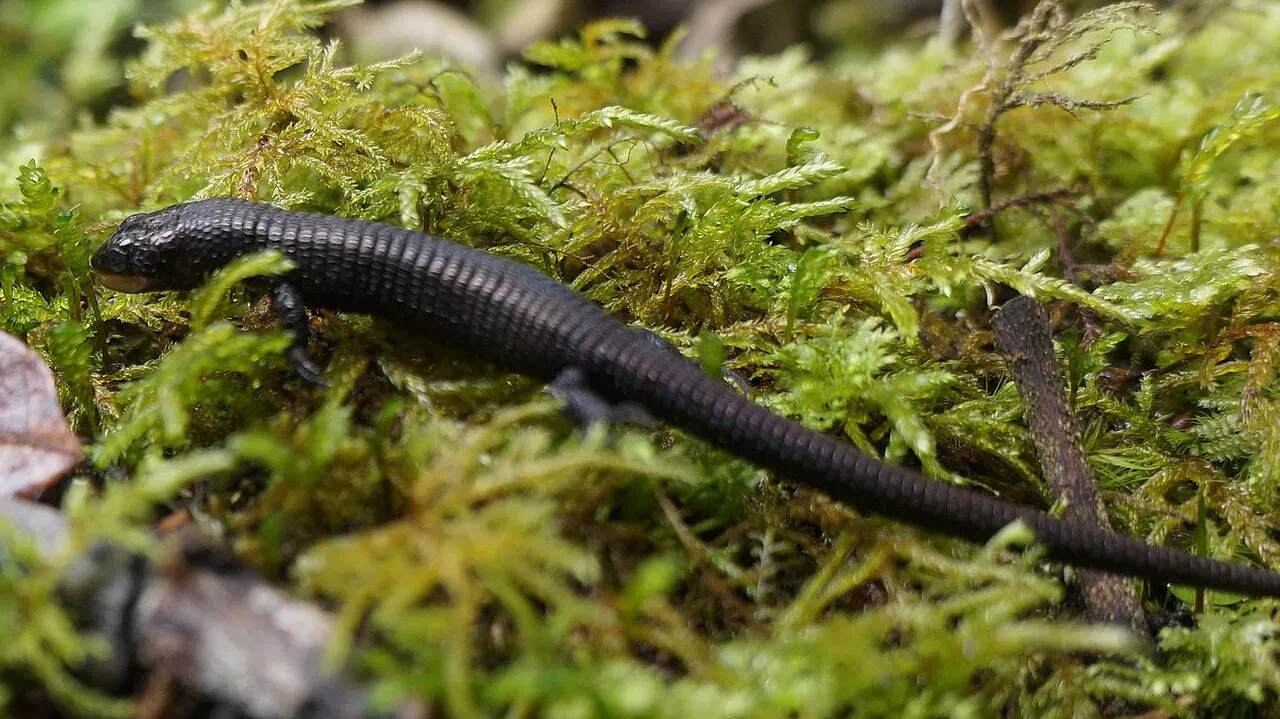
Riama balneator, sometimes called the hot spring lightbulb lizard, is a rarely seen burrowing lizard from cloud forest on the slopes of Tungurahua volcano in Ecuador. It is found nowhere else. The IUCN Red List rates it Endangered (assessed 2017), and fewer than ten individuals have reportedly ever been recorded.
How to recognise it
This is a slender, ground-dwelling lizard in the family Gymnophthalmidae, with limbs so short that the front and hind legs cannot reach each other. Males reach about 16.8 cm in total length, with a body (snout to vent) of around 6.4 cm. Females are similar, up to roughly 15.5 cm in total. The back scales are wrinkled and the back is brown with tiny blackish specks.
A pale, dark-edged stripe runs along the head and neck and fades toward mid-body. A row of 12 to 14 faint eye-like spots lies along each side. The belly is dark brown with an iridescent sheen. Males are darker, while females have reddish tones on the back half of the body and cream edges on the belly scales.
Where it lives
The species is endemic to Ecuador, on the eastern slopes of Tungurahua volcano in the east-central part of the country. The Red List places it in moist montane forest at about 2,650 to 2,950 m, and counts just two locations. The Reptiles of Ecuador site lists four localities and an area of about 286 square kilometres, while the IUCN gives an extent of occurrence of 100 square kilometres (2017).
Sources disagree on the exact type locality. The Reptile Database gives the southern slope of Tungurahua at about 2,750 m, and Reptiles of Ecuador gives the Puela River valley in Chimborazo province. Kizirian described the species in 1996 as a member of the genus Proctoporus, and it was moved to Riama in 2005. The name is Latin for caretaker of the baths and refers to Baños, the nearby town known for its hot springs.
Pins are Wikidata “endemic to” fields. Orange dots, when present, are GBIF occurrence tiles — survey bias included.
How it lives
Very little is recorded. It is a burrowing (fossorial) lizard of cloud forest and neighbouring pastures. Eggs and adults have been found under rotting logs in pastures near the forest edge, and the species lays eggs. What it eats is unknown, though lightbulb lizards in general eat insects.
The best-documented site, Montañas de San Antonio, has four observations. No recent sightings have been made there despite targeted searches.
Why it is in trouble
Its range is tiny and the habitat is shrinking. The IUCN notes a continuing decline in the area the species occupies, and lists mining and agriculture (scale unrecorded) as ongoing threats. Reptiles of Ecuador adds that farming and other human encroachment have fragmented and degraded the forest, although the IUCN does not rate the population as severely fragmented. Eruptions of the volcano it lives on are named as a possible future threat. Whether the population is rising or falling is unknown.
What is being done
At least part of its range lies inside a protected area, and the Red List lists site and area management as a conservation action. Research on population trends is the stated need, since so few animals have been found.
Sources
Written for this catalog in our own words from the sources below, checked against them on 12 November 2026. Population figures are estimates and carry the year they were made. Status and assessment year: IUCN. 2026. The IUCN Red List of Threatened Species. Version 2026-1. iucnredlist.org.




