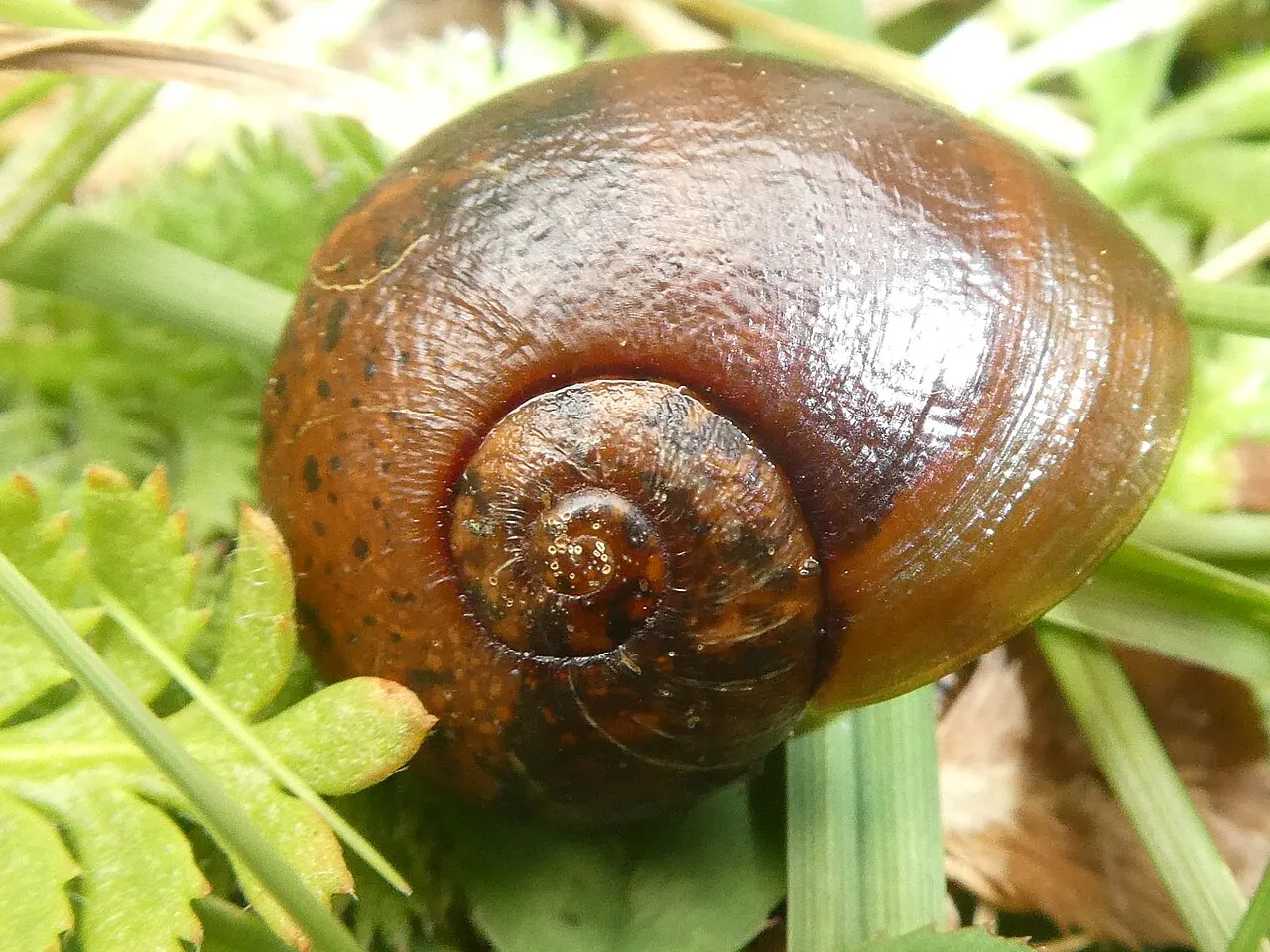
Critically Endangered
Rhytida oconnori
Rhytida oconnori
Rhytida oconnori is a medium-sized, air-breathing, carnivorous land snail found at only a few places at the top of New Zealand's South Island, in the Abel Tasman area and Golden Bay. The IUCN Red List records it as Critically Endangered (assessed 1996), and New Zealand ranks it Nationally Critical (2019).
How to recognise it
Rhytida oconnori belongs to the Rhytididae, a family of predatory land snails, and was described by the New Zealand malacologist A. W. B. Powell in 1946. It reportedly reaches about 33 mm in length and 19 mm in height, and its eggs are said to be larger than those of other snails in the family.
The shell is smaller and more fragile than that of Powelliphanta hochstetteri, a larger carnivorous snail that lives in the same part of the park. The inside of the shell is glossy, like mother of pearl.
Where it lives
The species occurs only at the top of the South Island. Named localities include Abel Tasman National Park, Punipaua Creek near the Paturau River west of Collingwood, and Parapara Peak, all in or near Golden Bay. A 2016 report from the Department of Conservation (DOC) described just two sites for the whole country: Abel Tasman and Parapara Peak.
A 1998 report had the Abel Tasman population surviving only within about 1 km of Pages Saddle, near Harwoods Hole. A 2016 DOC survey, carried out for Project Janszoon, found evidence of the snail up to 9 km east and northeast of there, mostly south and west of the Awaroa estuary. The species is therefore more widespread in the park than once believed, though earlier studies had shown it declining.
Snails in this family generally shelter under ferns and leaf litter or in damp spots under rocks, and some live in subalpine tussock and scrub.
Pins are Wikidata “endemic to” fields. Orange dots, when present, are GBIF occurrence tiles — survey bias included.
How it lives
Like its relatives it is a carnivore. Very little has been published on what this species eats or how it breeds, so much of what is known comes from the family or from its bigger neighbour.
Radio-tracking of ten Powelliphanta hochstetteri near Canaan Downs, over 41 days, showed that those snails moved only about 1.3 m on an average night and were usually active for just one or two warm, moist nights at a time. After that study, around 200 snails of the two species were tagged so that repeat monitoring could show how the populations change.
Why it is in trouble
Introduced predators were long the main suspects. The 2016 survey found rats were the most common predator of the two snails in the area, and the introduced song thrush is also listed as a predator of snails in this family.
More recent work points to weka, a native flightless bird. Weka were nearly gone from the area in the 1990s but have since rebounded, and their rise coincides with snail declines in the uplands. Researchers found hundreds of shells with the clean breaks and punctures that weka leave, and estimated that at least 70 percent of the snails were dying this way. That research covered both the Rhytida and Powelliphanta snails of the park.
The IUCN assessment dates from 1996 and uses an older version of the Red List system, so it gives no population trend or numbers.
What is being done
Project Janszoon has built two fenced enclosures, each 70 by 70 m, in areas where snails still live. The mesh keeps weka out but is wide enough for juvenile snails to disperse. About two years after fencing, both snail species were recovering inside, along with other invertebrates such as weta and earthworms.
The enclosures are small, and they protect only a patch of forest. DOC's 2016 survey also led Project Janszoon to say that predator control in the park needs to be extended, and DOC planned more intensive snail monitoring.
Sources
Written for this catalog in our own words from the sources below, checked against them on 12 November 2026. Population figures are estimates and carry the year they were made. Status and assessment year: IUCN. 2026. The IUCN Red List of Threatened Species. Version 2026-1. iucnredlist.org.




