Endangered
Lesina Bush-cricket
Rhacocleis buchichii
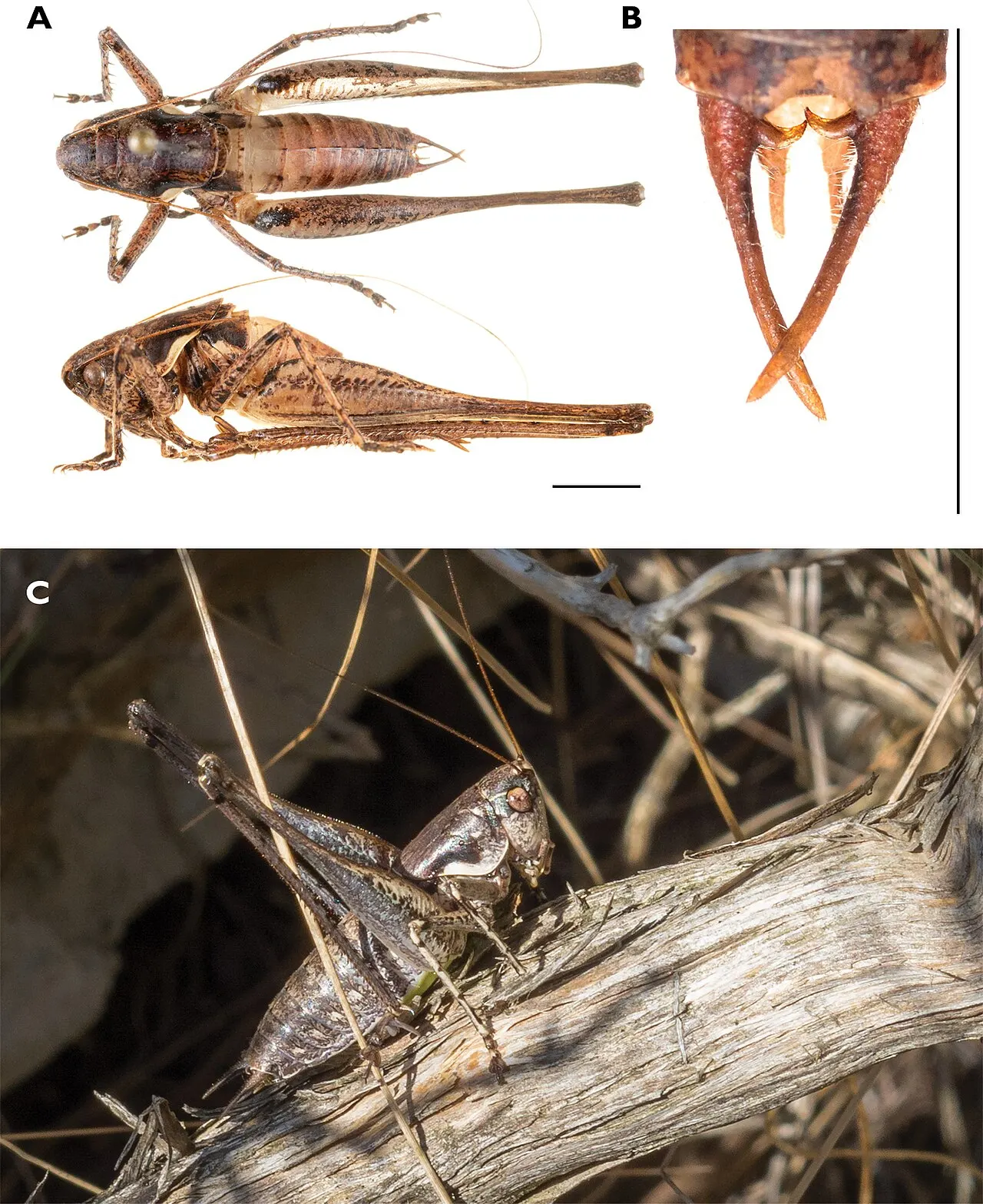
The Lesina bush-cricket (Rhacocleis buchichii) is a flightless, dark grey bush-cricket found only in Dalmatia, Croatia, on the islands of Hvar, Brač and Vis and on a few coastal mountains. The IUCN Red List assessed it as Endangered in 2016, though newer fieldwork has widened its known range.
How to recognise it
Its only fellow member of the genus in Croatia, Rhacocleis germanica, is more reddish and brownish and lacks a pale band on the side flaps of the pronotum (the shield behind the head). R. buchichii is darker and greyer and has a clear pale band there. Males have very long, slender, conical cerci at the tip of the abdomen, more delicate than those of R. germanica.
Its song has only been studied from two males recorded at 26 to 27 degrees C. They sang short phrases of about a fifth of a second, each made of 7 to 9 rapid syllables, repeated one to two times a second in series of 4 to 13. R. germanica phrases have about ten syllables.
Where it lives
It was first described in 1874 from the island of Hvar and later turned up on Brač and Vis, on Biokovo and Troglav (a peak in the Dinara massif) and, in one older record, at Zaostrog on the mainland coast. A report from Korčula has never been confirmed. The highest records are about 850 m on Troglav.
Past collectors found it in heath, rockrose scrub, under terebinth bushes, in juniper, among fig and olive trees and, on Biokovo, beneath black pine. One early collector called it timorous and hard to catch. Records run from late May to October, and two October visits to Biokovo in 2015 turned up about fifteen individuals.
Pins are Wikidata “endemic to” fields. Orange dots, when present, are GBIF occurrence tiles — survey bias included.
Why it is in trouble
The 2016 Red List assessment put its area of occupancy at 30 to 60 square km and its extent of occurrence at about 1,500 square km, with a decreasing population that is severely fragmented. A 2020 study in ZooKeys, which counted roughly ten known sites after new records from Vis and Troglav, calculated about 60 square km occupied and 3,700 square km of range. It proposed moving the species to a less threatened category, but the Red List entry still reads Endangered.
The IUCN names road building and tourist development, housing, forest fires and introduced mongooses. Most of these shrink or degrade the low shrubland and forest edges where it lives.
What is being done
It occurs in Natura 2000 sites on Vis, Hvar and Brač and in Biokovo Natural Park, though the ZooKeys study expects it outside protected areas too, where the main threats continue. The IUCN lists habitat and site protection, control of introduced mongooses and awareness raising as needed actions, along with research on its distribution and trend. The study's authors asked entomologists and visitors to photograph Adriatic island insects and post sightings to platforms such as iNaturalist.
Sources
Written for this catalog in our own words from the sources below, checked against them on 12 November 2026. Population figures are estimates and carry the year they were made. Status and assessment year: IUCN. 2026. The IUCN Red List of Threatened Species. Version 2026-1. iucnredlist.org.




