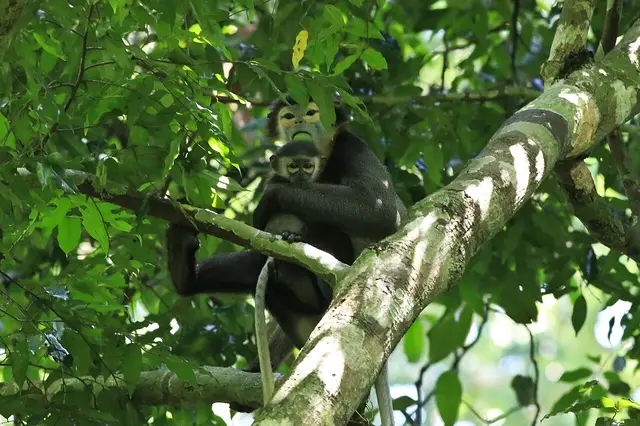
Critically Endangered
Red-shanked douc
Pygathrix nemaeus
Red-shanked douc is an Old World monkey in the family Cercopithecidae (order Primates) — Pygathrix nemaeus. The species has been declared critically endangered by the International Union for Conservation of Nature, with the main threats being: hunting, habitat loss and pet trade.
Appearance
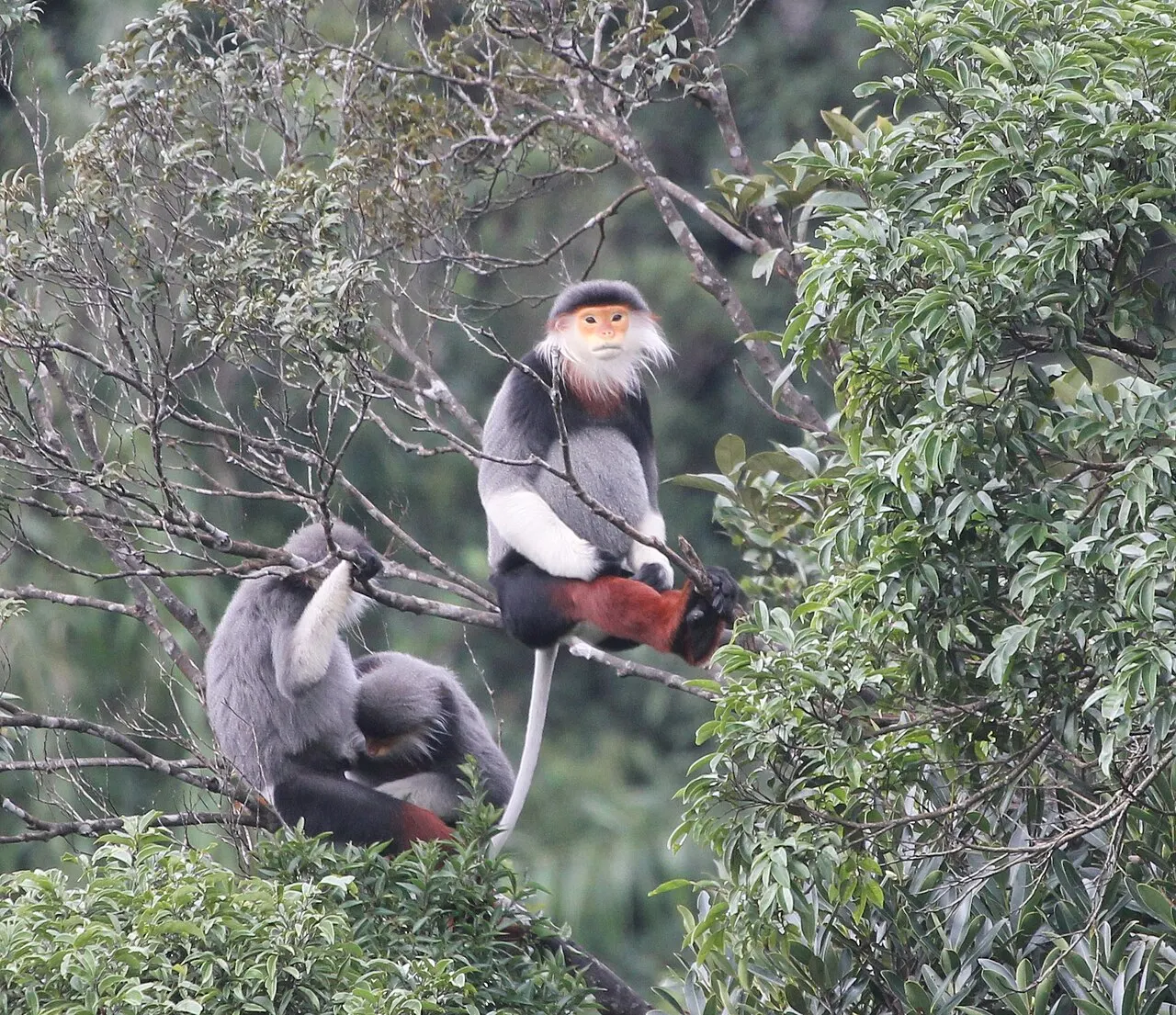
The red-shanked douc are among the most colorful primates. The fur on their cheeks and on their throat is white. Their face is a yellow-brown color and they have light blue eyelids.
The male has a head and body length of 55–82 centimetres (22–32 in) with a tail that measures 56–74 centimetres (22–29 in), and the female is between 60–63 centimetres (24–25 in) long with a tail that measures 44–60 centimetres (17–24 in) long.
Range and habitat
The red-shanked douc is native to Indochina. Vietnam, southern Laos, and possibly northeastern Cambodia, east of the Mekong river. It is the only douc species that inhabits all three countries of Indochina. In Laos, red-shanked doucs occur from the southern Nam Ghong Provincial Protected Area to the central-north part of the country.
Currently, the red-shanked doucs in Sơn Trà Nature Reserve are protected by the army, police and forest protection departments of Da Nang and Sơn Trà.
Pins are Wikidata “endemic to” fields. Orange dots, when present, are GBIF occurrence tiles — survey bias included.
Diet
Their four-chambered stomachs that allow for bacterial fermentation help them with their high-fiber diet.
In crisis
The species has been declared critically endangered by the International Union for Conservation of Nature, with the main threats being: hunting, habitat loss and pet trade. Red-shanked doucs live in fission-fusion, multilevel societies that have a mean of 18 individuals per band. In 2000, the IUCN Red List of Threatened Species classified the red-shanked douc langur as endangered.
In 2020, the IUCN updated their classification of the species to critically endangered, due to the population's continual decline. The main threat to the red-shanked douc is from hunting.
CITES lists this taxon on Appendix I. Confirm the current appendix on the CITES checklist.
Red-shanked douc is Critically Endangered on the IUCN Red List (assessed 2020, criteria A2acd+3cd). Confirm the official criteria and any later count on the assessment page.
Sources
Adapted from the English Wikipedia article on Red-shanked douc (CC BY-SA 4.0; authors are listed in the article history; changes were made), Wikidata item Q838944. Family and order context is original field-guide writing about the group, not a copied assessment of this one species. Not an IUCN assessment. Counts, when quoted, can change — confirm them on the recovery programme and on iucnredlist.org. Status and assessment year: IUCN. 2026. The IUCN Red List of Threatened Species. Version 2026-1. iucnredlist.org.