Critically Endangered
Black-shanked douc
Pygathrix nigripes
Black-shanked douc is an Old World monkey in the family Cercopithecidae (order Primates) — Pygathrix nigripes, recorded as Critically Endangered.
Appearance
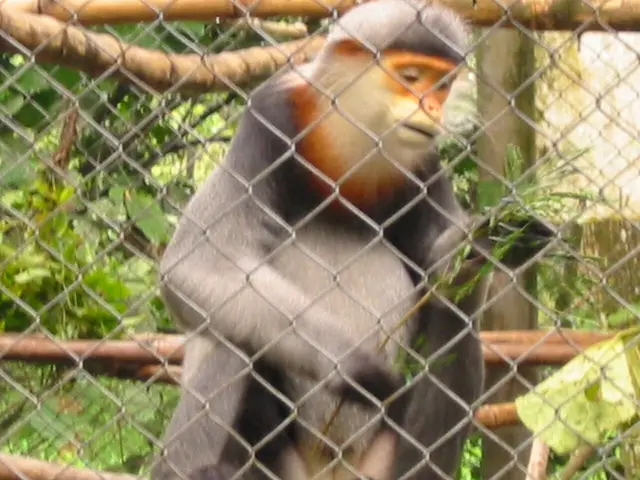
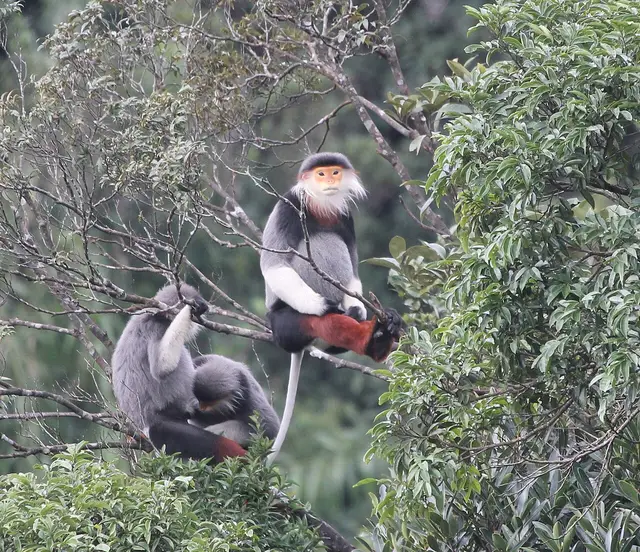
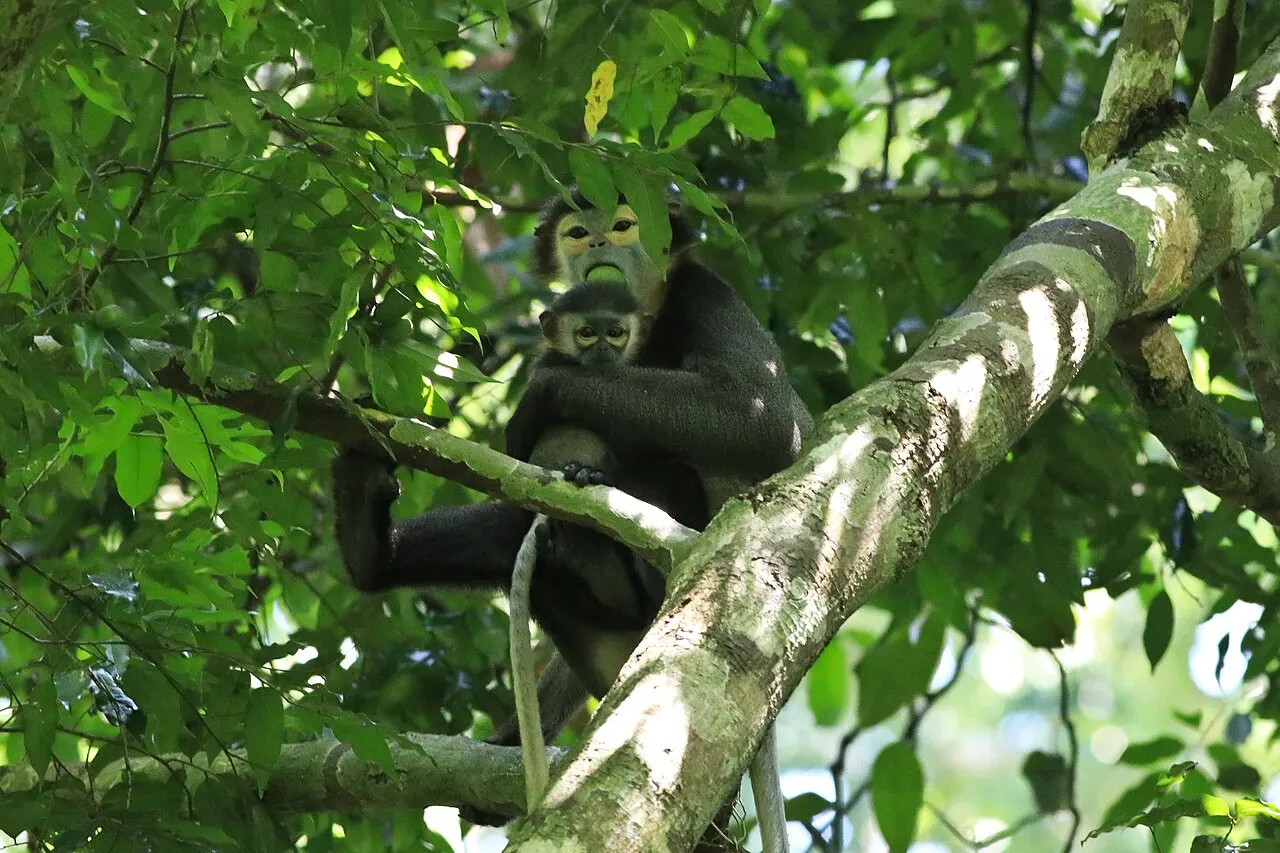
Like all species of Pygathrix, the black-shanked douc is characterized by its colorations. The colors on its head and neck are what differentiates the black-shanked douc from other species of the Pygathrix genus. Their most unique characteristic is their bluish face with large yellow eye-rings.
It has a tail as long as its body and head length. Few individuals were measured but the results for the male black-shanked douc had an average head and body length of 50 cm (20 in), an average tail length of 69 cm (27 in) and an average weight of 5.3 kg (12 lb).
Range and habitat
The black-shanked douc is an endangered species of douc found mostly in the forests of Eastern Cambodia, with some smaller populations in Southern Vietnam. The region they are mostly found in is called the Annamite Range, a mountainous area that passes through Cambodia and Vietnam. Its habitat is mostly characterized by evergreen forest in the mountains, in the middle to upper canopy.
In fact, the Wildlife Conservation Society reports almost 25,000 individuals in Cambodia's Keo Seima Wildlife Sanctuary, a population that has remained stable over the last decade.
Pins are Wikidata “endemic to” fields. Orange dots, when present, are GBIF occurrence tiles — survey bias included.
Diet
Studies in Cambodia and Vietnam have shown their diet to consist primarily of leaves, from a wide diversity of plant species. Fruits, flowers, and seeds were reported as the remaining portion of their diet at various proportions, according to food availability.
Indeed, studies found that their diet changed from dry season to wet season. Their diet varies from dry to wet season.
In crisis
Black-shanked douc have been observed in groups ranging from 3 to 30 individuals, depending on their habitat. The species changed conservation status in 2015 from endangered to critically endangered in the IUCN Red List of Endangered Species. This reassessment is due to an increase of the rate of population decline.
The largest populations estimated to be in Vietnam is around 500-600 individuals. Conservation efforts are being made to control illegal poaching and trade in Vietnam by putting laws against hunting and trading threatened species.
CITES lists this taxon on Appendix I. Confirm the current appendix on the CITES checklist.
Black-shanked douc is Critically Endangered on the IUCN Red List (assessed 2021, criteria A2acd+3cd). Confirm the official criteria and any later count on the assessment page.
Sources
Adapted from the English Wikipedia article on Black-shanked douc (CC BY-SA 4.0; authors are listed in the article history; changes were made), Wikidata item Q959360. Family and order context is original field-guide writing about the group, not a copied assessment of this one species. Not an IUCN assessment. Counts, when quoted, can change — confirm them on the recovery programme and on iucnredlist.org. Status and assessment year: IUCN. 2026. The IUCN Red List of Threatened Species. Version 2026-1. iucnredlist.org.