Critically Endangered
Red-fronted Macaw
Ara rubrogenys
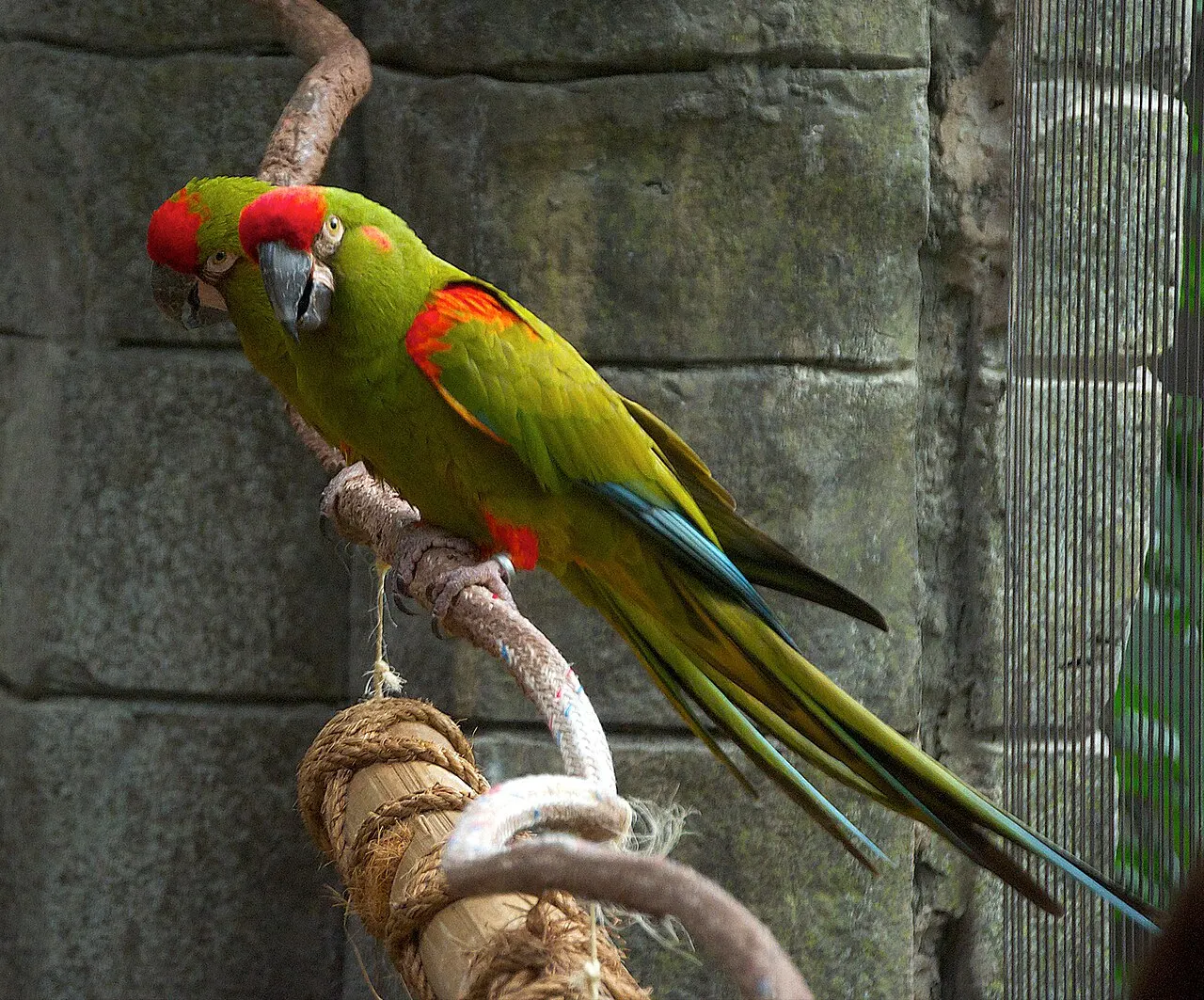
The red-fronted macaw (Ara rubrogenys) is a green parrot with an orange-red forehead that lives only in the dry Andean valleys of central Bolivia. It nests on river cliffs. The IUCN Red List assessed it as Critically Endangered in 2021, though a 2021 field survey counted more birds than the IUCN figure.
How to recognise it
At about 55 to 60 centimeters (roughly 22 to 24 inches) long, this is a medium-sized macaw. It is mostly bright green, with an orange-red forehead and crown, a small red patch over the ear, and red on the bend of the wing and the edges of the underwing. The primary flight feathers are blue, and pinkish bare skin surrounds the eye.
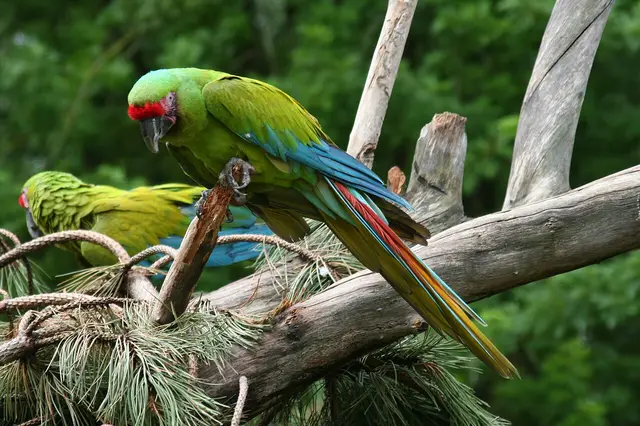
The military macaw is larger, lacks the red ear patch and red wing linings, and lives in different habitat.
Where it lives
The species is found nowhere outside Bolivia. It lives in rain-shadowed valleys on the east slope of the central Andes, at roughly 900 to 2,850 meters, in dry forest, scrub and farmland. The climate is hot by day and cold at night, with rain arriving in occasional heavy storms. It is reportedly the only macaw living in this kind of country.
The range is split among four watersheds. The Mizque watershed is the stronghold, holding about 53 percent of nesting pairs and 41.5 percent of the global population in a 2021 survey.
Pins are Wikidata “endemic to” fields. Orange dots, when present, are GBIF occurrence tiles — survey bias included.
How it lives
Most macaws nest in tree cavities, but there are no huge trees here. Red-fronted macaws breed semi-colonially in crevices and holes in tall river-valley cliffs, and a few pairs have used stands of an endemic palm. Breeding runs through the southern summer, roughly November to April, and clutches are 1 to 3 eggs.
In summer and autumn the birds live in pairs or family groups. In winter they gather in flocks, sometimes dozens strong, in peanut and corn fields or at shared roosts. They eat fruit and flowers of native trees, and outside the breeding season they raid corn and peanuts, which is why farmers often see them as pests. Most make short seasonal moves between breeding cliffs and winter feeding areas.
How many are left
Numbers are hard to pin down in such remote country, and sources disagree. Estimates for the early 1980s ran as high as about 5,000 birds. A 2011 survey counted 807, about 20 percent of them breeding. A 2021 survey by six teams across the known breeding range in four watersheds estimated about 1,160 macaws, including 138 to 159 nesting pairs, and found four new breeding areas. Two of the eight areas known in 2011 were empty by 2021.
The IUCN Red List's 2021 assessment gives a much lower figure, 134 to 272 mature individuals, and records a decreasing trend. Herzog and colleagues, who published the 2021 survey in Bird Conservation International in 2022, concluded that the species no longer meets the criteria for Critically Endangered and should be Endangered. It stayed Critically Endangered in the 2021 assessment.
Why it is in trouble and what is being done
Capture for the pet trade drove the decline, and farmers kill the birds as crop pests. Loss of habitat adds pressure. The species is on CITES Appendix I, which restricts international trade.
The macaw has bred successfully in captivity and is reportedly available as a pet, though not commonly.
Sources
Written for this catalog in our own words from the sources below, checked against them on 12 November 2026. Population figures are estimates and carry the year they were made. Status and assessment year: IUCN. 2026. The IUCN Red List of Threatened Species. Version 2026-1. iucnredlist.org.